



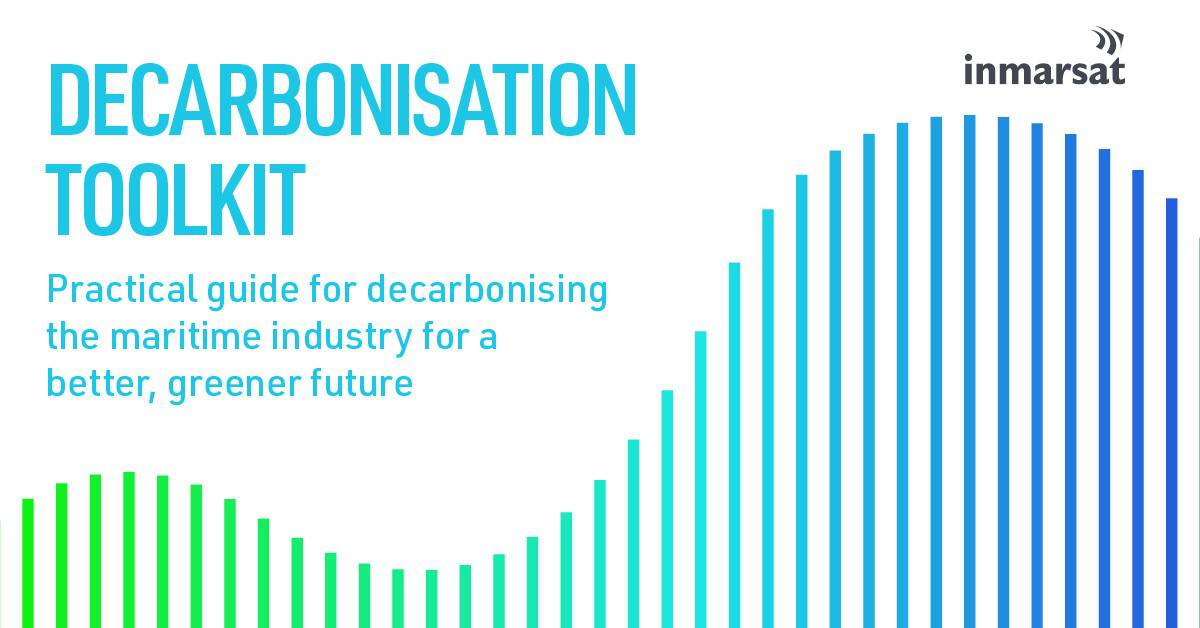
Inmarsat Maritime, a Viasat business, and a world leader in global, mobile satellite communications, has published its Decarbonisation Toolkit, which outlines a practical blueprint for decarbonisation in the maritime industry.
Compiled by maritime innovation consultancy Thetius, the report uses real life examples to set out a framework across three domains of energy transition: ‘Operation’, ‘Ship’ and ‘Human Element’.
At the operational level, voyage optimisation is a particularly effective means of decarbonisation. In September 2022, Scandinavian shipping company Wallenius Wilhelmsen announced its intention to adopt an AI-based voyage optimisation system across its 120-vessel fleet. The announcement followed the company’s 18-month trial of a performance-routing solution that yielded a 6.9% increase in vessel efficiency, equating to a projected 170,000-tonne carbon dioxide equivalent (CO2e) reduction in emissions with a fleet-wide roll-out.
Alongside voyage optimisation, collaboration and data sharing could play a key role in lowering emissions. In February 2023, KCC Chartering and integrated energy company Raízen signed a three-year contract of affreightment targeting more energy-efficient operations through improved charterer–cargo owner communications and data exchange. By minimising legs in ballast and improving the efficiency of loading and discharge processes, the partnership is expected to result in a 40% reduction in the carbon intensity of its agreement.
Under ‘ship’, other methods include port-call optimisation and green corridor schemes, while tools available for decarbonising the vessel itself include carbon capture and storage, optimised hull design, energy-saving coatings and devices, wind propulsion, future fuels and connectivity and data-exchange infrastructure.
For example, in the first quarter of 2023, ship management company Eastern Pacific announced the successful installation of carbon capture and filtering technology on board the chemical tanker Pacific Cobalt. Installed in the ship’s stack, the system will capture up to 40% of the vessel’s carbon dioxide emissions, filtering out sulphur and particulate matter from the exhaust gases.
The ‘human element’, meanwhile, relies on behavioural economics and change management in addition to skilled decarbonisation teams. According to the report, crews should be trained in the new technology and processes that enable greener shipping operations, and they must be willing to embrace the changes that the maritime energy transition entails.
Ben Palmer, President, Inmarsat Maritime, said: “The key to a successful decarbonisation strategy lies in implementing a practical, data-backed plan for the application of solutions that support greener, more efficient shipping companies today and for decades to come. As a long-standing technology partner to the international maritime industry, Inmarsat remains committed to supporting businesses in overcoming their challenges, seizing their opportunities and achieving their decarbonisation goals.”
Matthew Kenney, Principal Research Consultant, Thetius, said: “It is overly simplistic to think of decarbonisation as a compliance issue alone. Companies that have made proactive moves to seize the opportunities of decarbonisation are already seeing return on their investments. Carbon footprints are being reduced at the voyage, vessel and fleet level, and fuel costs, time and effort are being saved as a result. This report examines some of these achievements and maps out a practical blueprint to success.”
Decarbonisation Toolkit – Decarbonising the Maritime Industry for a Better, Greener Future can be accessed here.








 reduction in emissions with a fleet-wide roll-out.Alongside voyage optimisation, collaboration and data sharing could play a key role in lowering emissions. In February 2023, KCC Chartering and integrated energy company Raízen signed a three-year contract of affreightment targeting more energy-efficient operations through improved charterer–cargo owner communications and data exchange. By minimising legs in ballast and improving the efficiency of loading and discharge processes, the partnership is expected to result in a 40% reduction in the carbon intensity of its agreement.Under ‘ship’, other methods include port-call optimisation and green corridor schemes, while tools available for decarbonising the vessel itself include carbon capture and storage, optimised hull design, energy-saving coatings and devices, wind propulsion, future fuels and connectivity and data-exchange infrastructure.For example, in the first quarter of 2023, ship management company Eastern Pacific announced the successful installation of carbon capture and filtering technology on board the chemical tanker Pacific Cobalt. Installed in the ship’s stack, the system will capture up to 40% of the vessel’s carbon dioxide emissions, filtering out sulphur and particulate matter from the exhaust gases.)