


Oasis Marine, a small company in North-East Scotland, is leading the way in the decarbonisation of vessels with pioneering technology.
Initially providing a successful range of smaller mooring buoys, Oasis Marine has developed several industrial solutions, the Oasis Hydrogen Buoy and the Oasis Power Buoy, to provide offshore hydrogen bunkering and electric charging, allowing vessels to switch from diesel to green power.
The ground-breaking technology, using hydrogen for offshore bunkering, is thought to be a first for the industry.
The Oasis Hydrogen Buoy will be able to transfer green hydrogen produced by offshore wind farms, potentially becoming part of an offshore hydrogen highway, whereby hydrogen is stored at an offshore location before being transferred by buoy to vessels transporting hydrogen or using it as their fuel source.
It is estimated that shipping currently produces more than three percent of all CO2 emissions and the industry has been set a global decarbonisation target of a 20 percent reduction in emissions by 2030, rising to 70 percent in 2040, with full decarbonisation by 2050.
George Smith, Managing Director of Oasis Marine, said the Oasis Hydrogen Buoy and the Oasis Charging Buoy have huge potential in reducing the global shipping industry’s CO2 footprint.
“These buoys will have a tangible impact in our shift from hydrocarbons towards a green energy future,” he said. “Initially we are looking at deploying them in the North Sea offshore wind market. Currently windfarm maintenance vessels rely on fossil fuels and make up the largest component of an operational windfarm’s carbon footprint. While that will be our initial focus, the technology could be applied to other vessels across the maritime industry.
“The maritime energy mix of the future won’t be a single solution but will be made up of different renewable sources. Our Oasis buoys deliver two of those through hydrogen and electric charging, both of which come from renewable, low-cost energy generated by wind farms.”
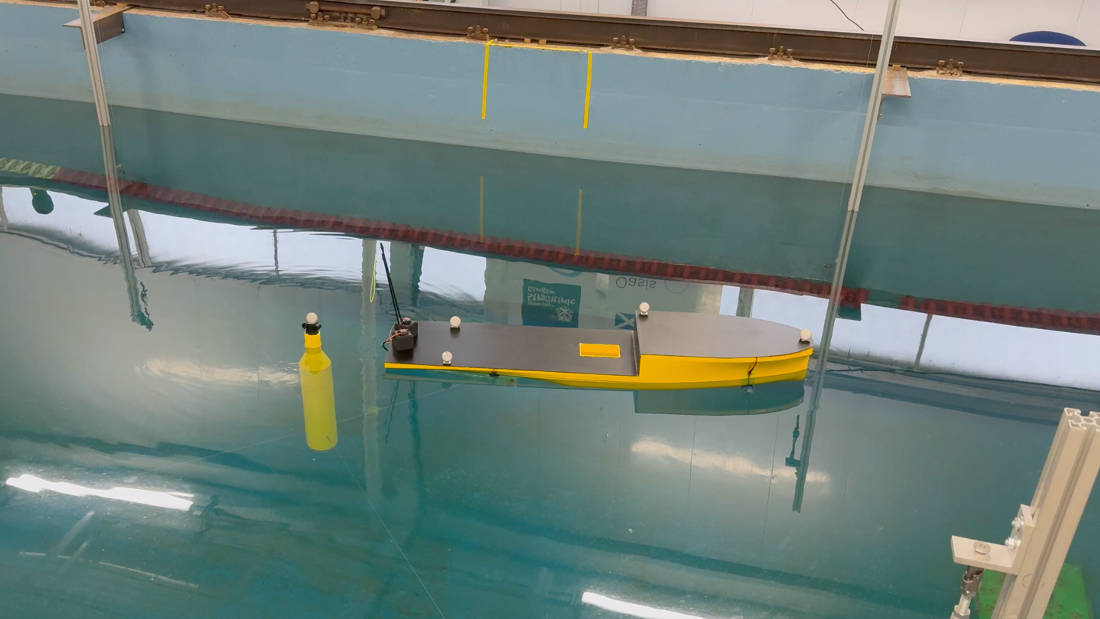
With funding and support from the Scottish Government via the Emerging Energy Technologies Fund (EETF) Hydrogen Innovation Scheme (HIS), mooring analysis of the hydrogen buoy was tested as part of the TestHOTS (Tank Testing of Hydrogen Offshore Transfer System) project demonstration.
The demonstration, at the Kelvin Hydrodynamic Laboratory in Glasgow, showed how the mooring buoy connects to vessels and scale model tank testing gathered valuable technical data such as the impact of wave conditions and sea states on mooring loads while bunkering.
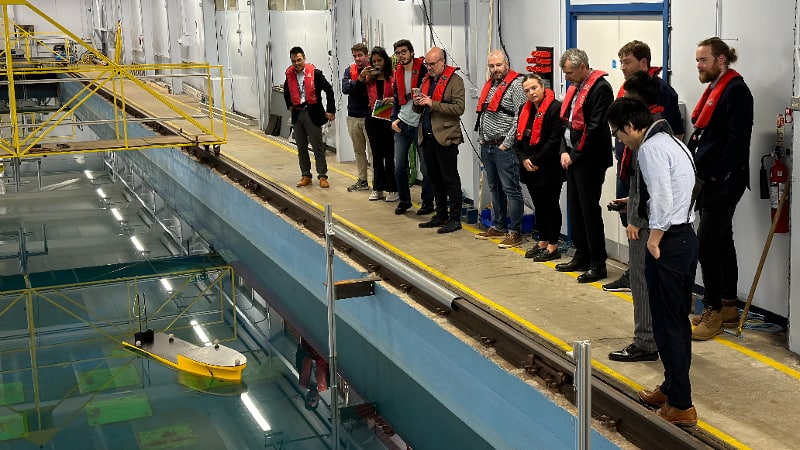
The project has already optimised the Oasis Hydrogen Buoy from numerical analysis and aims to further validate these findings from the wave tank testing. The demonstration followed a Clean Maritime Demonstration Competition (CDMC1) project, funded by the Department of Transport through Innovate UK, which allowed Oasis Marine to develop the design of the hydrogen buoy and prove the concept viable.
Oasis Marine partnered with Strathclyde University and ship owner O.S. Energy to conduct the hydrodynamic analysis and wave tank testing. One of O.S. Energy’s vessels is being retrofitted for hydrogen fuel and a model of the ship was used during the demonstration and tank tests.
Martin Nuernberg, Managing Director of O.S. Energy UK added: “The development and validation of technologies like the hydrogen buoy will enable our vessels to transition to cleaner alternative fuels and have significant impact on the offshore endurance of our fleet.”