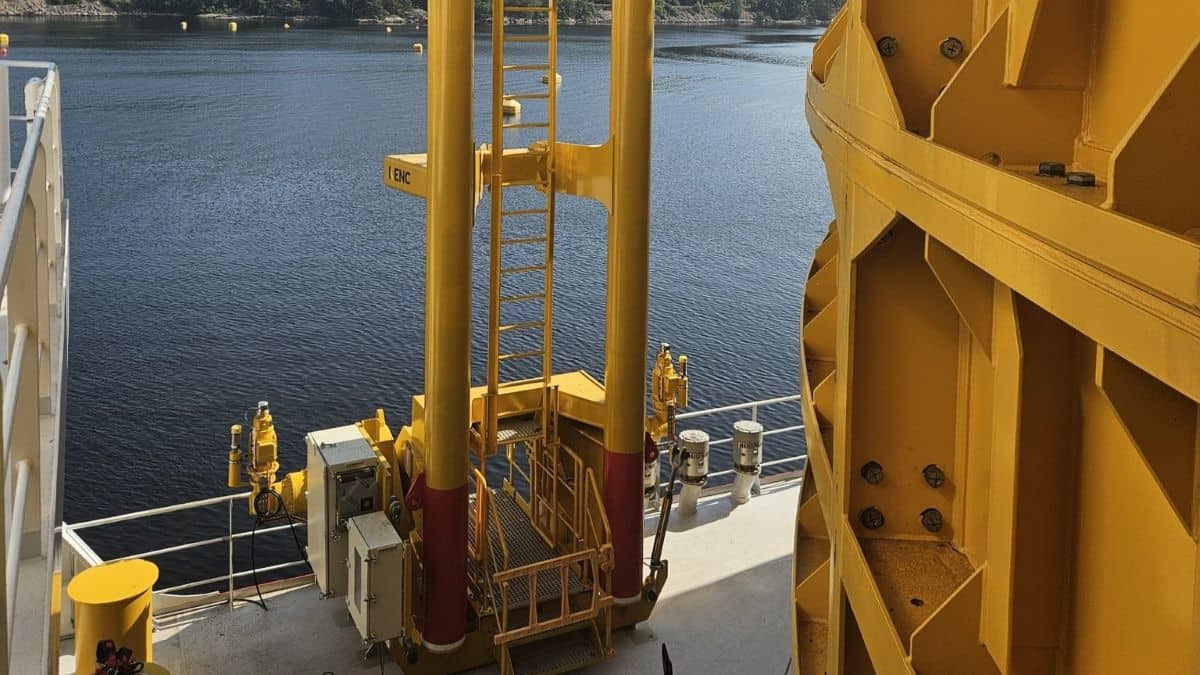
KENC Engineering’s semi-automated boat landing system is designed to improve crew safety, reduce manual handling and streamline offshore operations aboard the cable-laying vessel
KENC Engineering has designed and delivered a semi-automated boat landing system for Nexans’ cable-laying vessel (CLV) Nexans Electra, providing a safer and more efficient deployment solution without the need for the vessel’s crane.
The project represents the first collaboration between KENC Engineering and Nexans, with the new system designed to simplify offshore operations while reducing manual handling and improving crew safety.
The new boat landing system combines safety, efficiency and ease of use to support smoother offshore operations. Designed with the crew and day-to-day operations in mind, the solution makes deploying the boat landing simpler and more efficient. KENC developed a semi-automated system that reduces the need for manual handling and allows the crew to operate the system safely and efficiently.
For the movement mechanism, KENC developed a mechanical solution using gearboxes and a compact electric motor. This allows the boat landing to be moved in a controlled and safe manner during deployment and securing. The system is designed to handle the forces generated during operation while keeping the operation simple for the crew. Throughout the design process, KENC worked closely with DNV to ensure that the relevant standards and requirements were applied to the specific solution. Reflecting on the project and the collaboration with Nexans and DNV,” said Daniël Falkmann, Lead Engineer at KENC.
“What makes this project unique is that we transformed a traditional, manual operation into a semi-automated solution that is simple and safe to operate. It was great to work together with Nexans and DNV to develop a solution that is both technically robust and practical to use.”
One of the key benefits of the new solution is that the boat landing can be deployed and secured independently by a single operator, without the need for the vessel’s crane or additional rigging. This makes deck operations more efficient and gives the crew more time and capacity to focus on other critical tasks.
The boat landing system has been successfully delivered and put into operation. With this solution, KENC has provided a practical and reliable improvement to the daily operations on board Nexans’ CLV Nexans Electra.