The LS-C 60 cylinder-luffing crane will provide lifting capacity of up to 40 tonnes aboard the cargo and passenger vessel serving French Polynesia’s Tuamotu islands
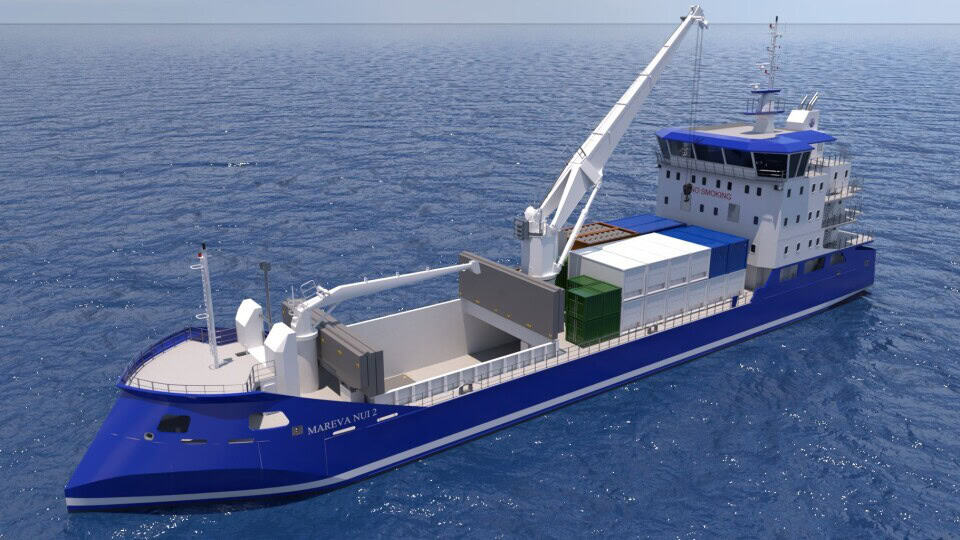
Liebherr’s LS-C 60 cylinder-luffing ship crane has been selected for the Mareva Nui II, a cargo and passenger vessel being built for Transport Maritime des Tuamotu-Ouest (TMTO) to serve island communities across French Polynesia’s Tuamotu archipelago.
Designed to combine cargo transport with onboard accommodation, the vessel will provide an essential transport link for communities dependent on reliable maritime connections. The LS-C 60 crane will support cargo handling with a lifting capacity of up to 40 tonnes, while its compact design helps maximise available deck space.
The crane’s low centre of gravity supports vessel stability, while its cylinder-luffing mechanism reduces the number of wire ropes and sheaves required, helping to simplify maintenance. With a minimum working radius of 3 metres, the crane is also suited to handling cargo in confined deck spaces.
The Mareva Nui II is tailored to a region where maritime transport is part of daily life. It will serve island communities that depend on regular and reliable connections. Built by Handelskade at Hong Ha Shipyard in Vietnam, the vessel combines transport capacity with onboard accommodation in a single design. Features such as tween decks, folding hatch covers and dedicated living spaces support this integrated approach.
‘This vessel is a vital link for TMTO’s operations, enabling them to serve communities across the Tuamotu islands with greater efficiency and reliability,’ said Menno van der Plas, Director of Handelskade. ‘The crane enables TMTO to manage different types of cargo in a consistent and dependable way.’
Handelskade is delivering the vessel on a full turnkey basis, covering engineering, construction, sourcing and commissioning. This coordinated approach ensures that all systems are aligned from the outset. As a result, the vessel can enter service fully equipped and ready for operation.
The operating profile of the Mareva Nui II requires equipment that performs consistently without adding operational burden. The LS-C 60 meets this requirement through a design that balances structural strength with efficient handling. Its stable and predictable performance supports safe operations, particularly where different onboard activities take place in parallel.
‘This project underlines the importance of selecting equipment that aligns with both vessel design and operating conditions,’ said Christian Voigtländer, Sales Manager of Liebherr-Rostock GmbH. ‘The LS-C 60 provides a well-balanced solution for this type of vessel concept.’
As the Mareva Nui II approaches completion, it reflects a practical approach to serving dispersed island regions. By combining multiple transport functions within one vessel and integrating equipment that supports long-term operation, the project contributes to maintaining reliable connections across the archipelago.