



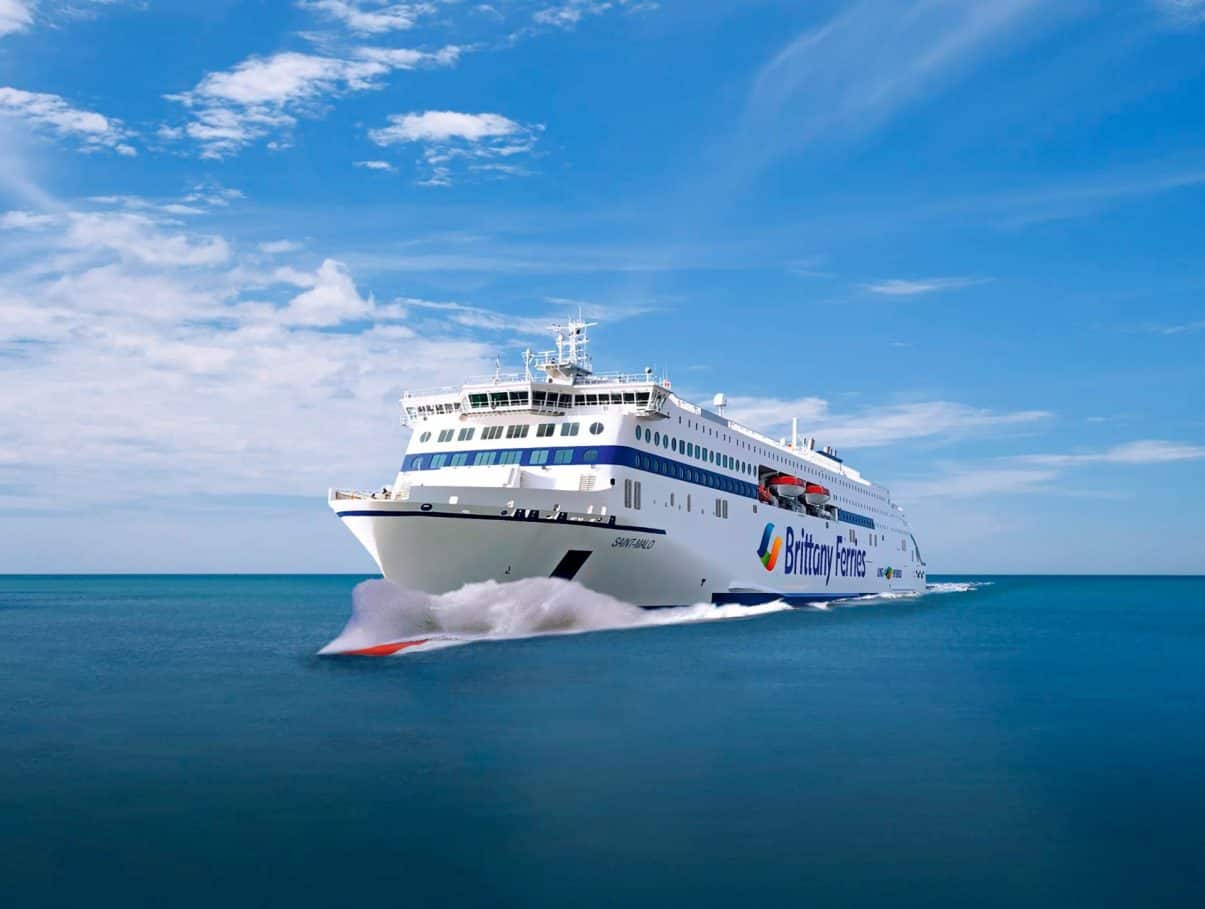
Leclanché SA continues to reach new milestones in the electrification of marine transport and announces that it has been selected as the battery technology provider for two hybrid vessels being built for Stena Line and Brittany Ferries. Each battery system has a capacity of 11.3 MWh, and, the RoPax (Roll on/roll off passenger) ferries will be the world’s largest hybrid vessels – surpassing Leclanché’s prior record-breaking marine projects. These projects planned for delivery in 2024 and 2025 further consolidate Leclanché’s backlog and ranks the company as a leading player in the e-marine space.
The two nearly 195-metre long hybrid E-Flexer ferries have been designed and developed by Stena RoRo (a Stena Line affiliate) in collaboration with Brittany Ferries and will be chartered on a 10-year lease to Brittany Ferries for operation between Portsmouth, United Kingdom, and the French ports of Saint-Malo and Caen.
Leclanché’s Navius MRS-3 TM technology reduces the environmental impact of ferries
The vessels’ hybrid propulsion system will be capable of operation using both liquified natural gas (LNG) fuel and Leclanché’s third generation, Navius MRS-3TM onboard battery storage system, helping to greatly reduce the environmental impact of ferries and improving sustainability.
Building on the investments made over the past 4 years in technology, product and market development, the Navius MRS-3 TM uses Leclanché’s state-of-the-art 3rd generation lithium-ion battery systems, each with a capacity of 11.3 MWh and a maximum of 940 volts. The system is guaranteed for 10 years of continuous operation and is the result of several years of real-life operation and optimisation. The Battery Energy Storage Systems (BESS) use a highly redundant structure with 46 battery strings. Delivery to the Navy yards is scheduled for the fourth quarter of 2023.
Leclanché’s Navius MRS-3 TM technology to set second industry record
Over the years, Leclanché has become the supplier of choice for a long list of hybrid and fully electric vessels including the recently awarded Scandlines PR24 project, where it is currently supplying a 10 MWh Navius MRS-3 TM system. At the time of the purchase order, it was the world’s largest hybrid ferry, as well as the Yara Birkeland, the world’s first autonomous and fully electric container ship, proving the high level of performance of the battery systems deployed.
Leclanché’s batteries have demonstrated improved safety features, faster charging, longer cycle life, smaller footprint and lower energy consumption than competitive solutions.
Leclanché is one of the only battery system suppliers to manufacture its own lithium-ion battery cells, packs, modules and casings to rigorous German and Swiss standards in its own automated manufacturing assembly lines in Willstätt, Germany and Yverdon, Switzerland.
“Stena is a leader in the development of technologically advanced vessels and an early participant in the green shipping transition,” said Staffan Stenfelt, General Manager Newbuilding at Stena RoRo. “We’re excited to partner with Leclanché in this major milestone in hybridisation technology and demonstrate the importance of flexibility in building next generation vessels that can adapt to the latest technology developments.”
“Brittany Ferries is committed to supporting – and help lead – the decarbonisation efforts of the maritime industry,” added Arnaud Le Poulichet, Director Engineering and Maintenance at Brittany Ferries. “Every vessel we invest in will pay dividends for the environment in the short-and-long term. We are proud to be supporting this green planetary agenda in a meaningful way.”
Phil Broad, CEO of Leclanché E-Mobility, said: “We are delighted to join in the efforts of both Stena RoRo and Brittany Ferries in favour of the decarbonisation of maritime transport. These latest project wins further emphasise Leclanché’s leadership position in the electrification and hybridisation of large vessels. In addition, these projects will strengthen our order book and our own production capacity, reinforcing the Company’s positive outlook. One of the main mission of Leclanché is to support manufacturers in their e-mobility projects by providing them with the most suitable and powerful battery systems on the market. The benefits of our differentiated cell technology and liquid-cooled system were key factors in our nomination. Another main competitive asset, the system design provides a distinct size and weight advantage versus our competitors and is especially cost-effective for large-scale systems such as those being manufactured for Brittany Ferries.”
Navius MRS-3TM is a trademark of Leclanché SA. All other tradenames are the property of their respective owners.











 continues to reach new milestones in the electrification of marine transport and announces that it has been selected as the battery technology provider for two hybrid vessels being built for Stena Line and Brittany Ferries. Each battery system has a capacity of 11.3 MWh, and, the RoPax (Roll on/roll off passenger) ferries will be the world’s largest hybrid vessels – surpassing Leclanché’s prior record-breaking marine projects (click here for images). These projects planned for delivery in 2024 and 2025 further consolidate Leclanché’s backlog and ranks the company as a leading player in the e-marine space. The two nearly 195-metre long hybrid E-Flexer ferries have been designed and developed by Stena RoRo (a Stena Line affiliate) in collaboration with Brittany Ferries and will be chartered on a 10-year lease to Brittany Ferries for operation between Portsmouth, United Kingdom, and the French ports of Saint-Malo and Caen.Leclanché’s Navius MRS-3 TM technology reduces the environmental impact of ferries The vessels’ hybrid propulsion system will be capable of operation using both liquified natural gas (LNG) fuel and Leclanché’s third generation, Navius MRS-3TM onboard battery storage system, helping to greatly reduce the environmental impact of ferries and improving sustainability. Building on the investments made over the past 4 years in technology, product and market development, the Navius MRS-3 TM uses Leclanché’s state-of-the-art 3rd generation lithium-ion battery systems, each with a capacity of 11.3 MWh and a maximum of 940 volts. The system is guaranteed for 10 years of continuous operation and is the result of several years of real-life operation and optimisation. The Battery Energy Storage Systems (BESS) use a highly redundant structure with 46 battery strings. Delivery to the Navy yards is scheduled for the fourth quarter of 2023.)