


Lloyd Werft selects Lehmann Marine’s AQUBE liquid-cooled battery technology for Germany’s next-generation research vessel for the German Aerospace Center (DLR)
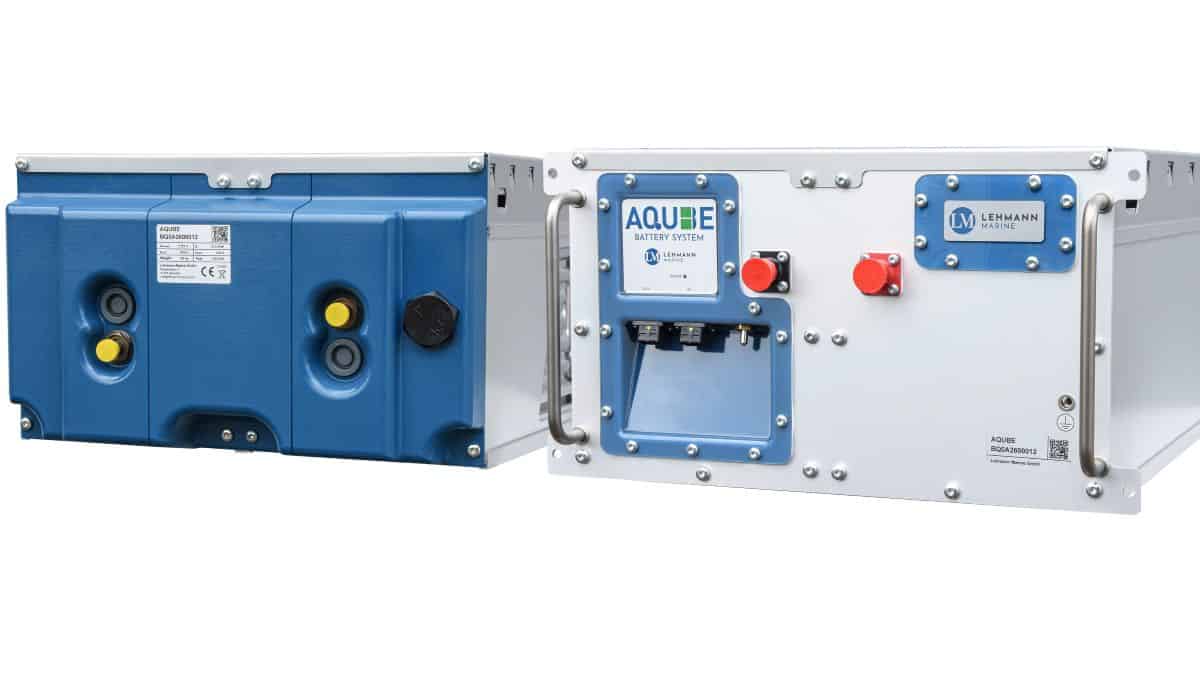
Lehmann Marine, a Sunlight Group company specialising in maritime energy storage, has secured the first commercial order for its newly developed AQUBE liquid-cooled battery system. The high-power energy storage platform has been selected by Lloyd Werft in Bremerhaven for a new research vessel being built for the German Aerospace Center/(Deutsche Zentrum für Luft- und Raumfahrt; DLR), Germany’s national research centre for aeronautics, space, energy and transport.
Scheduled for delivery in 2027, the 48-metre-long, 11.5-metre-wide seagoing technology platform will serve as a floating test facility for next-generation climate-neutral propulsion technologies, including hydrogen, hybrid, and fully electric setups – under real-world maritime conditions.
Carrying up to 20 researchers and industry partners, the vessel will conduct multi-day test voyages in the harsh environ-ments of the North and Baltic Seas.
With global shipping moving to eliminate carbon emissions across a sector that carries over 80% of world trade, this unique vessel bridges the gap between land-based laboratory testing and real-world sea trials.
To power a vessel designed to test the future of propulsion, DLR and Lloyd Werft needed a battery system that balances maximum power output with uncompromising safety and longevity. Lehmann Marine’s AQUBE delivers this through three key innovations made accessible for both technical and non-technical observers:
- High-power 2C performance: In battery engineering, a 2C rating means the battery can discharge its full capacity in just 30 minutes. AQUBE delivers up to 2C peak and 1.5C continuous power, providing the instant, heavy surges of energy required to manoeuvre a 48 m ship through rough North Sea waters or support power-hungry experimental setups onboard.
- Liquid-cooling architecture: While standard battery systems rely on air cooling, AQUBE circulates fluid di-rectly around the modules. Similar to thermal management in high-performance electric vehicles, this keeps battery cells at optimal operating temperatures, preventing degradation and dramatically extending service life under continuous high-power demands.
- Ultra-safe LFP chemistry: AQUBE uses Lithium Iron Phosphate (LFP) chemistry rather than traditional co-balt-based formulations. LFP is inherently fire-resistant, non-toxic, and cobalt-free – offering superior thermal stability at sea while aligning with green sustainability goals.
The contract marks a vital milestone in the market launch of AQUBE, demonstrating how Lehmann Marine has evolved since becoming part of Sunlight Group. By pairing Lehmann’s specialised German marine engi-neering with Sunlight’s massive manufacturing and R&D hub in Xanthi, Greece, the company offers European shipbuilders a resilient, localised supply chain—a critical advantage in today’s volatile global market.
”Building on the success of our air-cooled CUBE platform and the proven liquid-cooling heritage of COBRA, AQUBE takes our technology to the next level for demanding marine applications,“ said Matthias Schubert, Head of Sales and Marketing at Lehmann Marine. ”Securing our first AQUBE contract for a national floating lab of this caliber is a major validation. It proves that our battery architecture is ready to power not just research vessels, but the broader commercial fleet—from ferries and offshore vessels to cargo ships and tankers.“