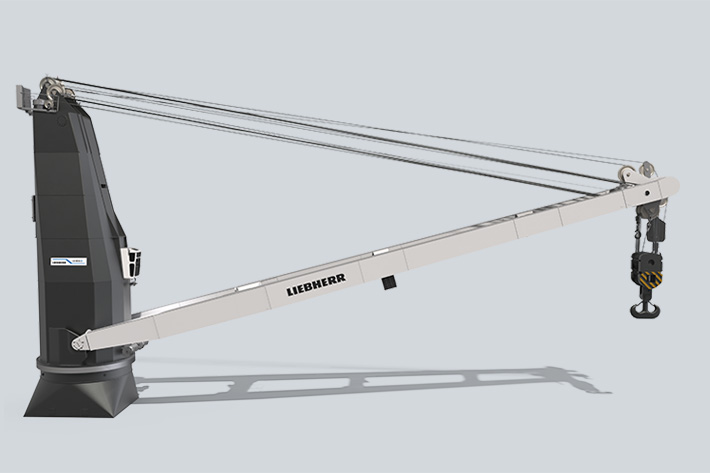



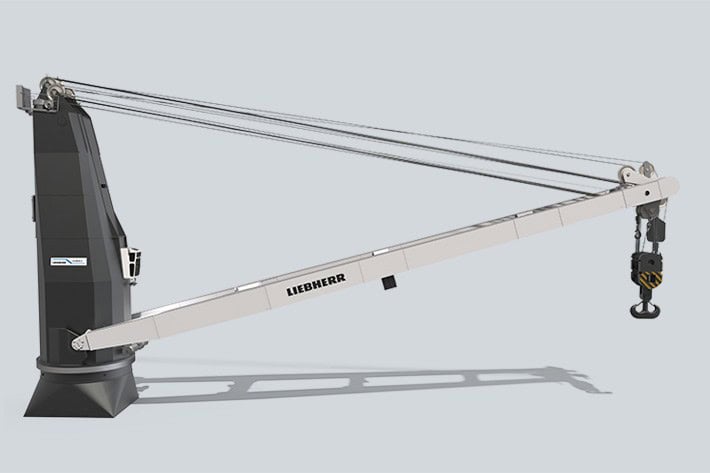
Liebherr’s heavy lift crane series is being expanded with an 800 tonnes crane. The aim with the new crane is to establish itself in the growth market of ever larger wind industry components. The crane is fully electrically powered and thus enables a reduction of CO2 emissions on the ship side in scenarios typical for heavy lift vessels.
The growth of wind turbines is leading to increasingly heavy individual component weights. In addition, the handling of large components requires a longer outreach of the cranes used than is often the case in the market. The supply of heavy lift vessels with cranes offering a maximum lifting capacity of 800 tonnes is lower than the expected future demand. Liebherr therefore sees a growth market in this crane segment and in the matching new shipbuilding. The Liebherr ship crane enters a new segment and expands the product portfolio of heavy lift ship cranes. “The new cranes follow on from a long tradition and decades of experience in building ship cranes. The first ship crane was delivered by Liebherr in 1958. The push into the 800 tonnes size segment does not represent new territory – Liebherr has already supplied onshore and offshore cranes in the 3000-5000 tonnes category,” comments Gregor Levold, Sales Director for Liebherr Offshore, Ship and Port Cranes.
All-electric and CO2 emission-free
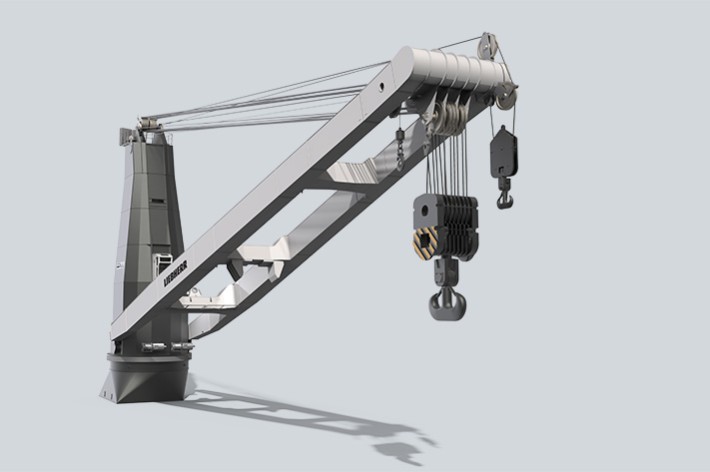
In addition to the much larger dimensions of the crane, the LS 800 E is particularly impressive due to its all-electric drive concept. All sections of the crane are electrically driven. As a result, the machine achieves higher energy efficiency and thus significantly reduces the ship’s CO2 emissions. Liebherr is already prepared for future environmental requirements in the maritime industry. “We have many years of experience with all-electric drives from the port equipment sector, among others. As usual, the development of the crane is done completely in-house. We can also cover the procurement of individual components largely in-house at Liebherr. These are invaluable advantages for our customers, especially nowadays,” adds Levold. In addition, all drive components are installed inside the crane. This facilitates the integration of the crane into the ship’s design and enables better utilisation of the areas below deck.
Tradition meets future
The new “Master V” control unit offers the highest computing power. The accompanying faster data processing enables the integration of future assistance systems and semi-automated process applications. All heavy-lift cranes are characterised by the Litronic control system developed in-house. It combines speed and precision and thus ensures a safe and at the same time efficient loading process. Continuous further development means that the latest features and applications will continue to be available to Liebherr ship cranes in the future.
New crane designation and design
During the design of the LS 800 E, the designation of the Liebherr ship cranes was furthermore adjusted. Instead of the previous CBB crane designation, the cranes will be called LS in the future. The new terms and the capital letters used allow a direct assignment as Liebherr (L) – ship crane (S). The number, as part of the designation, provides information about the maximum load capacity, which is 800 tonnes for the LS 800 E. The E stands for the electric drive and is supplemented by the suffix “All-electric” in the case of fully electric cranes such as the LS 800 E.
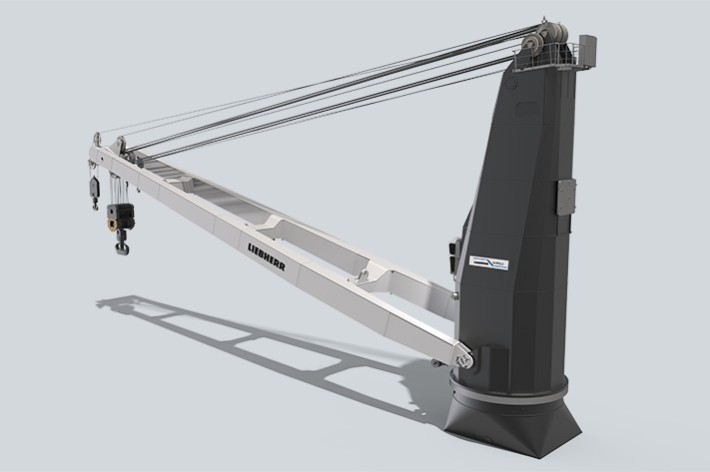
The exterior design of the crane has been renewed. The crane is factory coloured in white and grey and the designation of the crane is on the tower. The blue accent and the blue E symbol next to the crane type designation visually clarify the electric drive of the machine. This allows all future customers to directly communicate advanced and low-emission crane technology to their stakeholders.