



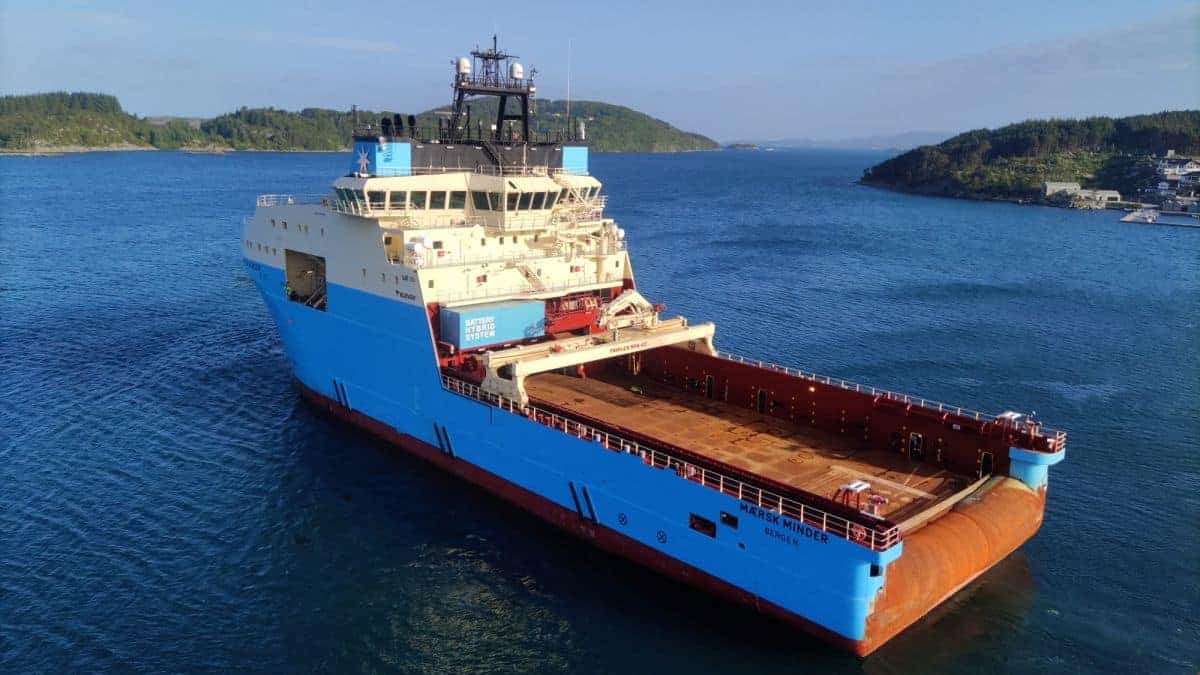
Maersk Supply Service has selected Fleet Data IoT platform from Inmarsat Maritime, a Viasat business, to help optimise the performance of its first vessel battery installation onboard Maersk Minder Offshore Supply Ship, in a solution which will also allow the owner to evaluate how best to optimise the use of zero-emission energy storage systems across its fleet.
An end-user API seamlessly gathers data from onboard equipment, automatically organises it with time-stamps, synchronises it, and uploads it to the customer’s visualisation tools, all presented in a user-friendly format.
Beyond streamlining in-house reporting and analytics, the API makes data available to original equipment manufacturers (OEMs), such as VPS, whose data-driven decarbonisation system, Maress, provides real-time insight into vessel performance to support fuel savings and emissions reduction. Crucially, Maress will help Maersk to evaluate the effectiveness of the battery system in terms of peak shaving and energy efficiency and determine the requirements for future battery installations for the rest of the fleet.
Sindre Bornstein, Chief Commercial Officer, VPS Decarbonisation, said “If the maritime industry is to achieve its emissions-reduction targets, it will rely on transparency, smart use of data and collaboration – and the Maersk Minder project combines all three. By providing an open platform for data analytics, Inmarsat enables Maress to deliver actionable insights, which in turn help Maersk Supply Service to enhance vessel efficiency in the short term and decarbonise its fleet through optimised battery-enabled operations in the long term.”
With complete visibility into the performance of the vessel and its hybrid battery system, Maersk can adapt its operations swiftly to keep pace with evolving environmental regulations. Notably, one of Maersk’s clients has already stipulated the use of battery power in certain offshore operations. This underscores the competitive advantage gained by sharing real time data on the impact of the Electric Storage System (ESS) on vessel efficiency and emissions with the charterers.
Sverre Vange, Energy Performance Manager, Maersk Supply Service, said “There are various economic and regulatory motivations for installing battery power on an offshore vessel, but charterer expectations are a particularly compelling factor. In the years ahead, attracting charterers will increasingly rely on the deployment of a battery system so the ability to keep charterers informed of the system’s performance will be invaluable.”
Automating data flows also frees seafarers up from manual NOx emissions reporting, added Vange, saving time and money, while yielding more accurate and consistent information. Vessels operating in Norwegian waters must reconcile NOx emissions data against a record of the type/location of offshore work done and ports called to establish their obligations under Norway’s NOx tax scheme.
Richard Goudbeek, Technical Sales Manager, Digital at Inmarsat Maritime, said “Data by itself is not useful unless it is processed to obtain information.Data processing involves analysing data and reasoning to gain insight and turn the results into fact-based decision-making. The Fleet Data end-user API allows Maersk to extract maximum value from available data and share it with OEMs and third parties like VPS. This collaboration is pivotal in developing actionable insights and advancing decarbonisation strategies within the industry.”
Maersk Supply Service has been a long-standing Inmarsat customer, dating back to its fleet-wide implementation of Fleet Xpress in 2017.