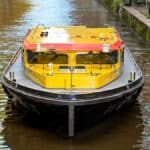
For the first time in the history of the Federal Republic of Germany, MAN Engines is supplying engines for German customs vessels. They are also the first vessels suitable for fording to be used by the customs authorities. The shallow draught of just 1.20 metres with a 23 metre length greatly reduces the risk of running aground at low water levels. “The new vessels provide significant added value in the calm waters of the North Sea and at low tide. This enables the customs authorities to carry out their official duties in a more targeted and effective way” says Claus Benzler, Head of Marine MAN Engines.

All vessels will use twin engine systems with 12-cylinder type D2862 LE438 V-engines from MAN. They each have an output of 882 kW (1,200 HP) at 2,100 rpm and, in addition to the Lloyd´s Register classification requirements, also comply with the current IMO Tier III emission standards by using an SCR system. “The compactness of the engines, the exhaust gas aftertreatment from MAN Engines and ultimately their excellent power-to-weight ratio were crucial factors that perfectly meet the stringent requirements of our client, Hamburg General Customs Directorate,” explains Christian Schmoll, director of the shipyard that is building the vessels, Tamsen Maritim in Rostock. In addition to the technical challenge of the shallow draught, they included the high speeds that are necessary for inspection operations.

A technical official from the customs authority and the shipyard’s project manager personally visited the MAN Engines plant in Nuremberg to confirm the low fuel consumption of the engines. “During the engine acceptance at the manufacturer’s plant, we re-check the practical operational values, primarily because the customs requirements are above those set out in the standards”. The consumption figures clearly show that they are well below what is stipulated in the standard, not just at certain points but over a wide load range. “In the development of our marine engines, we benefit from our Group’s know-how from the truck sector. There, fuel consumption, reliability and smooth running are among the most important criteria,” says Claus Benzler, Head of Marine MAN Engines.
| Boat | |
| Type of vessel | Customs boat |
| Designation | FPB 23 |
| Operator | Hamburg Customs Directorate |
| Shipyard | Tamsen Maritim GmbH |
| Region of operation | North Sea |
| Technical data | |
| Length | 23.00 m |
| Width | approximate 6.0 m |
| Draught | 1.20 m |
| Displacement | approximate 70 t |
| Fuel tank | 5,200 l |
| Crew | 3 – 6 |
| Gearbox | ZF 3050 |
| Propeller | 2 x 5 blade bronze fixed propeller |
| Engine | |
| Designation | MAN D2862 LE438 |
| Cylinders and arrangement | 12, V |
| Operating principle | 4-stroke diesel engine, water-cooled |
| Engine control | Electronic engine control (EDC 17) |
| Number of drive engines | 2 |
| Characteristic engine data | |
| Displacement | 24.24 l |
| Max. power output | 882 kW (1.200 HP) |
| Nominal engine speed | 2,100 min-1 |
| Max. torque | 4,440 Nm |
| in engine speed range | 1,400-1,900 min-1 |
| Dimensions (L/W/H) | 1,938/1,157/1,293 mm |
| Exhaust gas aftertreatment | |
| Emission standard | IMO Tier III |
| System | SCR only |
| Control unit | MAN iSea (EDC-17) |