



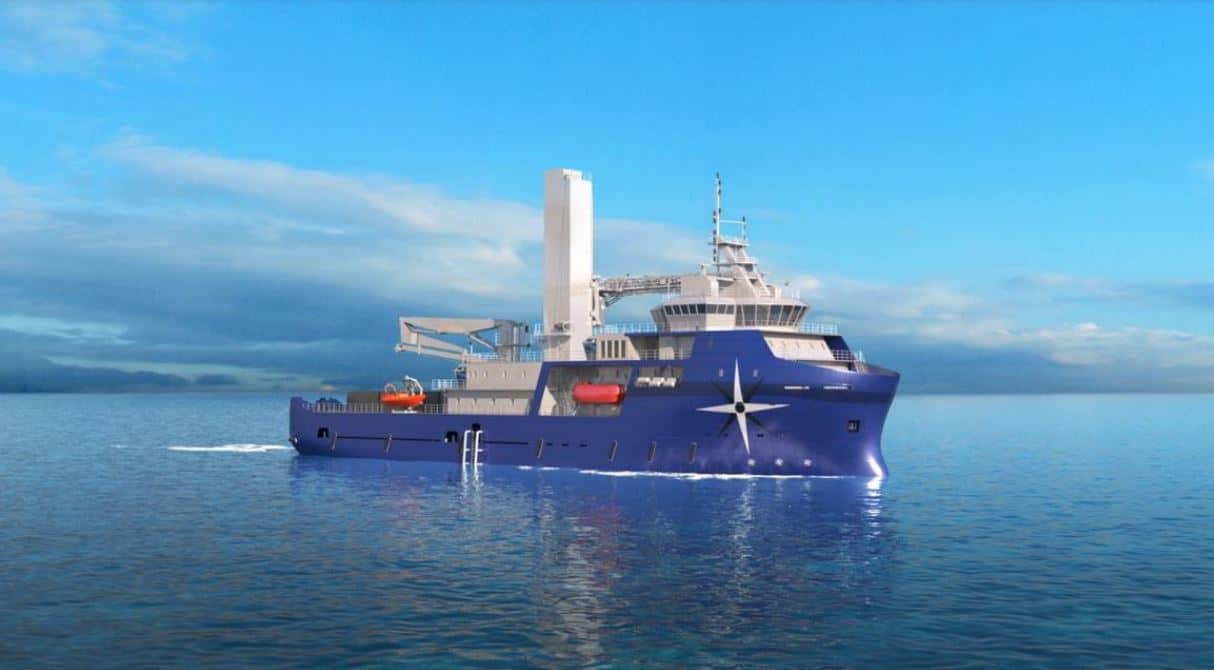
Marco Polo Marine Ltd a reputable regional integrated marine logistics company, announced that it will build, own and operate a new Commissioning Service Operation Vessel (CSOV) to meet the rising demand for support vessels required to service the booming offshore windfarm industry in Asia. When completed in 1Q2024, the vessel will also be the first CSOV to be designed in Asia. The Group will be funding the construction of the vessel with its existing resources and borrowings from financial institutions. A new CSOV is currently valued at about US$60 million.
The CSOV, with length of 83m and beam of 21m, is based on the latest design which has been co-developed by Marco Polo Marine and Seatech Solutions International (S) Pte. Ltd. and will be used in commissioning works during construction of offshore wind farms, as well as their maintenance operations. Equipped with the latest walk-to-work motion compensated gangway for safe personnel transfer from the vessel to the turbines, it also has a 3D motion- compensated crane to facilitate cargo transfer. The vessel will also be equipped with state-of- the-art green technology, such as hybrid battery-based energy storage systems, that will reduce carbon emissions by up to 15%-20% and designed as future-ready, catering for methanol fuel to enable low carbon emissions.
The vessel can comfortably accommodate up to 110 personnel on board, featuring spacious cabins, ample recreational areas, well-equipped fitness facilities, providing a “home away from home” feel for the personnel working and living on board. The vessel’s interior is designed for premium comfort, with large windows for maximum daylight, while complying with the highest standards of safety, together with a modern user-centric workflow for the wind turbine technicians.
“In March this year, we unveiled new designs for wind farm service vessels, and have received keen interest from offshore wind turbine makers and offshore windfarm developers. We observed that the industry continues to grapple with a CSOV shortage globally and charter rates continue to surge as well as the need to combat climate change.“
“It is a giant leap forward for the offshore maritime industry and we are optimistic about the ability to meet the rising demand for this vessel type with the deployment of its own CSOV in 1Q2024 tentatively. We will be making the relevant announcements once we have secured charter contracts for the vessel.”
Sean Lee, CEO of Marco Polo Marine
According to Clarksons’ offshore wind support vessel report for 2Q2022, charterers for offshore wind support vessels have started to secure ships earlier and for longer due to rising concerns of a shortage of suitable ships to meet the growth of the offshore windfarm market. In particular, CSOVs have seen higher utilisation and day rates across all regions due to higher demand from both renewables and the oil and gas sector as well as a rise in prices for newbuilt vessels.
Within the offshore windfarm sector, construction of new projects as well as projects near the final commissioning date have been driving demand for CSOVs, resulting in a shortage in availability for the vessels. Clarksons has observed an increase in day rates for CSOV notably in the shorter-term contracts but is also starting to see a potential increase in longer term rates.
In the long term, the growth of the global offshore windfarm market continues to remain robust. According to Global Wind Energy Council’s Global Wind Report 20221, the annual global offshore market is expected to grow by 49% from 21.1GW in 2021 to 31.4GW in 2026. Asia- Pacific region took the lead in global wind power development and accounts for 84% of the new offshore installations worldwide in 2021. Outside of China, Taiwan is one of the region’s fastest growing offshore wind markets and is expected to add 6.6GW of offshore wind capacity by 2026. Vietnam, South Korea and Japan also have ambitious plans to develop offshore wind resources, with plans to add 2.2GW, 1.7GW and 1GW of offshore wind power by 2026 respectively.
1 https://gwec.net/gwecs-global-offshore-wind-report/
About Marco Polo Marine
Listed on the Mainboard of the SGX-ST since 2007, Marco Polo Marine Ltd is a reputable regional integrated marine logistics company which principally engages in shipping and shipyard operations.
The Group’s shipping business relates to the chartering of Offshore Supply Vessels (“OSVs”) for deployment in the regional waters, including the Gulf of Thailand, Malaysia, Indonesia and Taiwan, as well as the chartering of tug boats and barges to customers, especially those which are engaged in the mining, commodities, construction, infrastructure and land reclamation industries.
Under its chartering operations, the Group has diversified its activities beyond the oil and gas industry to include the support of the construction of offshore windfarm projects. The burgeoning offshore wind energy industry in Asia is at a nascent stage where structures are in the process of being installed, which presents tremendous opportunities for the Group whose fleet is able to support the development of these projects.
The Group’s shipyard business relates to ship building as well as the provision of ship maintenance, repair, outfitting and conversion services, which are carried out through its shipyard located in Batam, Indonesia. Occupying a total land area of approximately 34 hectares with a seafront of approximately 650 meters, the modern shipyard also houses three dry docks, which have boosted the Group’s technical capabilities and service offerings to undertake projects involving mid-sized and sophisticated vessels.
For more information, please refer to our corporate website: www.marcopolomarine.com.sg










 (“Marco Polo Marine” or the “Company”, and together with its subsidiaries, “the Group”), a reputable regional integrated marine logistics company, announced that it will build, own and operate a new Commissioning Service Operation Vessel (CSOV) to meet the rising demand for support vessels required to service the booming offshore windfarm industry in Asia. When completed in 1Q2024, the vessel will also be the first CSOV to be designed in Asia. The Group will be funding the construction of the vessel with its existing resources and borrowings from financial institutions. A new CSOV is currently valued at about US$60 million.The CSOV, with length of 83m and beam of 21m, is based on the latest design which has been co-developed by Marco Polo Marine and Seatech Solutions International (S) Pte. Ltd. and will be used in commissioning works during construction of offshore wind farms, as well as their maintenance operations. Equipped with the latest walk-to-work motion compensated gangway for safe personnel transfer from the vessel to the turbines, it also has a 3D motion- compensated crane to facilitate cargo transfer. The vessel will also be equipped with state-of- the-art green technology, such as hybrid battery-based energy storage systems, that will reduce carbon emissions by up to 15%-20% and designed as future-ready, catering for methanol fuel to enable low carbon emissions.)