




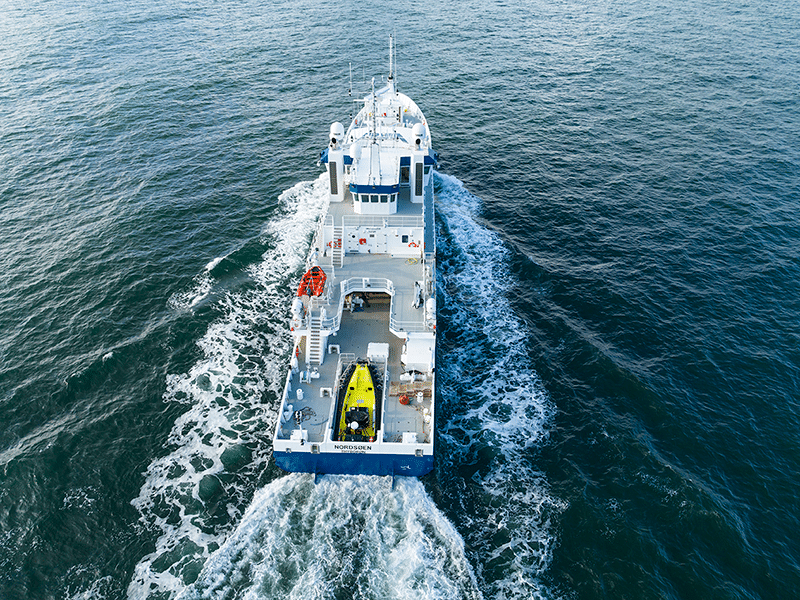
Last summer was a hectic time at Hvide Sande Shipyard, based on Denmark’s West Coast. July and August were filled with sea trials, finishing touches and commissioning of systems of the newbuild Nordsøen. Hvide Sande Shipyard won the public tender to build the vessel in late 2020. On August 24, 2022, the ship was named and handed over to her owner. It is the first Offshore Patrol Vessel which combines azimuthing propulsion pods with a Hull Vane® behind the transom.
12 to 17% less CO2 emissions
Given that the public tender awarded a lot of points on low lifecycle costs and energy efficiency, Hvide Sande Shipyards contacted Hull Vane BV during the concept design stage. Due to her length, displacement and speed range (10-18 knots), it was quickly determined that Hull Vane® would provide great benefits, which was later confirmed with CFD computations with and without Hull Vane®. The resistance reduction from the Hull Vane® amounts to 12% at 10 knots, 17% at 14 knots and 14% at 18 knots.
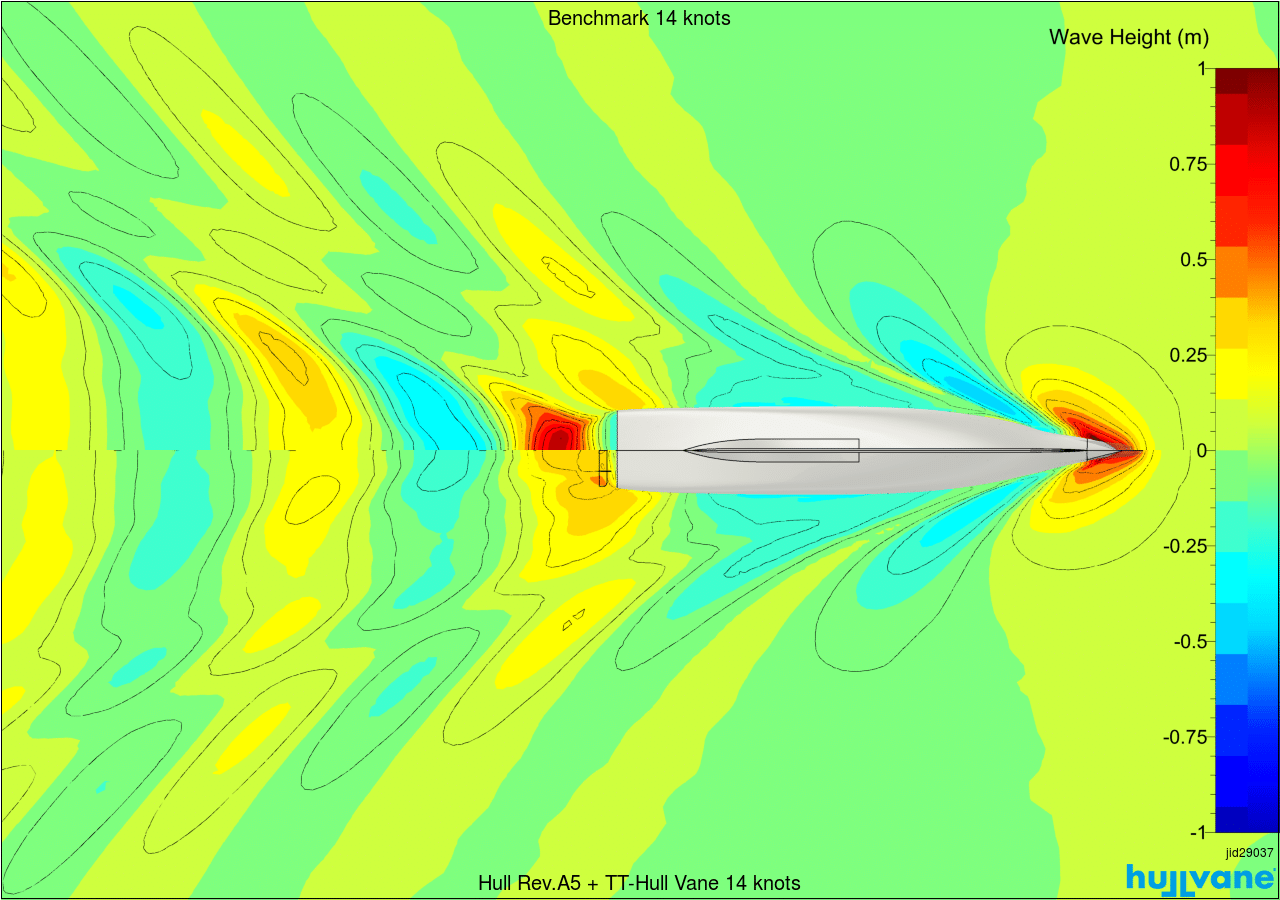 Wave profile without (top halve) and with Hull Vane® (bottom halve) at 14 knots.
Bruno Bouckaert, sales director of Hull Vane BV: “The project was atypical, in the sense that from the first conversation about Hull Vane® up to its installation, everything was done through online meetings, as we were in full Covid lockdown-times. That said, the project couldn’t have run smoother.
There are some interesting firsts for Hull Vane®: Nordsøen is the first ship where Hull Vane® is installed on a ship with azimuthing propulsion drives. The combination works perfectly, and in fact, because of the Hull Vane®, the pods have to do less steering corrections in bow- or stern-quartering seas, which also improves their efficiency and reduces the noise level.
Another first is the stern ramp system. On Nordsøen, the stern ramp is equipped with a slide-out system. All we had to do is make sure that the Hull Vane® was out of the path of this system. We see a benefit of such systems as it allows patrol vessels and naval ships with a stern ramp to be designed with an optimal hull shape, without a lot of transom immersion. Offshore Patrol Vessels sail a lot of time at moderate speeds (5-15 knots), and then it’s really beneficial to have not too much transom immersed”.
Quietly efficient
So what’s the verdict after the sea trials and several months of usage? All expectations have been met, and the vessel is said to be exceptionally quiet and efficient. The ship has never sailed without Hull Vane®, but it’s obvious that Nordsøen makes very few waves, a clear sign of her efficiency.
According to the operational profile published in the tender documents, the Hull Vane® on Nordsøen saves 317.000 liter of marine diesel fuel per year. That’s enough to drive all the way around the earth every other day with a normal diesel car. The CO2 emissions are reduced by 1.090 tons per year, at an off-the-charts low CO2 abatement cost of – 212 €/ton CO2 abated. The reduced resistance from the Hull Vane® allowed the shipyard to purchase smaller azimuthing pods and diesel-generator plant, a cost saving which exceeded the Hull Vane® cost and therefore reduced the total build cost. It may sound against the laws of quantum mechanics, but the Hull Vane® on Nordsøen actually has a negative payback period. The investment in the Hull Vane® was recovered before the ship even sailed her first nautical mile.
Hull Vanes have now been installed on many patrol vessels operating in the Netherlands, France, Belgium, Denmark and Nigeria. On all these vessels, the reduction in fuel consumption from the Hull Vane® exceeds 10%. It’s a proven and very cost-effective solution for governments wishing to reduce the use of energy and CO2 emissions of their fleet, at a negative cost due to the energy savings. Whatever the fuel of the future will be, Hull Vane® makes the future energy transition easier and more affordable.







12 to 17% less CO2 emissionsGiven that the public tender awarded a lot of points on low lifecycle costs and energy efficiency, Hvide Sande Shipyards contacted Hull Vane BV during the concept design stage. Due to her length, displacement and speed range (10-18 knots), it was quickly determined that Hull Vane® would provide great benefits, which was later confirmed with CFD computations with and without Hull Vane®. The resistance reduction from the Hull Vane® amounts to 12% at 10 knots, 17% at 14 knots and 14% at 18 knots.Wave profile without (top halve) and with Hull Vane® (bottom halve) at 14 knots.Diesel Electric pod drives Bruno Bouckaert, sales director of Hull Vane BV: “The project was atypical, in the sense that from the first conversation about Hull Vane® up to its installation, everything was done through online meetings, as we were in full Covid lockdown-times. That said, the project couldn’t have run smoother. There are some interesting firsts for Hull Vane®: Nordsøen is the first ship where Hull Vane® is installed on a ship with azimuthing propulsion drives. The combination works perfectly, and in fact, because of the Hull Vane®, the pods have to do less steering corrections in bow- or stern-quartering seas, which also improves their efficiency and reduces the noise level.Another first is the stern ramp system. On Nordsøen, the stern ramp is equipped with a slide-out system. All we had to do is make sure that the Hull Vane® was out of the path of this system. We see a benefit of such systems as it allows patrol vessels and naval ships with a stern ramp to be designed with an optimal hull shape, without a lot of transom immersion. Offshore Patrol Vessels sail a lot of time at moderate speeds (5-15 knots), and then it’s really beneficial to have not too much transom immersed”.)