



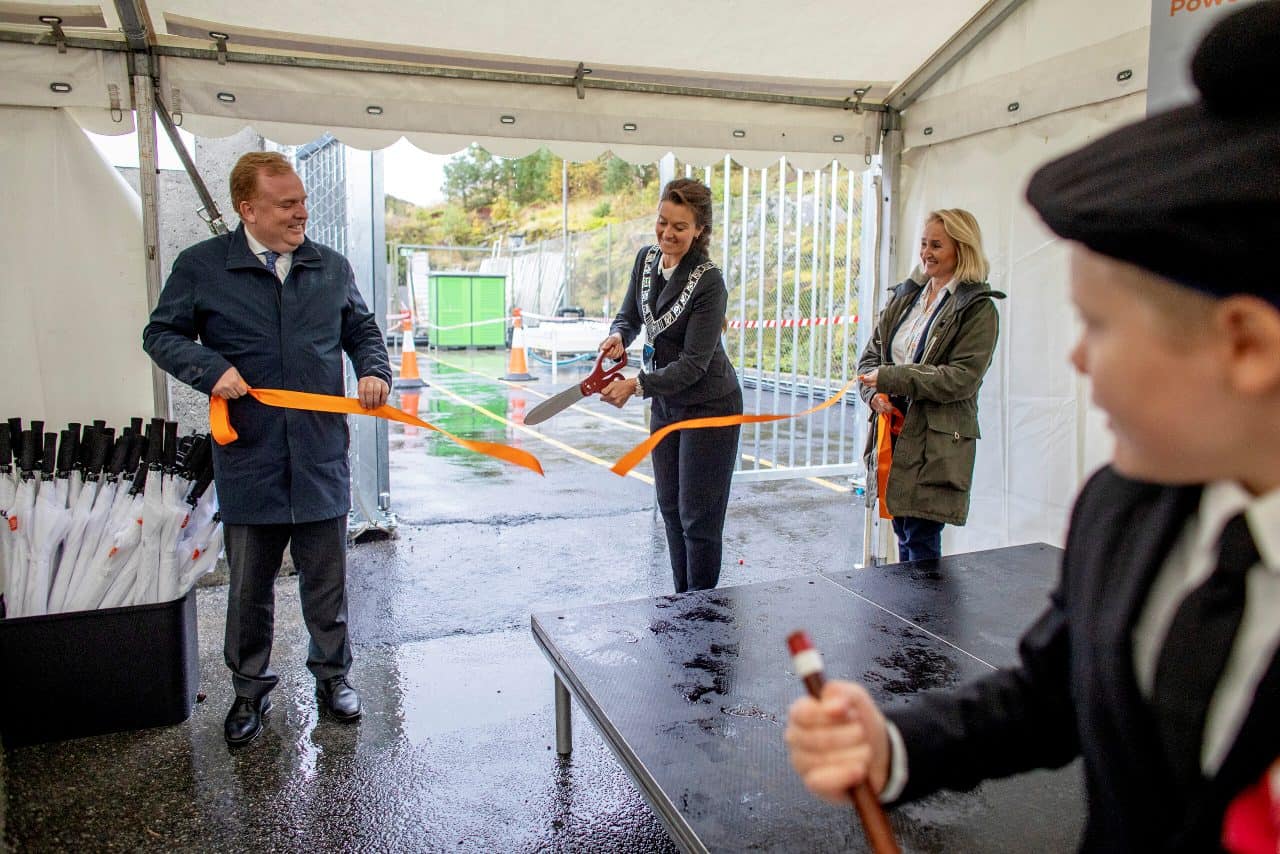
Corvus Energy, the world’s leading producer of battery systems for the ocean space, opened a brand-new test area for hydrogen fuel cells at their production site in Bergen, Norway.
As part of the H2NOR project, Corvus is going full blast with the development and production of sustainable, large-scale maritime-certified hydrogen fuel cell systems, with Toyota onboard as key partner and supplier of mass-produced fuel cell technology.
In March the project received Approval in Principle (AiP) by DNV and the test area is an important part of the prototype testing and validation. The test area was officially opened by Vice County Mayor of Vestland County Municipality, Natalia Golis (The Greens).
Thor Humerfelt, Senior Vice President Product Architect of Corvus Energy explains, “Batteries and fuel cells are complementary products, and they need to work together in order to achieve optimal efficiency and extended lifetime. We will test multiple combinations of batteries and fuel cells for various operational profiles, and this is why the test site is so unique and important. In the end, we will have a system that will give recommendations for the vessel’s crew on the most optimal operation.” He continues: “Corvus Energy has extensive knowledge in battery systems and marine safety. Through cooperation with Toyota, the world leader in fuel cell technology, we are now able to combine the best from both companies’ expertise.”
“The interest in hydrogen as a marine fuel is increasing significantly. A dedicated marine and optimized hydrogen fuel cell solution is a vital step toward the decarbonization of shipping. Being able to test both battery and fuel cell systems together and make them work in perfect harmony will potentially revolutionize the global maritime industry,” Geir Bjørkeli, CEO of Corvus Energy, said.
Another central project partner, Maritime CleanTech, emphasized the test area and the projects importance related to reducing cost of fuel cells, as well as increasing access to technology:
“Reducing the cost of fuel cells and increasing access to the technology is crucial to accelerate the green transition in the maritime industry. Innovation is hard work – and the validation processes are no quick fixes. Systematic testing and validation ensure the responsible and safe use of hydrogen and fuel cell technologies. This test site is a great example of how this should be done,” Håvard Tvedte, interim CEO of Maritime CleanTech, said.
Testing of the Hydrogen Fuel Cell system is in full progress.
Corvus Energy aims to have the first marine hydrogen fuel cell system type approved in 2023 and start scalable production and commercial delivery in 2024.

About Corvus Energy
Corvus Energy is the leading supplier of energy storage systems (ESS) for maritime, offshore, subsea and port applications. Corvus Energy offers a full portfolio of ESS suitable for almost every vessel type, providing high power energy storage in the form of modular lithium-ion battery systems. The purpose-built, field-proven battery systems provide sustained power to hybrid and all-electric heavy industrial equipment, including large marine propulsion drives. Corvus Energy has unsurpassed experience from 650 projects, totaling over 500 MWh and more than 4,5 million operating hours. The company also also – through the H2NOR project – develops maritime hydrogen fuel cells in collaboration with the world leader in fuel cell technology, Toyota Corporation.








 by DNV and the test area is an important part of the prototype testing and validation. The test area was officially opened by Vice County Mayor of Vestland County Municipality, Natalia Golis (The Greens).)