




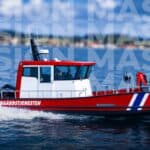
Norled, together with SEAM and others, have developed a new system for charging and operating express boats with electric batteries. Potentially catapulting express boats into a new electric age.
For a little over a year, SEAM has been working closely with Norled in the conceptualization and development of a new battery solution for electric express boats.
The new system, which Norled has coined as Autonomous Battery Swap (patent pending), will be able to not only maintain the high speed of an express boat, but also provide a more even and pragmatic approach to charging batteries at quays.
Autonomous Battery Swap is a robotic charging station which swaps out batteries on express boats while at quay. One part stands permanently on the quay, with its’ own battery station. The other is mounted on the boat, with two battery packs on a turntable.
The battery station will be able to swap out the empty batteries with fully charged batteries in three minutes, with the boat now ready for either 30 minutes of sailing in 35 knots, or 45 minutes in 30 knots.
The concept was introduced by Norled at the Zero Conference in Oslo, Wednesday 24th of November.
Finding the right solution
– The starting point came from an initiative by Norled, who wanted to find a more efficient way to electrify the express boat segment, says Project Manager at SEAM, Svein Johnny Naley.
Up until now, the challenges revolving electrifying express boats mainly came down to weight and size, and how this would affect the speed.
Traditionally, such as in the case of electric ferries, the battery is installed directly onto the vessel – increasing the weight.
– We started out wide and, in close collaboration with Norled, started finding potential solutions that were technically realistic. During this process we also accumulated insights from different external contractors for evaluation. We have invested a great deal into research and development of new technology, so this gave us a good opportunity to showcase our expertise in that regard – as well giving us a healthy challenge.

While there were many other approaches considered, the advantages of a battery swap solution were considerable.
– You can electrify both new and existing vessels, without having to install big, heavy battery packs on each boat. Lower weight gives lower fuel consumption, which in turn gives greater environmental advantages and lower operating costs.
Compared to traditional charging stations for electric ferries, the Autonomous Battery Swap provides a much quicker layover at each quay, because the batteries have already been charged while the boat is in transit.
This also creates less strain on the powergrid because the batteries can be charged by the already available grid capacity.
Multiple external companies participated in the process of both designs and technical solutions. Among the local contributors, Naley mentions SMV, Aarbakke Innovation, Halogen and Ramo Engineering as great contributors.
– We gathered ideas and input from multiple companies both locally and abroad. I believe we were able to manage all of these very constructively, which resulted in the solution we ended up with together with Norled.
An established partner
This is not the first time Norled has chosen SEAM as their partner in crime.
Chief Operating Officer, Otto Koch, believes this project confirms the great collaboration between the two companies.
– We have worked closely with Norled for a while, on many different projects involving groundbreaking work. We work well together, and we believe this project proves that.
Project Manager Naley believes the already established relationship with the shipping company was key to unlocking efficiency in this project.
– It has without a doubt been a very important aspect when delivering and securing efficiency throughout. Clear demands with quick replies; a good dialogue in these projects is essential in order to succeed, and I want to praise Norled for their enthusiasm and efficiency.
SEAM has many years of experience with developing electric and automation systems for hybrid and fully electric vessel operations.

– We also delivered the hydrogen systems for MF Hydra – which is the world’s first hydrogen operated ferry. We invest in considerable amounts of resources to stay updated and ahead in regard to fuel cell technology and the fast-growing development in battery operations.
COO, Otto Koch, is optimistic about what future possibilities this project might attract.
– Projects like these are important to SEAM in many ways; we have the opportunity to get introduced to a larger part of the business chain; we are able to challenge individuals and organizations to think differently; and we believe we generally become more attractive to our surroundings if we can take part in the development of new solutions.
Challenging the norm
– We have to be able to think in different ways, challenge and root for each other. The industry has proven that it’s possible to achieve zero emissions in many different areas. Especially considering the milestones achieved in ferry operations.
But looking at past successes is not enough. Koch and the rest of the team at SEAM are determined to look forward in order to find optimal energy solutions and reducing emissions.
– Now we have to look towards other areas where there’s a need for better reach and more energy. We’ve learned a lot from working closely with our customers and suppliers, with our aim to achieve good results for the end customer. Moving forward we need to use what we’ve learned, both in terms of method and development, to find the next great solutions.










, will be able to not only maintain the high speed of an express boat, but also provide a more even and pragmatic approach to charging batteries at quays.)