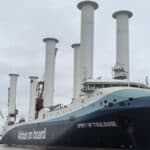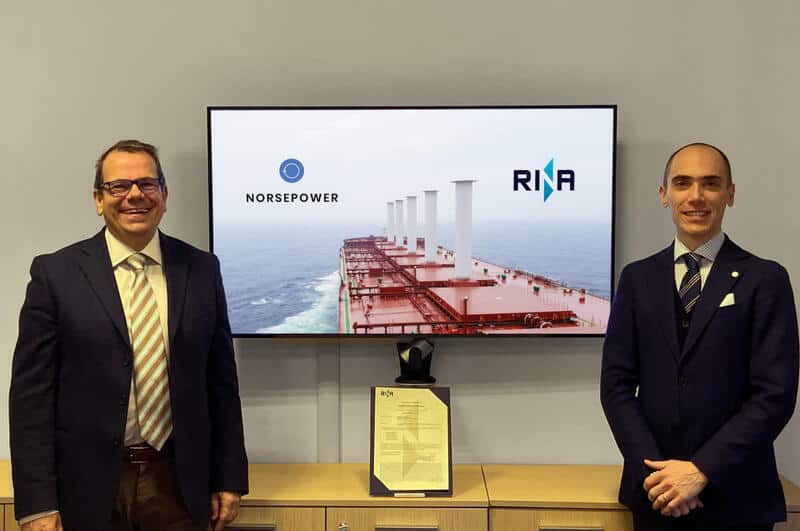
Norsepower has been granted Approval in Principle for its Rotor Sail technology solution from classification society, RINA.
The Norsepower Rotor Sail Solution is a modernised version of the Flettner rotor – a spinning cylinder that uses the Magnus effect to harness wind energy to propel a ship, allowing the main engine to be throttled back to improve fuel efficiency and to obtain a reduction of greenhouse gas emissions, without compromising the service speed.
There is a growth of interest in the shipping industry for this technology and according to Norsepower, the current savings that can be achieved with Rotor Sail installation ranging between 5-25%.
From a regulatory perspective, the International Maritime Organisation (IMO) introduced GHG emission targets for 2030 and 2050 which need tangible and proven solutions to make this a reality. While shipping companies are coming under more scrutiny from financiers, charterers and shippers to embrace greater environmental and social governance, class societies are looking for achievable solutions which will help the industry achieve these targets.
Tuomas Riski, CEO, Norsepower Oy Ltd said: “It is a pleasure to work with key partners such as RINA and for our technology to be recognised as a proven solution which delivers key savings for shipowners with fuel savings and emissions reduction, particularly as the shipping industry gets ever closer to IMO 2030 and IMO 2050 targets.
“Our technology has over 140,000 hours of operation and saved over 9600 tonnes of CO2 emissions, proven by independent verification parties on vessel trials. Achieving Approval in Principle from RINA takes us one step closer to improving awareness of the significant and proven savings Rotor Sails can deliver, standardising the use of Norsepower’s Rotor Sails in shipping’s decarbonisation strategy as well as demonstrating the ever growing importance of investment in clean technologies to meet regulatory compliance.”
Giuseppe Zagaria, Technical Director, RINA commented: “The IMO has identified the role of rotor sails as a technology able to benefit the main engine power under certain conditions and we are pleased by the results declared by Norsepower’s Rotor Sails in the levels of savings which could be achieved.
“Wind propulsion is a freely available resource which is making large cargo and passenger vessels cleaner and more cost effective and we look forward to working with more technology providers to support shipowners in making vessels cleaner and greener.”
Norsepower is the first company in the world to implement hundred-year-old sailing principles in a commercially viable modern product to support green shipping.
Read about Norsepower’s technology here.