
Dutch Ministry of Defence awards contract to develop and deploy containerised passive acoustic towed array systems for crewed and uncrewed maritime platforms
World leader in passive fibre optic acoustic subsea sensing OPTICS11 has expanded its OptiArray portfolio after securing a contract from the Dutch Ministry of Defence to further develop and deliver operational containerised towed array systems.
The agreement will see the Netherlands-based subsea sensing specialist provide advanced anti-submarine warfare (ASW) capability that can be rapidly deployed from a wide range of crewed and uncrewed maritime platforms.
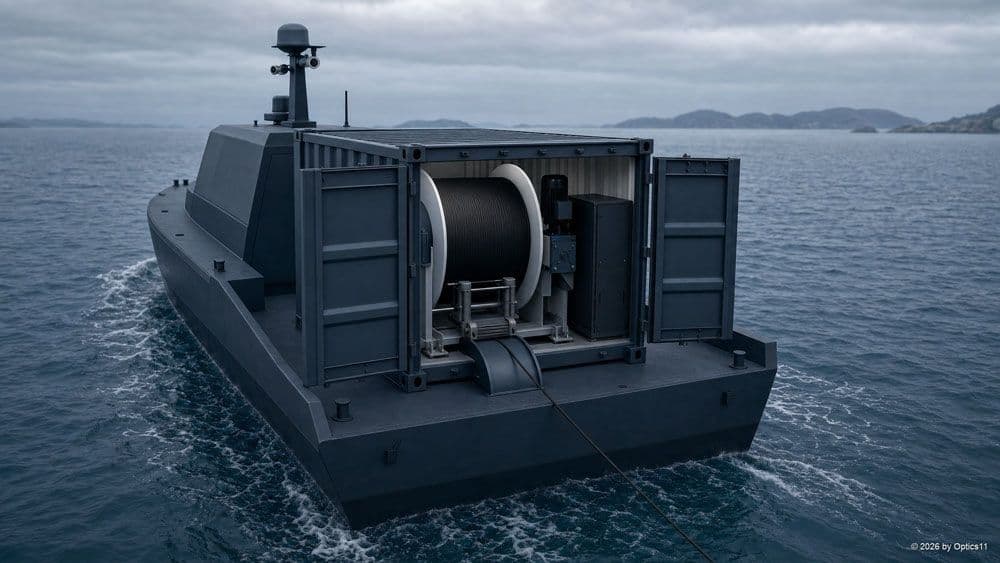
Designed around OPTICS11’s passive fibre optic acoustic sensing technology, the containerised systems offer a flexible and cost-effective solution for integrating sophisticated underwater surveillance capabilities without the need for major vessel modifications. Their modular design enables rapid deployment across multiple vessel types, supporting evolving naval and maritime security requirements.
The Dutch Ministry of Defence has contracted the first systems under the ASWINABO, or Anti-Submarine Warfare In A Box, programme, which is intended to strengthen the readiness and self-sufficiency of the Royal Netherlands Navy. The contract continues the adoption of OPTICS11’s technology by the Royal Netherlands Navy.
Autonomous underwater systems are becoming more widely available, while subsea and maritime infrastructure is an increasingly attractive target for espionage, sabotage and hybrid threats. Sophisticated underwater monitoring is becoming a critical component of national security.
OptiArray, the next-generation fibre-optic-based towed array, is built using world-leading fibre optic hydrophone technology to deliver exceptional underwater detection for anti-submarine warfare and maritime surveillance. Unlike conventional electrical towed arrays, which rely on powered electronics throughout the sensing chain, generate electrical noise and are susceptible to electromagnetic interference, OptiArray is passive and so remains acoustically silent while capturing significantly richer acoustic information. The result is earlier detection, more accurate target classification and greater operational confidence for decision making.
Alongside delivery of the operational systems, the project will establish the production, integration and validation capability required to support future deployment at scale. Investment in manufacturing readiness, supply chain resilience and production infrastructure will also help mature technologies supporting future programmes, while strengthening the Netherlands’ ability to rapidly field advanced underwater sensing capabilities as operational requirements continue to evolve.
Paul Heiden, CEO of OPTICS11, said: “The underwater threat environment is evolving rapidly, but advanced threat sensing has traditionally been confined to a small number of specialist naval platforms. By containerising OptiArray, we’re making world-class detection faster, more flexible and cheaper. We want to set the standard for unmanned underwater and above-water drones, as our technology is a perfect fit for doing this: light, small, highly sensitive and very accurate. As critical subsea infrastructure becomes increasingly contested, prevention starts with detection.”
Lucas Leppink, Captain RNLN (OF-5), Head of the Maritime Systems Department, COMMIT (NL-MoD), said: “With ASWINABO, the Royal Netherlands Navy will be able to equip its surface ships, unmanned surface vessels and any other vessel of opportunity with underwater surveillance capability, a game-changer for maritime security operations and undersea infrastructure protection.”