



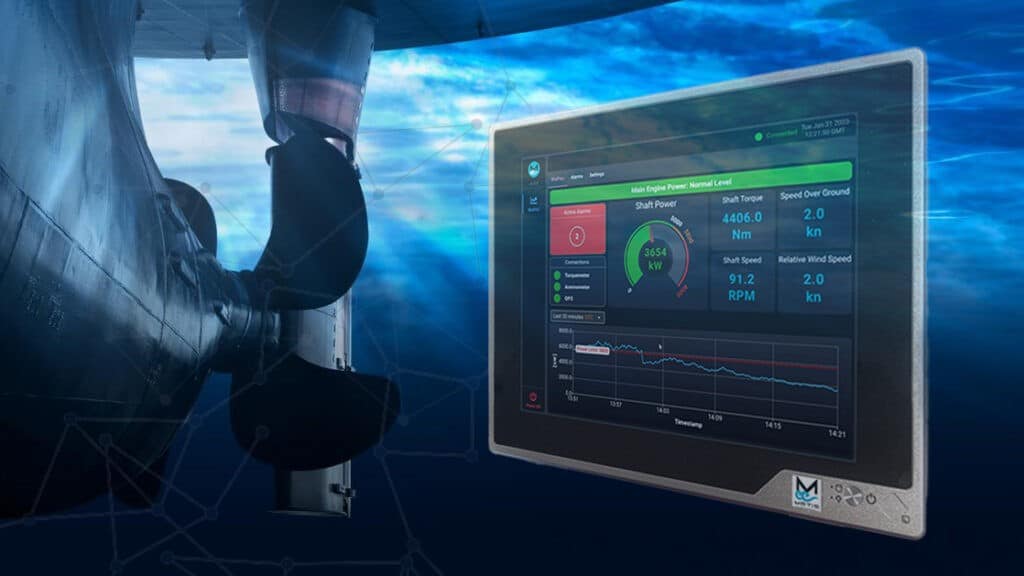
Engine or shaft power limitation is a practical means of achieving fuel oil consumption optimization within the framework of the IMO’s recently introduced EEXI regulation. However, for all its benefits, implementing the method requires careful consideration.
Andreas Symeonidis, Marketing and Partner Relations Manager, METIS Cyberspace Technology.
From January this year, by the time of their first periodical survey, ships of 400gt and above must satisfy IMO’s Energy Efficiency eXisting ship Index (EEXI) – a measure of their technical ability to reduce greenhouse gas emissions.
EPL and ShaPoLi
To improve efficiency and achieve compliance with EEXI requirements, engine power limitation (EPL) and shaft power limitation (ShaPoLi) are proving the most popular among shipowners thanks to their relative simplicity, cost efficiency and minimal impact on vessel operations.
Both are approved, non-permanent and tamper-proof methods of power limitation, with EPL limiting maximum engine power directly and ShaPoLi achieving the same result by restricting maximum shaft power.
More specifically, the systems limit the engine’s Maximum Continuous Rating (MCR) or maximum Shaft Power output, to a percentage of its original output depending on the vessel’s individual EEXI requirements. The new maximum engine power, the EEXI calculation point, is 75% of its limited MCR (MCRlim) or 83%MCRlim in case of EPL. Once this has been established, the ship can operate up to its MCRlim. Since engine power is proportional to the cube of vessel speed, a 10% decrease in speed reduces hourly fuel consumption by almost 30%.
Other solutions for meeting EEXI requirements include clean technologies – such as batteries, waste-heat recovery systems, air lubrication and wind-assisted propulsion – and low- or zero-carbon fuels. However, on their own, these solutions may not have a sufficient impact on energy efficiency to achieve the required EEXI rating, meaning engine power limitation will be needed anyway in most cases.
For all the benefits of EPL or ShaPoLi, there are several factors that shipowners must consider before implementing a power limitation device.
Overriding the MCRlim
At the 76th session of the Marine Environment Protection Committee in June 2021, the IMO adopted a resolution providing guidance on EEXI compliance and the use of a power reserve with an EPL or ShaPoLi system. According to the resolution, power limitation is only to be overridden in the interests of safety, for example in harsh weather conditions where accessing the power reserve may help to save lives at sea. Furthermore, the use of the power reserve must issue an alert and be recorded in the ship’s onboard management manual.
Reviewing time charter parties
The ability to gather, measure and analyze equipment performance represents a key requirement in effective EPL and ShaPoLi implementation, and nowhere is this more apparent than in considering potential issues arising between shipowners and charterers. Since power limitation can affect a vessel’s speed, performance and description, the adoption of an EPL or ShaPoLi system necessitates a thorough review – and possibly a re-negotiation – of existing time charter party agreements. It was to address this issue that BIMCO developed its EEXI Transition Clause for Time Charter Parties 2021.
Considering the wider implications
In fact, the impact of power limitation on vessel speed can create issues throughout the supply chain, causing delays in the delivery of goods and other logistical complications. It may even cause heightened demand for vessels to compensate for increased delivery times, which could counteract the environmental benefits of power limitation. Moreover, with many shipowners already mitigating fuel consumption and emissions through slow steaming, a significant proportion of the global merchant fleet would likely yield no additional benefit from implementing an EPL or ShaPoLi system.
Therefore, although power limitation represents a practical means of meeting EEXI requirements, shipowners need to carefully consider the operational implications of adopting EPL or ShaPoLi, while the industry must work to address concerns surrounding the method’s widespread implementation. Using AI-based analytics to verify their effectiveness provides a good place to start.
For more information on METIS and its portfolio of digital solutions that support maritime’s decarbonisation, visit www.metis.tech









 – a measure of their technical ability to reduce greenhouse gas emissions. EPL and ShaPoLiTo improve efficiency and achieve compliance with EEXI requirements, engine power limitation (EPL) and shaft power limitation (ShaPoLi) are proving the most popular among shipowners thanks to their relative simplicity, cost efficiency and minimal impact on vessel operations. Both are approved, non-permanent and tamper-proof methods of power limitation, with EPL limiting maximum engine power directly and ShaPoLi achieving the same result by restricting maximum shaft power. More specifically, the systems limit the engine’s Maximum Continuous Rating (MCR) or maximum Shaft Power output, to a percentage of its original output depending on the vessel’s individual EEXI requirements. The new maximum engine power, the EEXI calculation point, is 75% of its limited MCR (MCRlim) or 83%MCRlim in case of EPL. Once this has been established, the ship can operate up to its MCRlim. Since engine power is proportional to the cube of vessel speed, a 10% decrease in speed reduces hourly fuel consumption by almost 30%.)