



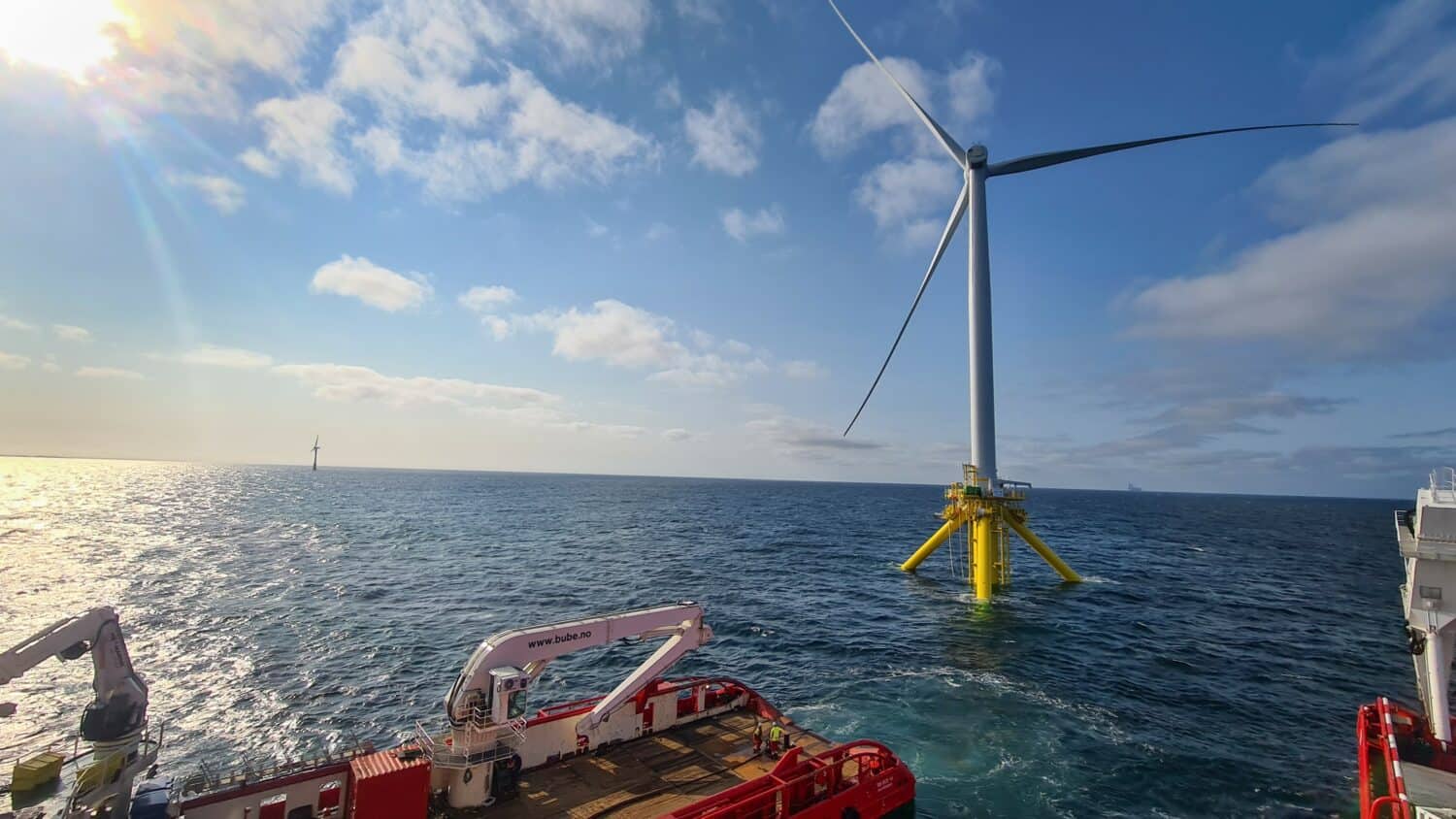
RWE, NTE and Havfram have signed a collaboration agreement. Together, the three companies intend to participate in the Norwegian government’s tender process for floating offshore wind energy, which will begin later this year.
Norway has ambitious climate targets: by 2030, the country aims to reduce its greenhouse gas emissions by 50 to 55 per cent compared to 1990 levels, whilst at the same time promoting green growth. The Norwegian Ministry of Petroleum and Energy has designated a new area for this purpose: Utsira Nord, located around 30 kilometres off the coast of Norway west of the island of Svendsholmen, offers the opportunity to build up to 1.5 gigawatts (GW) of new floating offshore capacity.
Sven Utermöhlen, CEO Offshore Wind RWE Renewables: “Utsira Nord is an excellent opportunity for us to develop a floating offshore wind project on an industrial scale with two strong Norwegian partners. In the field of floating offshore wind power, we are doing pioneering work
at no less than three demonstration plants, including the TetraSpar Demonstrator which is being commissioned now at its site less than 20 kilometres from Utsira Nord. We will put the knowledge and experience we have gained in our pilot projects to work in Norway in the future.
Christian Stav, CEO of NTE, explains: “NTE is in the forefront of producing and delivering renewable energy. To be able to reach the 1.5C goal of the Paris Agreement and to successfully accomplish the green transition, we need to increase the production of renewable energy.
Hydropower and floating wind are perfectly complementary energy sources in the Nordic energy mix. Therefore, we look forward to collaborating with RWE and Havfram as we are now taking the first steps towards developing floating wind in the Norwegian North Sea together. The technical know-how and international experience of our partners complement our local expertise across the entire value chain.”

The partners are convinced that offshore wind energy will be a key component in the future energy mix and one of the solutions to meeting the growing demand for renewables. Moreover, it will permit new industries to develop and will lead to news jobs being created.
“The expansion of offshore wind is a crucial factor for a successful energy transition in Norway. With RWE and NTE, we strive to advance this transition, and aim to be a valuable addition to Norway’s marine
energy sector,” says Odd Strømsnes, CEO of Havfram.
According to current findings, 80 per cent of the marine areas potentially available for wind farms worldwide are suitable only for floating technology. From a depth of about 60 metres, foundations firmly anchored to the seabed are hardly economic. For this reason, RWE is conducting in-depth research and development work for floating offshore wind technology. The company is currently investigating the potential of this innovative technology in three joint ventures in Norway, the US and Spain, and is thus in an ideal position to carry out further
projects in the Norwegian North Sea.
Havfram is a Norwegian subsea and offshore wind contractor with a global footprint, with subsidiaries in the US, the UK and others. Havfram has wide experience in planning and execution of complex offshore operations. The company has a large engineering and project
implementation team that provides synergies between the business areas and will greatly benefit in the development of this Norwegian area.
Apart from Utsira Nord, the Norwegian Ministry of Petroleum and Energy has designated another area for offshore renewables: Sørlige Nordsjø II. RWE has already expressed interest in this area, which borders the Danish sector in the North Sea.










 of new floating offshore capacity.)