


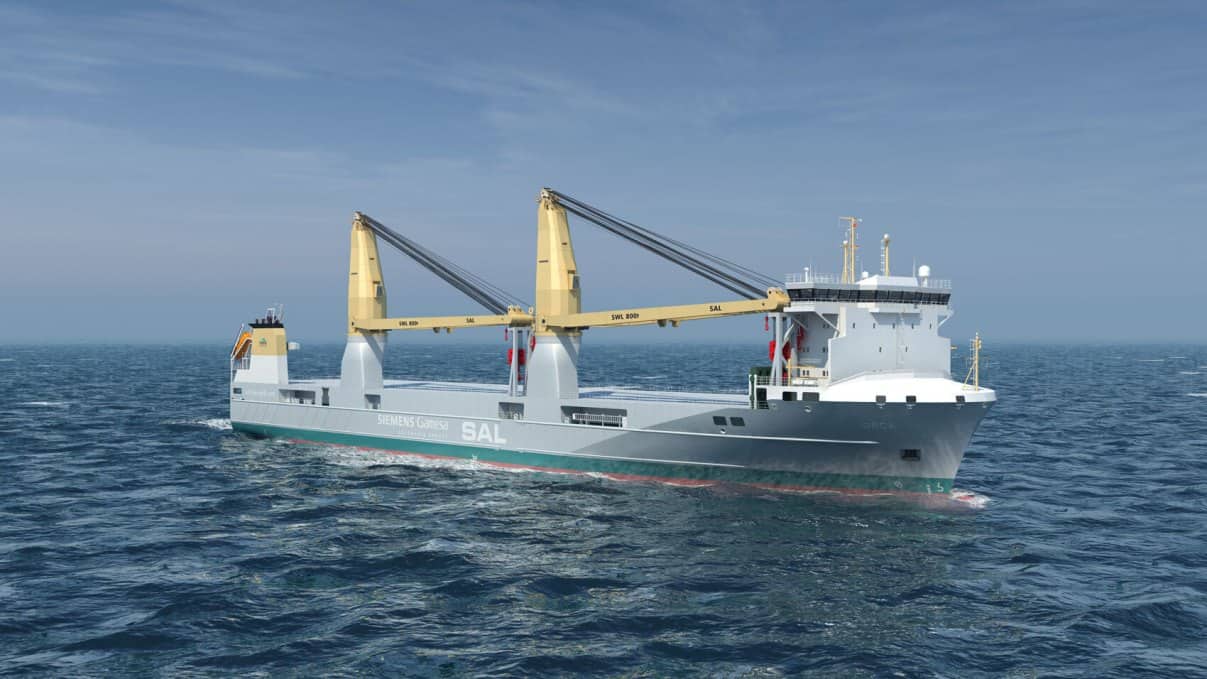
SAL Heavy Lift, one of the world’s leading maritime heavy lift and project cargo carriers, has signed building contracts for four firm plus two optional new generation heavy lift ships with Wuhu Shipyard, China. This joint newbuilding programme involving SAL Heavy Lift and partner Jumbo Shipping is called Orca Class.
Scheduled for delivery starting in mid-year 2024, the first two ships will be exclusively involved in the transportation of offshore wind turbine components in a long-term commitment with Siemens Gamesa Renewable Energy. Two additional sister vessels will enter the premium heavy lift shipping market to serve the clients of the Jumbo- SAL-Alliance in the first half of 2025.
“The Orca vessels are setting new standards in global heavy lift shipping. They represent the new benchmark both in terms of their technical capabilities and modern climate-friendly propulsion systems,” says Dr. Martin Harren, Owner and CEO of SAL Heavy Lift and the Harren Group. “The ships will be the most efficient vessels in their class with consumption and emission figures far superior to any existing heavy lift vessel today. As a signatory to the ‘Call to Action for Shipping Decarbonization’, our Group has committed to the decarbonisation of shipping activities by 2050. I am proud that this newbuilding order shows how we are keeping our promise for significant, concrete action.”
The vessels were developed in close cooperation with SAL’s joint venture partner, Jumbo Shipping (Schiedam, The Netherlands), another true heavyweight in the industry. Jumbo Shipping Owner Michael Kahn stresses: “One can say that these ships mark the beginning of a new era for the Jumbo-SAL-Alliance – no exaggeration. I would like to take this opportunity to thank the newbuilding design team at SAL for their great cooperation. I am very impressed with their passion and technical expertise. The ships will help bring us even closer together.”
The vessels measure 149.9 m x 27.2 m and provide a capacity of 14,600 dwt. Despite their compact outer dimensions, the vessels have a box-shaped single cargo hold with the largest dimensions in its class. Provided the hatch covers with a capacity of 10 t/m2 are utilised for stowing super-heavy deck cargoes, such as 3,000 t cable carousels, the vessels can accommodate over-height cargo in the hold and sail with open hatch covers up to full scantling draft.
Christian Johansen, Global Commodity Manager – Ports & Transportation, Offshore at Siemens Gamesa Renewable Energy, says: “We are excited to continue and build on our strategic partnership with SAL Heavy Lift with their Orca Class programme. We see their ultra-efficient profile and carbon-neutral potential as a perfect fit with our aim of decarbonising our supply chain. As companies, we share a lot of the same values – and we are happy to embark on this journey together with SAL.”
Thomas Mortensen, Head of Transport Project Execution, Offshore at Siemens Gamesa Renewable Energy, adds: “We are especially impressed with the flexibility these new vessels represent. Our business is complex, challenged by rapid globalisation as well as the increasing size and weight of our turbine components. The need for flexibility is higher than ever, and the Orcas meet several of our anticipated medium- to long-term transportation challenges. Best-in-class intake, speed and lifting capabilities are all key factors in our decision to work with SAL on the two first Orcas.”
Jan-Peter Esbensen, Managing Director of SAL Denmark, has been involved in the discussions with Siemens Gamesa Renewable Energy from the very beginning: “It is great to see how an initial idea is now turning into such great and trend-setting vessels. We look forward to growing our cooperation with Siemens Gamesa Renewable Energy in the years to come.”
Ice class notation 1A, a Polar Code certification and the reduced design temperature of the hull and equipment allow the ships to safely operate in cold conditions as well.
Two 800 t Liebherr cranes specifically designed for this ship type can handle cargo items weighting up to 1,600 t in tandem. “Despite extremely high crane pedestals of more than 11 m, the overall crane height and thereby the vessel’s air draft remains at just about 38 m. This makes it possible for the vessel to pass Kiel Canal and enter strategically important ports worldwide,” explains Sebastian Westphal, CTO at SAL Heavy Lift. “The fully electric cranes are perfect for the vessel’s intelligent energy management and recovery system. This is based on a battery storage system that can be used together with conventional gensets in hybrid mode, or in combination with the vessel’s shore power connection for fully electric port operations.”
Developed in house, the ship type design expertly combines the experience and know-how from decades of complex heavy lift project execution with the latest technologies. Jakob Christiansen, Head of Research & Development, Retrofit & Newbuilding at SAL Heavy Lift, comments: “We developed and optimised various vessel details, especially in relation to the hull form and propulsion system, in close cooperation with the renowned Naval Architecture faculty at the Hamburg University of Technology. Recent tank performance tests revealed that we have created one of the world’s most efficient hull forms for a vessel of this size – outmatching all existing heavy lift and MPP vessels.”
In addition to the optimised hull design, the Orca vessels will have an innovative propulsion system consisting of compact and efficient main engines and a diesel- electric booster function. Compared to other heavy lift vessel designs, this hybrid setup features the widest available range of economic speed settings and redundancy.
At a service speed of 15 kn, the vessels will consume significantly less than 20 t of fuel oil per day – similar to far smaller-sized and geared MPP vessels. Alternatively, the vessels will be able to trade at a slow, ultra-efficient speed of 10 kn at 6 t while still being able to reach a maximum speed of 18.5 kn for urgent deliveries – if a windfarm installation vessel is waiting for an urgent component delivery, for example.
The vessels are equipped with dual-fuel engines, which means that they can use methanol as an alternative fuel. If green methanol becomes available in key ports as anticipated towards the end of the decade, the Jumbo-SAL-Alliance will be able to offer their customers carbon-neutral transport solutions – a defined environmental protection goal that both companies share. For more information on SAL and Jumbo’s sustainability goals, please see the latest Harren Group sustainability report – now available online.
NaMKü (“Sustainable Modernisation of Coastal Vessels”) funding from the German Federal Ministry for Digital and Transport allows SAL to utilise pioneering technology in the vessels innovative power train with the target on highest efficiency and significant emission reduction. Among other eco-friendly effects, this will lower NOx emissions 10 percent below the IMO Tier 3 level while undercutting EEDI phase 3 limits for CO2 emissions by 21 percent.