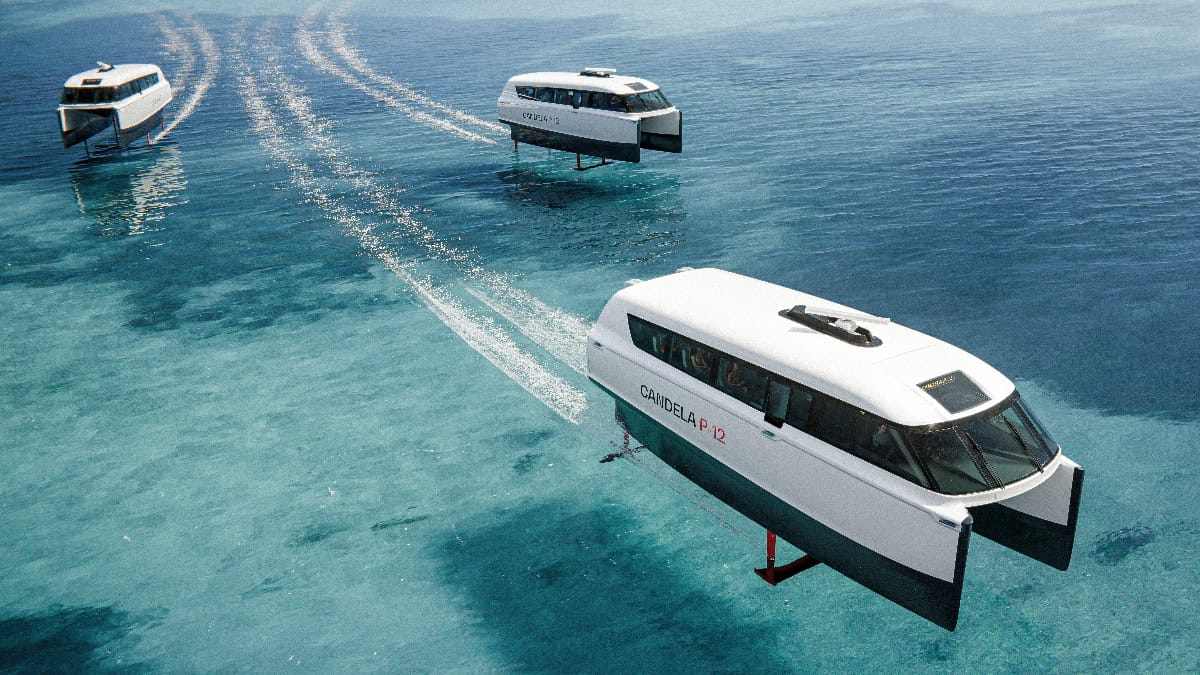
Candela P-12, the world’s first electric hydrofoil ferry, will service the planned water network in NEOM, the gigantic, sustainable development taking shape in Northwest Saudi Arabia. NEOM has procured an initial batch of 8 of the foiling, electric shuttle ferries, making it the largest announced order in Candela’s history.
“The P-12 is designed to create zero-emission water transport systems which have significant improvements over traditional water commuting” says Gustav Hasselskog, CEO and founder of Candela.
“Unlike legacy systems with large, slow, and energy-inefficient conventional ferries, the Candela P-12 is a smaller and faster unit, allowing much more frequent departures and quicker journeys for passengers. All daily necessities and services will be just a short boat commute away.”
Candela P-12 was launched last year and is set to debut in Stockholm’s public transport during fall 2024.
Flying above the waves on computer-guided underwater wings, hydrofoils, the P-12 uses 80% less energy than conventional ferry, allowing it to combine long range and high speed for the first time in an electric vessel. With a speed of 25 knots and more than 2 hours of endurance, the Candela P-12 holds the distinction of being the fastest and longest-range electric passenger ferry to date.
The hydrofoils also unlock a new level of comfort. Passengers will fly smoothly over the Red Sea, as the P-12’s digital flight control system balances the ferry 100 times per second by adjusting the hydrofoils’ angle of attack, keeping it stable even in winds and waves.
As fuel usage rather than the manufacturing phase makes up the bulk of a ferry environmental impact, energy efficiency is crucial to curb emissions. Since Candela’s foiling vessels use 80% less energy than a conventional ferry of the same size, a life cycle analysis performed by the KTH Royal Institute of Technology in Stockholm concluded that a P-12 will emit 97.5% less CO2 during its lifetime compared to a conventional diesel vessel of the same size.

The Candela P-12 seats between 20 and 30 people depending on configuration.
The electric Candela C-POD motors, located in pods underwater, are exceptionally silent and create minimal disturbance for marine wildlife. When flying, the P-12 creates only a negligible wake, allowing for quicker journeys where conventional ferries are speed-restricted due to their massive and damaging wakes.
“We’re extremely proud to provide a vessel system designed with both passengers and the environment in mind. Short waiting times, quick connections, and a very enjoyable experience without taxing the environment with wakes, emissions, and noise will revolutionize how we travel on water,” said Gustav Hasselskog of Candela.
The first batch of 8 vessels will be delivered to NEOM, in 2025 and early 2026.