


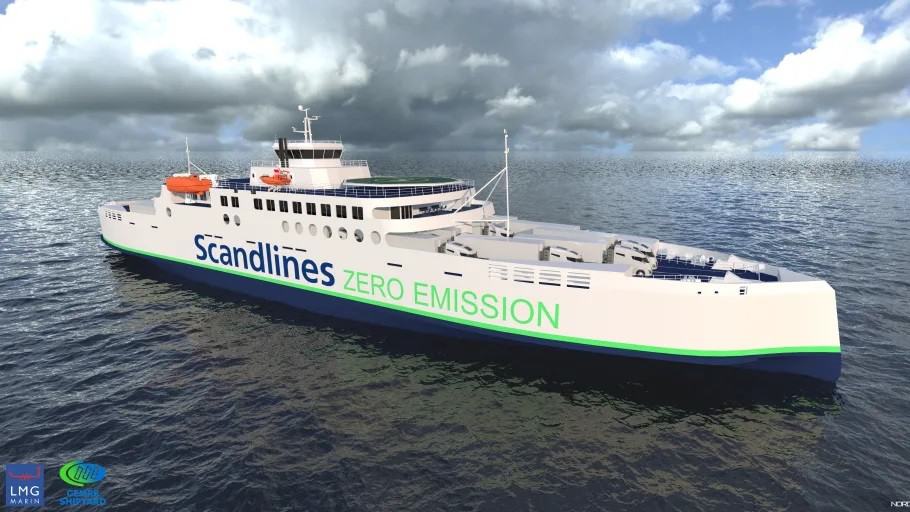
Scandlines has entered into a contract with the Turkish shipyard Cemre to build an emission-free freight ferry for the Rødby-Puttgarden route. The ferry will be deployed in 2024 and will launch the next generation of ships on the route.
The ship has a capacity of 66 freight units, which increases the current capacity by 23 percent.
With a crossing time of one hour, the ferry is emission-free. It can also function as a hybrid ferry, as is already known from the Scandlines routes between Denmark and Germany. As a hybrid ferry, the crossing time is 45 minutes. The ferry can thus also be used as a reserve ferry if one of the four double-tender ferries that currently serve the Rødby-Puttgarden route is at the shipyard.
As is known from the ferries at Gedser-Rostock, it will be possible to transport trucks on both the upper and lower decks. This means that bearing 3 in Rødby and bearing 1 in Puttgarden must be rebuilt so that trucks can also be loaded on the upper wagon deck. At the same time, a new area for trucks will be established in the terminal in Puttgarden.
Scandlines thus replaces the two oldest ships in the fleet, M / F Holger Danske and M / F Crown Prince Frederik.
“With the increased capacity, we will be able to meet the increasing needs of freight customers. In 2021 alone, the number of freight units has increased by 12 percent, ”says Scandlines’ CEO Carsten Nørland.
With an emission-free ferry, Scandlines is taking a big step on the green journey. The ferry will initially leave exclusively in Rødby. Already in 2019, Scandlines invested in a 50 kV / 25 MW power cable to Færgevej in Rødbyhavn. This cable is now extended to the ferry berths, where a transformer and charging station will be installed. In the long term, the plan is also to be able to charge in Puttgarden when a good solution has been found for the purchase of green energy.
The ship’s modular structure makes it possible to later adapt the ship so that it can also include passenger cars. Scandlines thus achieves maximum flexibility, both in terms of future technology and needs.
“Scandlines has long focused on the entire area of sustainability. The hybrid system was a quantum leap in green ferry operations. Not only does Scandlines have the world’s largest fleet of hybrid ferries, the system is also copied worldwide and has been a huge success. Now we are ready to take the next big step and deploy the first emission-free ferry. The next generation is thus ready to take over at Rødby-Puttgarden, ”says Vagn Sørensen, Chairman of the Board of Scandlines.
“NABU absolutely welcomes the fact that Scandlines is taking another big step towards emission-free ferry operations. The company not only significantly reduces CO 2 emissions and proves that even larger ships can sail completely without emissions of greenhouse gases and air pollutants already today, but “We are happy and grateful for this courageous step,” said Sönke Diesener, a shipping expert from the German environmental organization NABU.
Data for emission-free Scandlines freight ferry to the route Rødby-Puttgarden:
Length: 147.4 meters
Width: 25.4 meters
Design draft: 5.30 meters
Load capacity: 66 freight units (approximately 1,200 track meters)
Maximum number of passengers: 140
Service speed: 18 knots