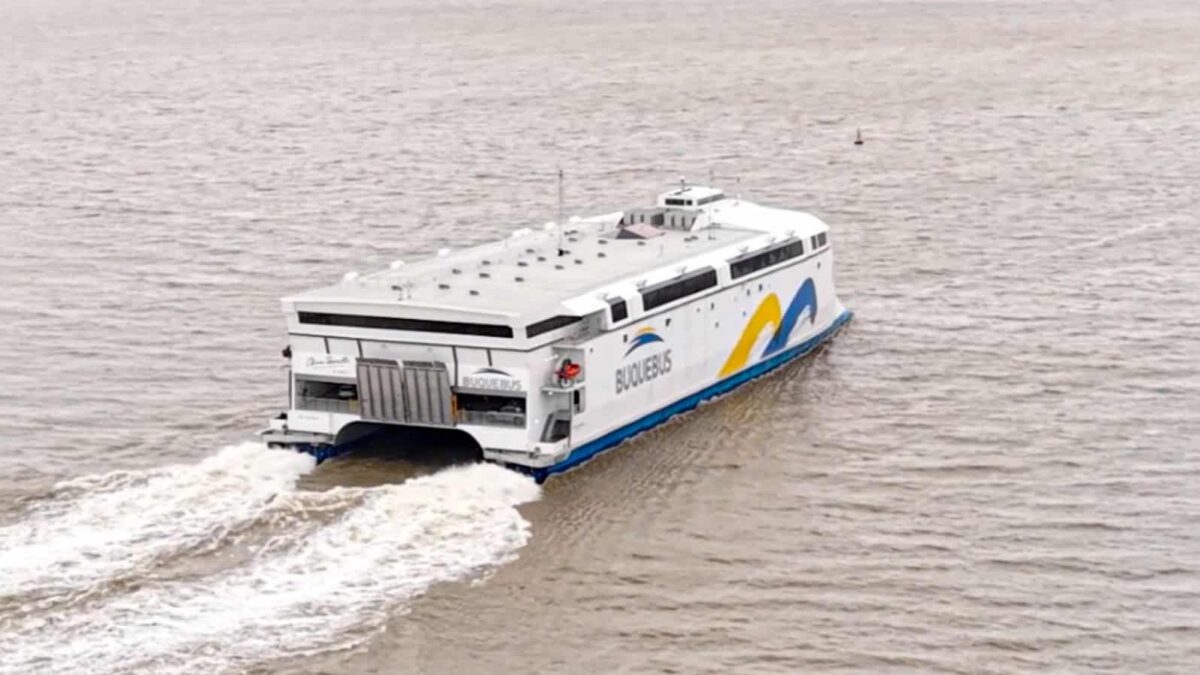
Built for Buquebus to connect Argentina and Uruguay, the China Zorrilla, the world’s largest battery-electric ferry, marks a major milestone in large-scale marine electrification following its maiden commercial voyage
The world’s largest battery-electric ferry has officially entered commercial passenger service, in South America, marking a major milestone for maritime electrification and zero-emission vessel operations. Built by Incat Tasmania for long-standing customer Buquebus, the 130-metre China Zorrilla has completed its maiden commercial voyage between Buenos Aires, Argentina, and Colonia, Uruguay, across the River Plate.
Powered entirely by batteries, the vessel is the largest electric ship ever constructed and has been designed to carry up to 2,100 passengers and 225 vehicles. The commencement of service represents the culmination of years of design, engineering, innovation and construction, bringing to life one of the most ambitious and technically complex projects ever undertaken by the Tasmanian shipbuilder.
The vessel’s entry into service followed an official launch ceremony in Buenos Aires on 21 October, attended by Incat Managing Director Craig Clifford, representatives of Buquebus and maritime authorities from Argentina and Uruguay. The occasion celebrated a landmark achievement in electric shipping and the longstanding partnership between Incat and Buquebus.
Incat Chairman Robert Clifford said the vessel’s entry into service was one of the proudest moments in the company’s history. “This is a truly historic day for Incat, for Tasmania and for the global maritime industry. For years, hundreds of talented people at our Hobart shipyard have worked tirelessly to bring this extraordinary vessel to life. We’ve overcome enormous technical challenges, pushed the boundaries of what was thought possible and built something the world has never seen before.”
“To now see this ship carrying passengers in commercial service, powered entirely by batteries, is an incredible achievement and a moment of enormous pride for everyone who has been part of the journey. This ship proves that large, high-capacity commercial vessels can operate on electric power, and that passengers can enjoy a completely different experience in the process, without the traditional diesel-engine noise, vibration or exhaust emissions.”
Incat Managing Director Craig Clifford, who was aboard China Zorrilla for her maiden commercial voyage, said experiencing the vessel in operation was a remarkable moment. “To be here in South America and travel aboard this vessel with passengers for the first time is something very special. “After watching this ship take shape over so many years in Hobart, to now see her doing exactly what she was designed and built to do is incredibly rewarding.”
“What really stands out is the passenger experience. When you’re aboard a vessel of this size, you naturally expect to hear and feel the machinery working beneath you. On Hull 096, that familiar engine noise and vibration simply aren’t there. “It’s one thing to talk about what electric shipping can deliver, but it’s another thing entirely to experience it firsthand. I think passengers are going to be genuinely surprised by just how different this vessel feels.”
The vessel features more than 250 tonnes of batteries and an energy storage system exceeding 40 megawatt-hours, powering eight electrically driven waterjets. It also features an expansive passenger interior, including a duty-free retail area of approximately 2,300 square metres.
With construction also underway at its Hobart shipyard on three 129-metre battery-electric ferries for Danish operator Molslinjen and two 78-metre hybrid-electric vessels, Incat is continuing to push the boundaries of sustainable shipbuilding and shape the next generation of high-speed ferry travel.