


SCHOTTEL is providing propulsion systems along with a specialised control concept for the barges and tugs supporting Mineral Resources Onslow Iron project. All seven barges and two of the project’s seven tugs are newbuilds under construction at COSCO Shipping Heavy Industry facilities in Zhoushan and Guangdong, China. Five barges are already in service at the Port of Ashburton in Western Australia, and the remaining units are slated for delivery in 2026. The two tugs are also expected to be delivered in 2026.
“MinRes commenced discussions with SCHOTTEL early in the design stage of the project”, says Jeff Weber, Executive General Manager at MinRes Marine. “The combination of SCHOTTEL thrusters and SCHOTTEL PropControl for the Azimuthing Stern Drive tugs has been fundamental to the success of the transhipping operation.”
“The Onslow Iron project presented exceptional operational challenges that required tailor-made propulsion and control solutions,” emphasizes Tobias Oser, Sales Director Merchant at SCHOTTEL. “Together with MinRes, a reliable setup was developed that not only meets the specific operational demands of the Onslow Iron project but also sets high standards for flexibility in transhipping operations.”
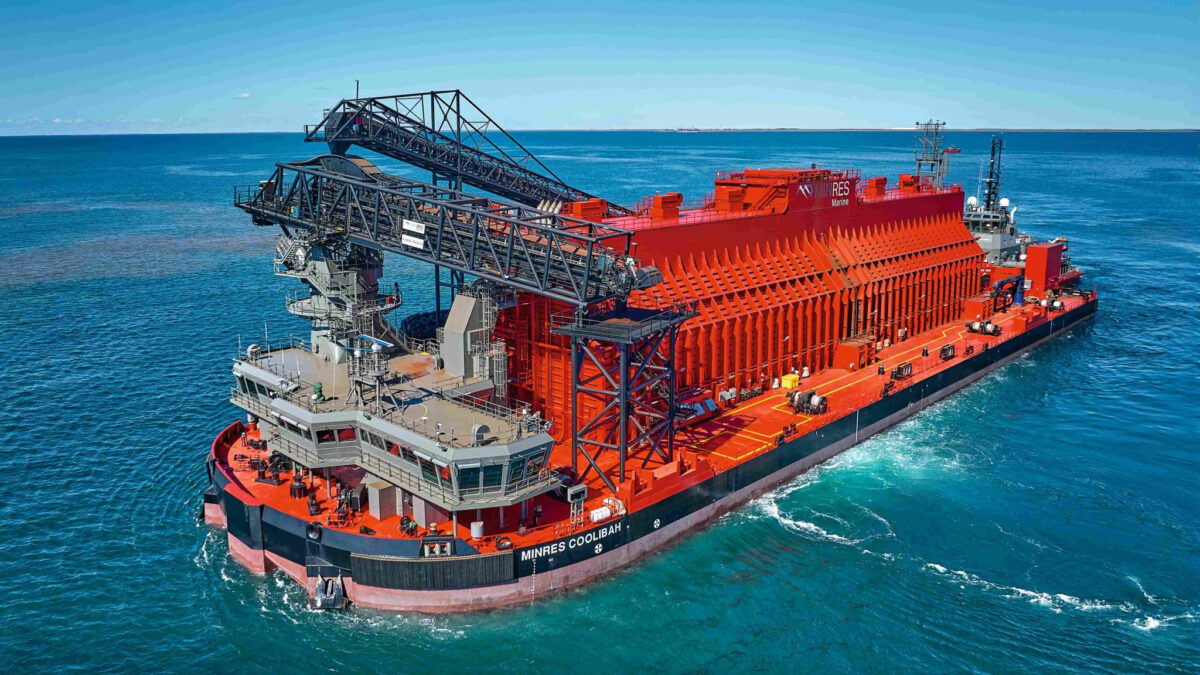
The vessels transport iron ore from the port to Capesize bulk carriers anchored 40 kilometres offshore. To achieve the minimal draught required for loading the 20,000-ton barges at the port, each ship is powered by two SCHOTTEL PumpJets type SPJ 320. The modern shallow-water propulsion unit provides full thrust in all directions, even at minimum immersion depths.
For enhanced manoeuvrability, the 123-metre-long and 36-metre-wide barges are linked to the tugs via an articulated tug and barge arrangement (ATB) – forming a transhipper. The two newbuild tugs will each be equipped with two SCHOTTEL RudderPropellers type SRP 610 and one TransverseThruster type STT 1. This propulsion package delivers high power and exceptional positioning accuracy, enabling optimal handling of the barges in the port and during loading of the bulk carriers. The remaining five tugs, including three with SCHOTTEL RudderPropellers, are existing vessels specially converted for their new operation purpose.
Due to limited visibility from the lower-height tugs when pushing the barges, steering is managed from the wheelhouse of the barges. SCHOTTEL developed a control concept in close collaboration with MinRes to address this challenge. The innovative system allows any tug – even those without SCHOTTEL propulsion – to be flexibly connected to any barge, ensuring uninterrupted operations during downtimes or maintenance of a tug. A logic system detects which tug is linked to the barge and automatically activates only the relevant functions on the control panel based on the thruster configuration of the respective vessel.
About the Onslow Iron project
The Onslow Iron project is unlocking billions of tonnes of previously stranded iron ore deposits in the West Pilbara region of Western Australia. The project recently reached nameplate capacity, just over two years after breaking ground at the Ken’s Bore mine site 150km inland of Onslow. The project uses an innovative supply chain from pit to port: After being crushed in unique modular crushers, iron ore is transported on a private dedicated haul road to the Port of Ashburton, where a closed conveyor system loads the ore onto the transhippers. These shallow draft vessels ferry the ore to awaiting ocean going vessels anchored offshore – eliminating the need for a deep water port and significantly reducing the environmental impact of the operation.