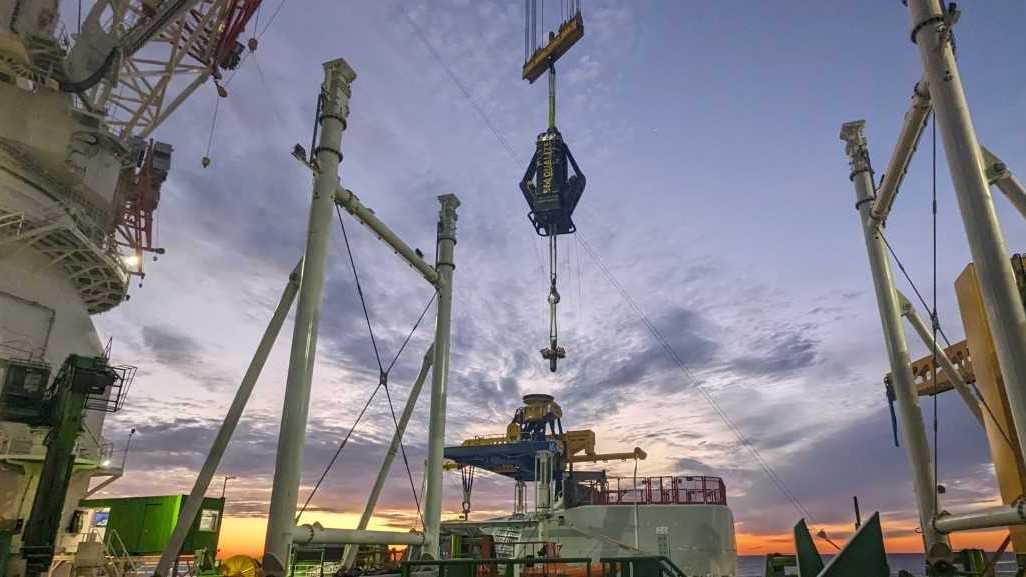
Dutch heave compensation specialist Seaqualize executed the world’s first offshore transfer lifts of wind turbine components from a heaving supply vessel. Their newly developed offshore lifting device, the Heave Chief 1100 is deployed by DEME Offshore US. Together with the feeder barge solution developed by DEME Offshore US with partners Barge Master, Foss Maritime and Seaqualize, and the operators and equipment from GE Renewables, this technology will ensure that the Halliade X 13 MW turbines can be installed year round, to form the first commercial scale wind farm installation project in the USA, Vineyard Wind.
Heave compensation
Over the last years, many have spoken about how to execute safe and continuous feeder barge operations: the supply of wind turbine components on a heaving supply vessel to a jacked up installation crane vessel, out in the open Atlantic Ocean preferably year round. Now, it’s finally been done. The team of DEME Offshore, GE Renewables, Barge Master, Foss Maritime, Seaqualize and many other US partners both on- and offshore, have transferred and installed the first turbines, and are working closely together to get the other turbines out in the water.
Seaqualize is responsible for executing the fast lift from the barge to the installation vessel, while compensating for heave motions. Never before have such delicate but heavy lifts been done, under safe compensation, and with full active heave control. It now needs to be done hundreds of times more in the upcoming months, to make sure the team can keep installing wind turbines all year round, even in adverse weather conditions.
The operation
DEME Offshore, the market leader in offshore wind installations, is the first contractor embarking on such an operation, by transporting and installing wind turbine generators for the Vineyard Wind 1 project. Each turbine will be transported in separate components from the supply harbor to DEME’s installation vessel Sea Installer.
The project, lead by Avangrid Inc. and CIP, located off the coast of Massachusetts, is a significant step towards reducing carbon emissions and meeting clean energy goals by delivering clean energy to 400.000 homes, while offering increasing opportunities for U.S. companies to join, build expertise, add jobs and grow into this market.
Inline Balanced Heave Compensators up to 1100 mT
Seaqualize develops and operates inline Balanced Heave Compensators, a next generation lifting tool specifically designed for heavy lift, in-air active load control. Their newest HC1100, is capable of compensating and fast lifting 1100 mT, required to balance turbine components of the 15MW generation. Normally such lifts would require extremely flat seas, as re-hits with the heaving barge deck, or shock loads to the lifting crane would cause serious damage. Over the first set of lifts made so far, the HC1100 has shown it can seriously increase the workability of such operations: lifting can continue while the machine continues to fully compensate heave motions up to 3,5m and the first lifts showed it can fast-lift full loads at speeds of over 70cm/s (42 m/min). For the tall tower sections of up to 70m high, two separate systems by Barge Master further compensate pitch and roll motions.
The HC1100 allows for flexibility in the planning of the operation. Weather conditions can impact the timing and order of the lifting sequence. For offshore crews, it is helpful to have a machine on board that is ready within minutes, and can easily switch between varying loads, or types of operation while remaining in the crane hook: besides fast-lifting turbine components, the HC1100 is also used to carefully place back delicate component frames to the supply vessel for the return trip, required for the next load out. This requires the machine to actively follow the motions of that barge vessel and thus greatly reducing set down speeds.
How is this different from Oil and Gas operations?
Managing Director Gjalt Lindeboom says: “Some will say: ’Haven’t we done floating lifts for years already in the Oil & Gas industry? The answer is ‘yes’, but not at this scale, frequency and with such delicate, standard components. In Oil & Gas, it is not uncommon to wait several days or even weeks to execute one single safe floating transfer lift of, for example, a heavy platform top side, or vessel module. It only has to be done once and that is the project. Furthermore, the component is usually engineered and fabricated to withstand any undesired transport, lifting or installation loads, simply by adding protective steel.”
Both are not possible in the extremely cost-driven and competitive Offshore Wind Sector. For example: the Vineyard Wind project requires more than 800 lifts, with loads ranging anywhere between 10 and 1,000mT, all in the quickest succession possible. Windfarms already planned for the upcoming years are sometimes even almost twice as large. Every couple of hours of waiting per lift for the right conditions is immediately a huge delay for having first power coming from the wind farm. Plus, these components have to be lifted exactly as they are mass produced and designed. Those designs have a 30yr lifetime of generating electricity at sea in mind, not the bumpy transfer lifts.
Second project will start this month
Lindeboom: “We are very proud of these first successful fast-lifts and the contract and cooperation with DEME. In addition, the second Seaqualize Heave Chief – the HC750 – is about to start operations this month, on another wind farm installation project ramping up in the US. We are currently planning the production of additional machines to support projects in 2024 up to 2026. Combined with the first successful results from Vineyard Wind, this cements Balanced Heave Compensation as the way to go for safe and efficient offshore feeder lifts. Floating offshore heavy lifting has many complex problems. For now, it’s been shown that ‘heave compensation’ is not one of them… anymore!”