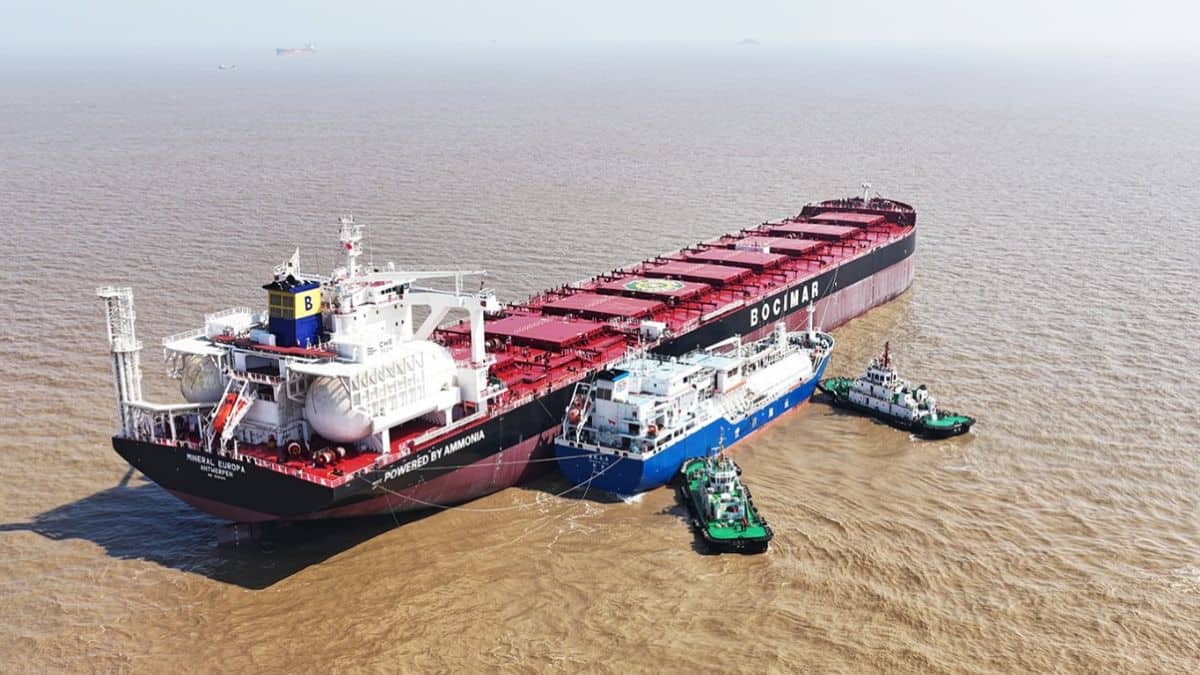
Shenghang Yongle transfers 1,000 tonnes of green ammonia to CMB.TECH’s ammonia-powered Mineral Europa at Zhoushan anchorage, China
A liquefied gas carrier originally designed by FKAB Marine Design has completed what Jiangsu Andefu Energy Development describes as the world’s first commercial ship-to-ship bunkering operation using green ammonia.
On 13 October 2026, Shenghang Yongle transferred 1,000 tonnes of green ammonia to Mineral Europa, an ammonia-powered vessel owned by Belgian maritime group CMB.TECH, at the Zhoushan anchorage in Zhejiang Province, China.
The operation represents a milestone in the development of green ammonia as an alternative marine fuel, demonstrating the safe transfer of the fuel between vessels for use in commercial shipping.
Ammonia is expected to play an important role in shipping’s transition away from fossil fuels, particularly in deep-sea segments where direct electrification is not practical. When produced using renewable energy, ammonia offers a pathway towards marine transportation without CO₂ emissions from the fuel itself.
Ammonia-powered ships, however, require more than new engines and fuel systems. They depend on safe and reliable infrastructure capable of transporting, storing and delivering the fuel where it is needed. The first commercial bunkering by Shenghang Yongle is therefore an important step towards making green ammonia available as a marine fuel at scale.
FKAB developed the original L21 vessel design as a flexible semi-refrigerated and semi-pressurised liquefied gas carrier. When the vessel was selected for conversion into an ammonia bunker vessel, FKAB continued its involvement by preparing the technical drawing documentation together with cargo-handling specialist Gloryholder.
“The completed bunkering operation is an important proof point for ammonia as a marine fuel. It shows how a flexible vessel platform, supported by the right engineering and safety systems, can become part of the infrastructure needed for shipping’s transition away from fossil fuels. We are proud that an FKAB-designed vessel has helped bring commercial ship-to-ship green ammonia bunkering into operational reality,” says Peter Hermansson, Managing Director of FKAB Marine Design.
Jiangsu Andefu Energy Development led the conversion and certification process in close cooperation with China Classification Society. FKAB and Gloryholder prepared the technical drawing documentation required for the conversion.
The conversion included modifications to the bunkering system, development of operating procedures, risk assessments, and the establishment of safety and emergency-response arrangements. Particular attention was given to ammonia toxicity, material compatibility, low-temperature operation, leak detection and risk control during bunkering.
Shenghang Yongle completed its conversion in August 2026 and received the first class certificate for liquid ammonia bunkering issued by a classification society. The bunkering operation in Zhoushan has now demonstrated the vessel’s capability in practice.
The green ammonia was transported by Shenghang Yongle from Andefu’s tank farm in Nanjing to Zhoushan. Its delivery to Mineral Europa completed a supply chain spanning production, land transportation, storage, waterborne transportation and ship-to-ship bunkering.
The project provides a practical example of how an existing ammonia-capable gas carrier can be developed into an operational bunkering asset.