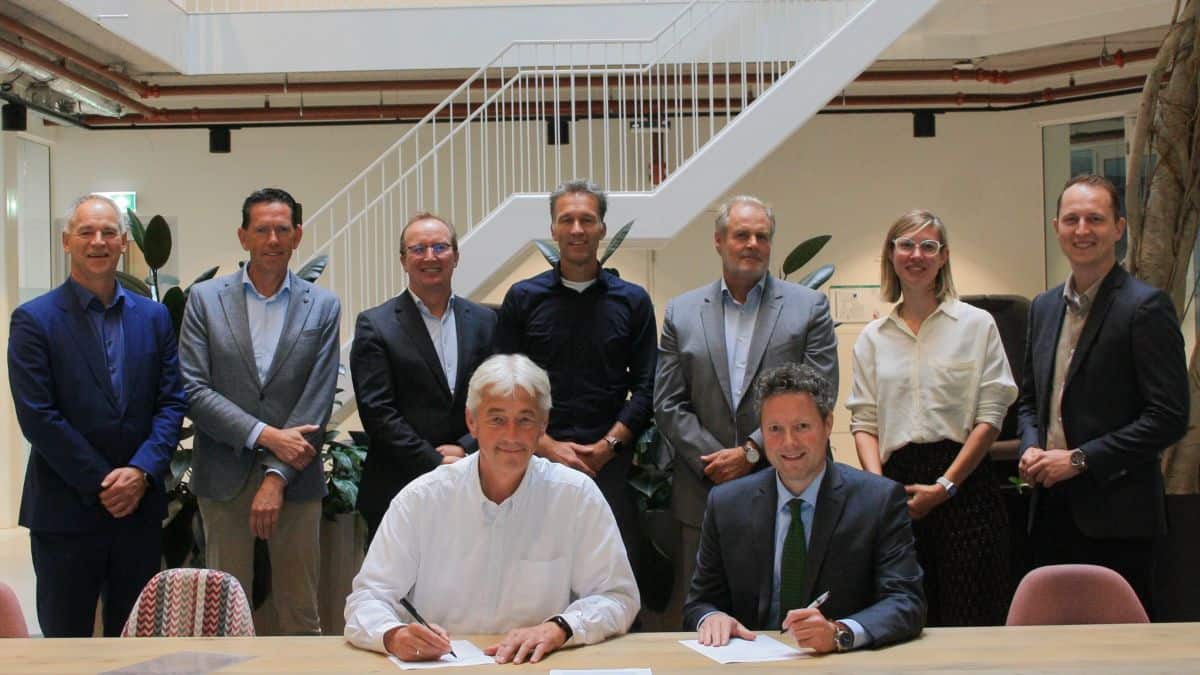
The STREAM project was officially signed on September 4th, marking the launch of an innovative collaboration between four leading Dutch shipyards — Neptune Marine, Royal IHC, Gebroeders Kooiman Shipyard, and Mercury Yacht Construction. Supported by a €2 million grant, the project aims to develop a self-learning, automated panel production line that combines smart welding robots and collaborative robots to advance efficiency and innovation in shipbuilding.
STREAM—short for Systematic Development of Efficient Shipbuilding Processes for Dutch Shipyards through Robotics & Automation—aims to make shipbuilding processes more efficient, cost-effective, and competitive on the global stage. The initiative represents a significant step toward the modernization and future-proofing of Dutch shipyards.
The project focuses on the development of an automated panel line, utilizing smart welding machines, welding robots, and welding robots. A panel line is the part of the shipyard where steel plates are welded into larger ship components, such as the hull. To minimize risks during the research phase and make the system future-proof, a self-learning control system is being developed that learns from deviations during production and adjusts the process immediately.
The technology for the welding robots and collaborative robots is being developed by SAM XL, while RoboHouse is collaborating with shipyard employees to investigate how the smart welding robot can be implemented in practice. Both partners are part of a field lab at Delft University of Technology. The ambition, as the first project within the Shipyard of the Future Drechtsteden-Rotterdam project, is for this region to become one of the most important European regions for complex shipbuilding by 2030. The region already accounts for 43% of Dutch maritime activity and has a combined annual turnover of over €5 billion.
To maintain Dutch shipyards’ competitiveness and stay ahead of the curve, modern shipyards based on new digitalization and robotization technologies are needed. This reduces costs and addresses labor shortages. One of the biggest challenges in shipbuilding is the welding process. Although automation is being extensively experimented with worldwide, standard welding robots prove virtually impossible to implement in Dutch shipyards due to the wide variation in ship designs and working conditions. Therefore, STREAM is specifically working on technology that can handle this variation.
Neptune’s panel production line serves as a development environment for the welding robots. Uniquely, this isn’t done in separate steps, but within a single, integrated production line, controlled by a self-learning system linked to the ship’s 3D design model. This allows for early detection of errors, process adjustments, and feedback of information to the design – a direct improvement over the current, largely manual working method. Knowledge is being accumulated and shared in a yet-to-be-established testing ground: the Living Lab.
Benjamin Grefkens, CEO of Neptune & project leader for STREAM: ” Progress comes from sharing knowledge and working together to build the Shipyard of the Future. With STREAM, our shipyards, Deal, and the field labs RoboHouse and Delft University of Technology are joining forces to elevate shipbuilding – a national treasure – to a higher level. By innovating together, we are taking the step from traditional craftsmanship to high-tech craftsmanship.”
STREAM is the first concrete implementation project within the regional Werf van de Toekomst Drechtsteden-Rotterdam partnership . This partnership contributes to the national flagship project Werf van de Toekomst , of which NMT-IRO is the project owner and is part of the National Sector Agenda for the Maritime Manufacturing Industry.
The Drechtsteden/Rotterdam region is forming a powerful coalition of nine shipyards: Damen Shipyards Group, Neptune Marine, Royal IHC, Gebroeders Kooiman Shipyard, Den Breejen Shipyard, Slob Shipyard, Oceanco Group (of which Mercury Yacht Construction is a part), Holland Shipyards Group, and De Haas Shipyards. These shipyards are being supported throughout the process by the regional development company InnovationQuarter and the regional network organization Deal.
This project also involved collaboration with the subsidy agencies IMC/UniResearch. InnovationQuarter and Deal established the partnership, contributed to connecting the shipyards, and utilized the appropriate subsidy scheme.
STREAM is supported by a €2 million grant from the Ministry of Economic Affairs and Climate Policy, via the Netherlands Enterprise Agency (RVO.nl). This grant is part of the Maritime Innovation Projects Subsidy Scheme.
The total project value is €4.5 million.