


Italian survey contractor Subsea Fenix expands uncrewed survey and inspection capabilities with new battery-hybrid USV, marking HydroSurv’s first delivery into Italy
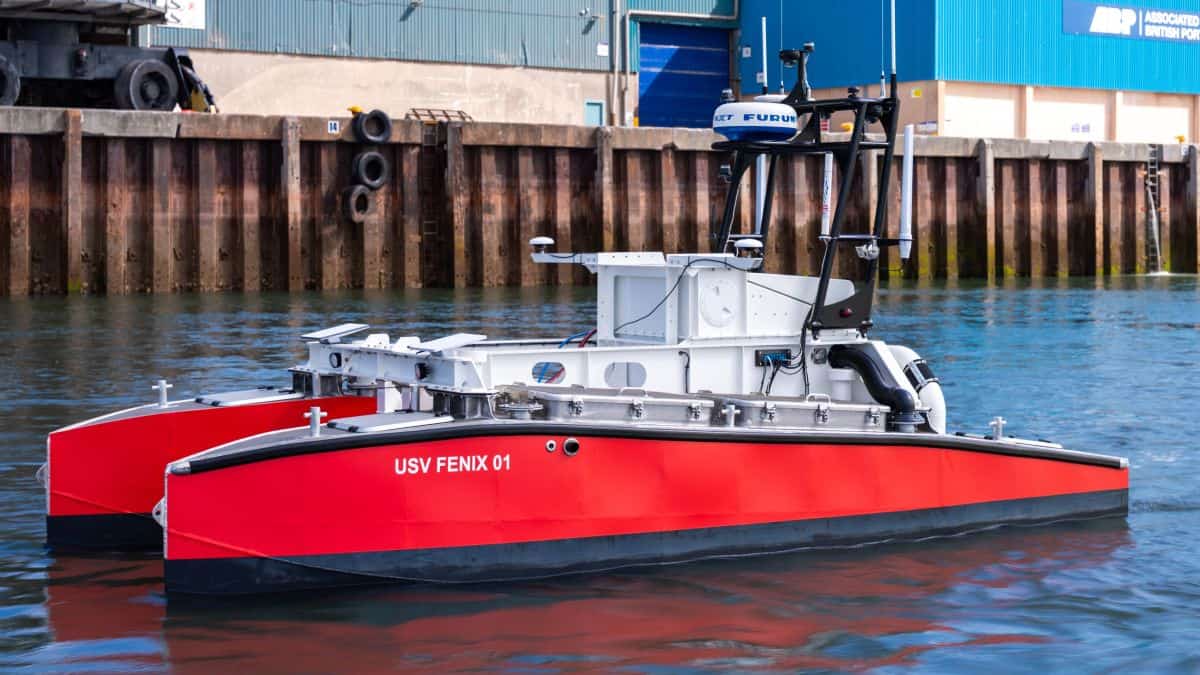
Italian survey contractor Subsea Fenix has taken delivery of a 5.7-metre battery-hybrid Uncrewed Surface Vessel (USV) from HydroSurv, combining hydrographic survey and ROV inspection capabilities in a single platform.
The delivery marks HydroSurv’s first vessel delivery into the Italian market and represents the next stage in Subsea Fenix’s development of uncrewed marine operations.
Subsea Fenix began deploying USVs in 2018, initially using compact 1.5-metre platforms for survey operations. Since then, the company has completed more than 400 survey projects using these smaller vessels, building extensive experience in remote and uncrewed operations across inshore, nearshore and offshore environments.
Stefano Mancini, Owner & CEO of Subsea Fenix, said: “REAV was the natural choice for us, thanks to its versatile and fully customisable platform. HydroSurv proved to be focused on customer needs and helped us select the right system for our needs. Their offer ranges from very small, coastal-type vessels to large, long-range vessels, with full flexibility in terms of the sensors to be integrated. We were impressed by their “can-do” approach and the possibility to integrate any tool or sensor on the platform, but what really convinced us to move with HydroSurv was the flexible approach to convert the REAV-60 from pure survey platform (including multibeam, side scan sonar and sub-bottom profiling) to a fully remote ROV platform, integrating our Saab Seaeye Falcon on the vessel”
“HydroSurv has been fully committed in developing our ideas, overcoming engineering challenges and integrating on such a compact platform all that we wanted. This is the first system of a series we plan to add to our fleet, and HydroSurv will be, amongst other partners, part of our journey.”
The result is USV Fenix 01, a 5.7m battery-hybrid USV based on HydroSurv’s REAV-60 platform and developed specifically around Subsea Fenix’s ambition to bring its experience with smaller USVs, ROV’s and vessels into a significantly more capable operational class USVs. The initial target is to provide a platform capable of working with less constraint, especially in the nearshore area where the conventional assets struggle to perform such activities. At the heart of the vessel is a modular payload architecture that allows the platform to be configured for different mission profiles.
Considering the complexity of the whole project, the development of the REAV-60 for Subsea Fenix is split in three separate phases, in accordance with the definition of USV/Tool categories as indicated by the IMCA M257 guidelines. Today the platform has achieved Category A (vessel mounted equipment, including MBES, SBP, USBL, etc.) and has been fully-commissioned during the month of August. In parallel, the integration of the launch and recovery system for towed system is in progress and will allow the REAV-60 to achieve Category B USV status (deployment for side scan and magnetometer) by year end. The last phase of the project is well underway and planned for completion by Q1 2027 which will allow the platform to achieve Category C (active deployment, ROV/ROTV) status.
For hydrographic and geophysical survey operations, USV Fenix 01 can accommodate a survey skid incorporating a Teledyne T51 multibeam echosounder, Innomar sub-bottom profiler, EdgeTech towed side-scan sonar (4125i), USBL (Sonardyne MiniRanger 2) and much more depending on clients’ requests and project needs. For subsea inspection, the same vessel can be configured with an ROV skid incorporating a SAAB Seaeye Falcon inspection-class ROV, and thanks to the specific LARS system, it allows the use of pipe tracker HydroPACT 660. This enables Subsea Fenix to deploy a common uncrewed platform with dynamic positioning capabilities across multiple operational requirements, rather than maintaining separate vessel solutions for survey and subsea inspection.
The vessel has been developed around the demanding station-keeping and manoeuvrability requirements associated with these operations. The 2026 updates to the REAV-60 incorporate twin steerable 11kW Rim Drive Technology pod drives, providing enhanced low-speed control and station-keeping performance. A significantly upgraded power architecture incorporates separate AC and DC generation systems alongside a 48V electrical architecture shared with HydroSurv’s REAV-47 platform family.
For Subsea Fenix, these developments are particularly important when deploying an ROV from a USV platform. USV Fenix 01 is designed to support ROV operations to water depths of up to 300m, while also providing the precise manoeuvring and line-keeping performance required for repeatable hydrographic survey operations.
The combination of capabilities is intended to give Subsea Fenix and its customers greater flexibility in how it mobilises for offshore work – with one platform able to undertake multiple classes of mission depending on the installed payload.
For HydroSurv, USV Fenix 01 represents one of its most ambitious USV deliveries to date and demonstrates the potential of its larger REAV platforms to support specialist offshore applications beyond conventional survey operations.
“During initial discussions with Stefano and Ivan in December last year, it was clear that Subsea Fenix already had clear ideas of what they needed to achieve with the USV, but also with the ambition to challenge us on what a REAV-60 could be capable of. USV Fenix 01 is a good example of what can happen when the platform design authority and the operator work together at the outset rather than treating an uncrewed vessel as a fixed product.” said David Hull, Founder & CEO, HydroSurv.
The commercial proposition is central to Subsea Fenix’s investment. By replacing elements of conventional vessel mobilisation with an uncrewed platform, the company expects to reduce operational cost, mobilisation time and personnel requirements while increasing the flexibility with which survey and inspection assets can be deployed,