




Throughout 2022, the UK Hydrographic Office (UKHO) has been working closely with the Port of London Authority (PLA) and SEAiq Pilot to further our understanding of the S-102 Bathymetric Surface product specification; part of the new IHO’s new S-100 data standards that will underpin the next generation of marine navigation solutions.
S-102 holds out the exciting possibility of providing mariners with greater granularity of bathymetric information than the current generation of ENCs, supporting safer and more efficient navigation. In order to move forward with confidence and to ensure that S-102 meets the needs of users, it is important to put it to the test in a real-world setting.
We worked with the PLA and SEAiq Pilot to conduct the UK’s first S-102 sea trials, enabling us to test our assumptions and validate the performance of the S-102 standard.
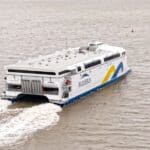
The trial was conducted with the support of the M.V. Laureline, a CLdN vessel inward bound from Rotterdam to the Port of London. The UKHO team had the invaluable opportunity to join the port pilot onboard the M.V. Laureline as it completed its transit from the pilot station to the berth.
By trialling the S-102 standard under real-life conditions and alongside mariners and pilots, we can see exactly how the product will be deployed, listen to the experience of those who will rely on it, and learn the lessons that we can apply to the ongoing development of this and other S-100 generation products.
Armed with these insights, we can ensure that S-102 not only optimises the safety benefits, but also the economic benefits for ports and ship operators, who will be able to plan and execute their port arrivals and departures with far greater precision.












 has been working closely with the Port of London Authority (PLA) and SEAiq Pilot to further our understanding of the S-102 Bathymetric Surface product specification; part of the new IHO’s new S-100 data standards that will underpin the next generation of marine navigation solutions. S-102 holds out the exciting possibility of providing mariners with greater granularity of bathymetric information than the current generation of ENCs, supporting safer and more efficient navigation. In order to move forward with confidence and to ensure that S-102 meets the needs of users, it is important to put it to the test in a real-world setting. We worked with the PLA and SEAiq Pilot to conduct the UK’s first S-102 sea trials, enabling us to test our assumptions and validate the performance of the S-102 standard. The trial was conducted with the support of the M.V. Laureline, a CLdN vessel inward bound from Rotterdam to the Port of London. The UKHO team had the invaluable opportunity to join the port pilot onboard the M.V. Laureline as it completed its transit from the pilot station to the berth. By trialling the S-102 standard under real-life conditions and alongside mariners and pilots, we can see exactly how the product will be deployed, listen to the experience of those who will rely on it, and learn the lessons that we can apply to the ongoing development of this and other S-100 generation products. Armed with these insights, we can ensure that S-102 not only optimises the safety benefits, but also the economic benefits for ports and ship operators, who will be able to plan and execute their port arrivals and departures with far greater precision.)