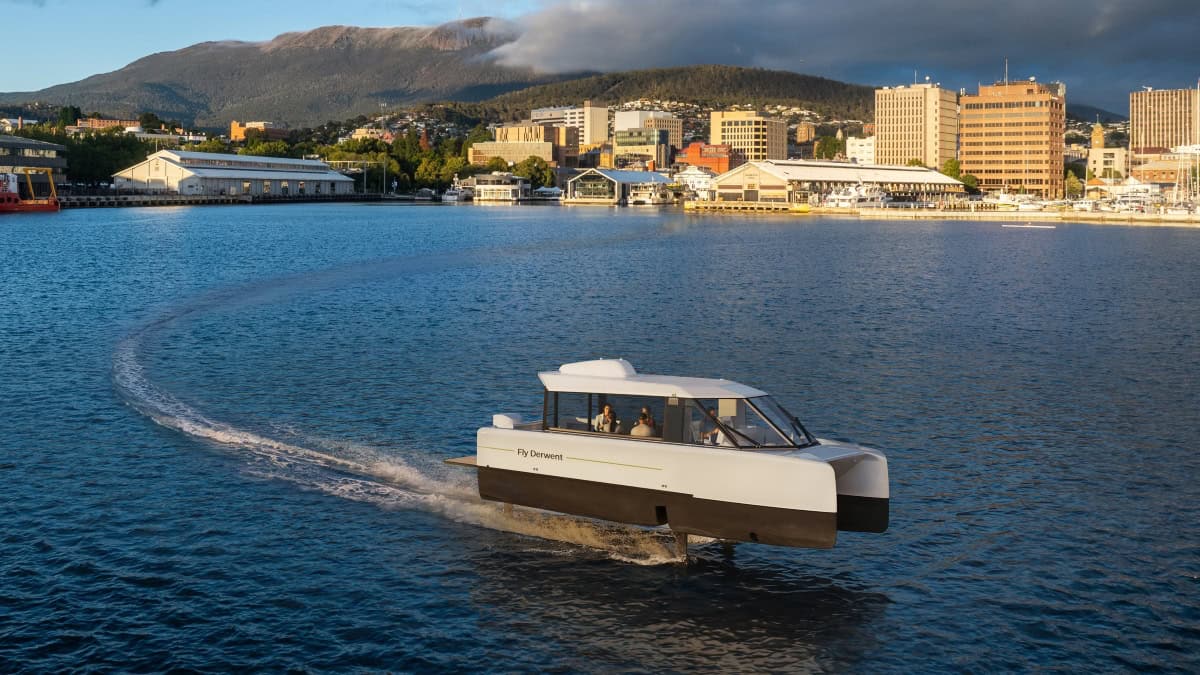
Fly Derwent to deploy VS–9 foiling ferries on Hobart’s Derwent River, with plans to scale to VS–12 fleet
New Zealand marine technology innovator Vessev announce the launch of a new zero-emissions ferry network in Hobart, Australia—positioning urban waterways as a scalable and efficient transport solution. The network will be operated by Fly Derwent, a newly established clean-energy transport venture, with services set to run along the Derwent River.
The operation will utilise Vessev’s VS–9 foiling ferries initially, with plans to scale up to a larger VS–12 fleet as demand grows. The phased rollout is expected to deliver a high-frequency water transit system while avoiding the need for significant shoreside infrastructure investment.
Powered by Tasmania’s world-leading renewable grid, which runs on approximately 100% renewable electricity including hydrogeneration, wind and solar, the service is designed to deliver one of the lowest-emissions commuter transport models globally.
Vessev’s VS–9 and VS–12 are premium electric hydrofoiling vessels built to commercial standards for public transportation. The 29-foot VS–9 carries 10 passengers with a range of up to 50 nautical miles at a cruising speed of 25 knots, while the 37-foot VS–12 can carry up to 30 passengers.
The vessels are powered by a fully integrated foil system inspired by America’s Cup designs that automatically adjust to conditions up to 100 times per second, delivering a smooth, stable ride with virtually no wake. This opens new waterways for transport around the world, minimizing environmental impact in sensitive environments, like those found along the Derwent River.
Fly Derwent Principal Cameron McCulloch, an engineer with nearly 20 years of executive experience in the clean energy sector, said the network will be more like a metro system than a traditional ferry service. “From the very beginning this project has been about demonstrating how Tasmania’s renewable energy focus can translate into sustainable transport leadership. This technology unlocks affordable, river-based commuter and tourism transport in Hobart without the need for large-scale infrastructure changes. That’s what excites me most – not just the boats themselves, but everything they make possible in Hobart and beyond.”
“Our work with Cameron and Fly Derwent not only brings efficient and reliable transportation to Hobart, it also represents the beginning of a much larger shift in how cities think about on-the-water mobility,” said Eric Laakmann, co-founder and CEO of Vessev. “Electric hydrofoiling enables an entirely new category of water transport. Tasmania is a standout environment to demonstrate this at scale, where abundant renewable energy and strong local ambition come together to show what zero-emissions marine transport can look like.”
The VS–9 is expected to arrive in Hobart in early 2027, with the VS–12 fleet to follow.