




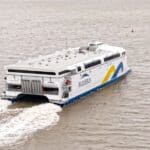
The technology group Wärtsilä will supply the engines, waterjets, and fuel storage and supply system for a new high speed catamaran ferry. The vessel is being built at the Incat yard in Tasmania, Australia on behalf of Argentinian ferry operator, Buquebus. Having an overall length of 130 metres, a width of 32 metres and the capacity to carry 2,100 passengers and 226 cars, it will be the largest aluminium catamaran ever built by Incat. The order with Wärtsilä was placed in July 2022.
The vessel will operate between Argentina and Uruguay with Wärtsilä’s 31 dual-fuel engine technology using primarily LNG fuel produced at Buquebus own LNG plant. The vessel will also incorporate shaft e-motors powered via the main engine gearboxes taking further advantage of Wärtsilä’s LNG technology. With LNG, the minimised emissions of CO2, nitrous oxides (NOx), sulphur oxides (SOx) and particulate matter will make the ferry Tier III compliant and able to operate in emission control areas (ECAs).
“We have selected Wärtsilä waterjets many times in the past, and have always been extremely satisfied with their performance,” says Tim Burnell, Incat’s CEO. “This though is the first time we will include Wärtsilä engines, and we are excited about the potential they provide. This will be the world’s largest and greenest vessel of its type, and we are very happy to be working with Wärtsilä to make the project a huge success.”
“This is indeed an exciting project. Our latest WXJ generation axial flow waterjets reduce the installation footprint on average by approximately 25 percent, compared to non-axial flow jet designs. They also give a higher power-to-weight ratio, and come with an advanced Propulsion Control System. Combining this with our highly efficient, fuel flexible engines, means that it is a truly future-proof investment,” adds Mikko Mannerkorpi, General Manager, Sales, Wärtsilä Marine Power.
The full scope of supply comprises four Wärtsilä 31DF dual-fuel engines, four Wärtsilä WXJ1500SR waterjets, and two Wärtsilä LNGPac fuel storage, supply and propulsion control systems. The equipment will be delivered to the yard commencing in mid-2023.
Wärtsilä has a long-standing relationship with Incat, a global leader in aluminium ship technology. Incat provides optimal lightweight ship solutions for ferry operators, special service providers, and military applications.
The Wärtsilä 31DF is the most powerful engine in its class. It has a power output ranging from 4.6 to 9.6 MW at 720 and 750 rpm. It features exceptional fuel economy while maintaining outstanding performance across the entire operating range. The higher output per cylinder provides a compact footprint and a cost-efficient installation. The diesel version of the Wärtsilä 31 has been recognised by Guinness World Records as the world’s most efficient 4-stroke diesel engine.











, sulphur oxides (SOx) and particulate matter will make the ferry Tier III compliant and able to operate in emission control areas (ECAs).)