


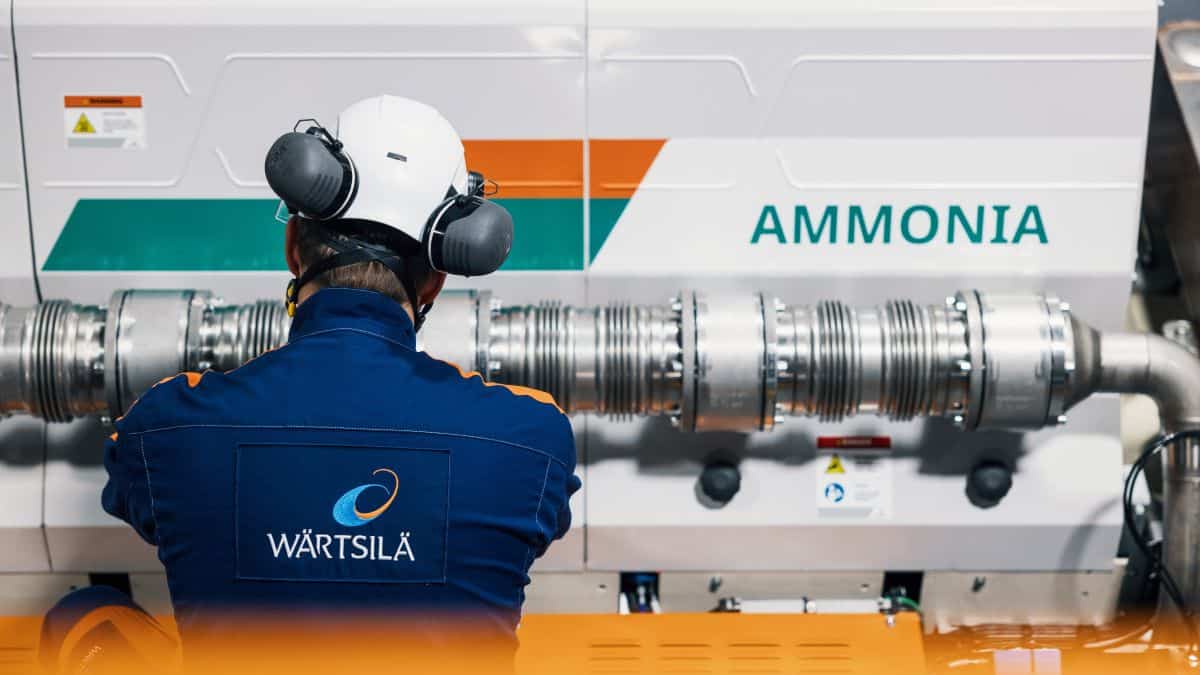
Wärtsilä has achieved a landmark advancement in sustainable marine propulsion with its 4-stroke ammonia-fueled engine, demonstrating up to 90% greenhouse gas (GHG) emission reductions compared to conventional diesel engines. This milestone follows extensive testing and optimization of the engine’s performance since its commercial introduction in November 2023
The latest results, assessed against the FuelEU Maritime reference and measured on both a Well-to-Wake and Tank-to-Wake basis, show that a 95 percent ammonia energy share now achieves up to a 90 percent reduction in greenhouse gas emissions compared to equivalent diesel engines. This represents a further 18 percent improvement on the solution’s emissions performance.
The Wärtsilä 25 ammonia engine, which is available as part of the Wärtsilä 25 engine platform, was developed based on the company’s vast safety and operational experience gained from low pressure dual-fuel (DF) engines running on LNG. The recent tests have shown ammonia to be a suitable fuel for the low-pressure Otto cycle concept which is the design that Wärtsilä has utilised for its ammonia engine solution. The decision to opt for a low-pressure Otto cycle concept was based on several factors, including safety, efficiency and overall potential for greenhouse gas reduction, among several other parameters. Comprehensive tests conducted on different engine sizes have shown that the efficiency of the low-pressure Otto cycle concept is consistent with, and equal to, that of dual-fuel LNG engines. Ammonia is also highly knock resistant, with robust combustion capabilities across a wide range of engine settings.
“With decarbonisation front and centre of our company strategy, we have continued to enhance the capabilities of our ammonia engine solution – adding even more safety features and further improving its performance. This is in line with our commitment to “continuous improvement”, whereby we continue to develop, test and enhance new and current technologies and solutions which will support the industry with making meaningful marine emission reduction. For our ammonia engine we opted for the low-pressure Otto cycle concept as we are confident this will deliver the best levels of safety, efficiency and reliability for our customers,” comments Stefan Nysjö, Vice President of Power Supply, Wärtsilä Marine.
The enhancements made to the Wärtsilä 25 4-Stroke ammonia engine’s performance benefit the entire ammonia solution, which comprises of an AmmoniaPac fuel gas supply system, the Wärtsilä Ammonia Release Mitigation System (WARMS), and the Wärtsilä NOx Reducer (NOR) for optimal exhaust after-treatment. Safety, efficiency and reliability are central to the solution design, maximised by a highly sophisticated automation system and maintenance agreement to ensure safe and efficient onboard operations. Alongside future engine orders, the enhanced performance will also be integrated into engines already contracted as first deliveries are due to take place from 2026 onwards.
Ammonia has emerged as a promising alternative fuel as the shipping industry looks for more sustainable fuel options. With global regulations having set a clear destination for shipping – net zero emissions by mid-century – ammonia will play a significant role in enabling the shipping industry to reduce its emissions. A report from Wärtsilä highlights the role that sustainable fuels will play in achieving this target which is set by the International Maritime Organization (IMO). According to the report, existing decarbonisation solutions, such as fuel efficiency measures, can cut shipping emissions by up to 27 percent; however, sustainable fuels, such as ammonia, will be a critical step in eliminating the remaining 73 percent.