


Upgraded Ro-Ro pair strengthens Sea-Cargo’s short-sea shipping operations
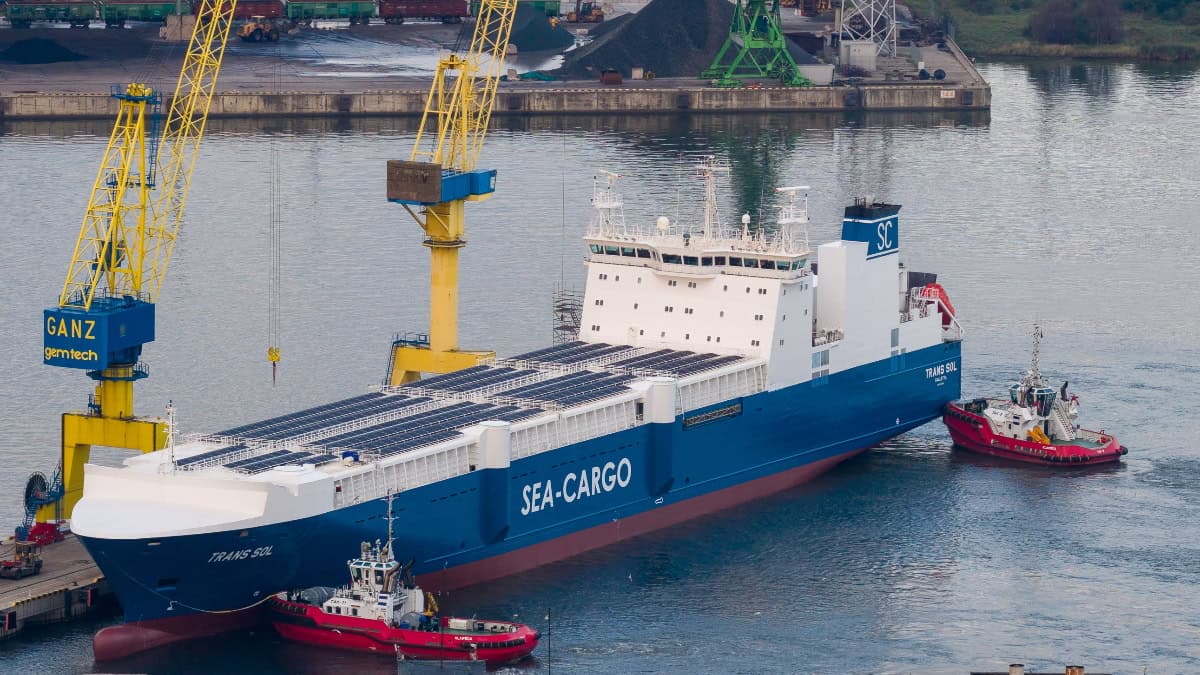
Following the official unveiling of Sea-Cargo’s Ro-Ro vessel Trans Sol during One Ocean Week in Bergen, attention has turned to the extensive upgrade and modernisation of the sister vessels Trans Hav and Trans Sol.
Both vessels underwent a full-scale modernisation programme in Q2–Q3 2025 at Western Shiprepair, part of BLRT Repair Yards within the BLRT Grupp network, aimed at enhancing efficiency, extending service life, and aligning the vessels with evolving environmental and operational requirements
Commissioned by Sea-Cargo AS and under the supervision of Stödig Ship Management, the project saw both vessels undergo a comprehensive upgrade programme aimed at extending service life while significantly improving efficiency and environmental performance.
The scope of work included the installation of optimised propellers to enhance propulsion efficiency, a NOₓ scrubber technology to meet stricter emission standards, and hybrid-ready battery and frequency converter systems. In addition, the vessels were equipped with a fully integrated Power Management System and feature approximately 1,600 m² of solar panels for onboard renewable energy generation.
On the structural side, both ships were fitted with a new covered weather deck manufactured by Western Baltija Shipbuilding, a company within BLRT Grupp, thereby increasing cargo capacity and improving protection for sensitive loads. Provisions were also incorporated for future wind-assisted propulsion- the installation of rotor sail foundations to support next-generation emissions-reduction solutions.
Project engineering was delivered by Western Baltic Engineering, another company within the Group, in cooperation with Marine Design & Consulting and Naval Tec.
According to Simonas Keliotis, Commercial Director at Western Shiprepair, the projects stood out for their scale and technical complexity: “These were far from routine retrofits. A wide range of major upgrades was carried out in parallel, including the installation of scrubbers, deckhouse construction, the manufacturing and installation of a covered weather deck, and rotor sail foundations. In addition, executing the modernisation of two sister vessels within the same programme required detailed preparation and close collaboration across multiple teams.”
Keliotis adds that the scope of steelwork alone reached approximately 1,500 tonnes- a significant volume for retrofit projects of this type. “Managing such extensive work while maintaining the planned schedule required precise planning, careful sequencing of activities, and continuous alignment between all stakeholders.”
The result is two upgraded, efficient Ro-Ro vessels now supporting Sea-Cargo AS’s ambitious goal of reducing fossil fuel consumption by up to 50 per cent, and we are proud to have contributed to a project that combines operational performance with a clear sustainability ambition.