


Boreal electric foiling fleet to enhance commuter connectivity across Norway’s fjord-dependent transport network
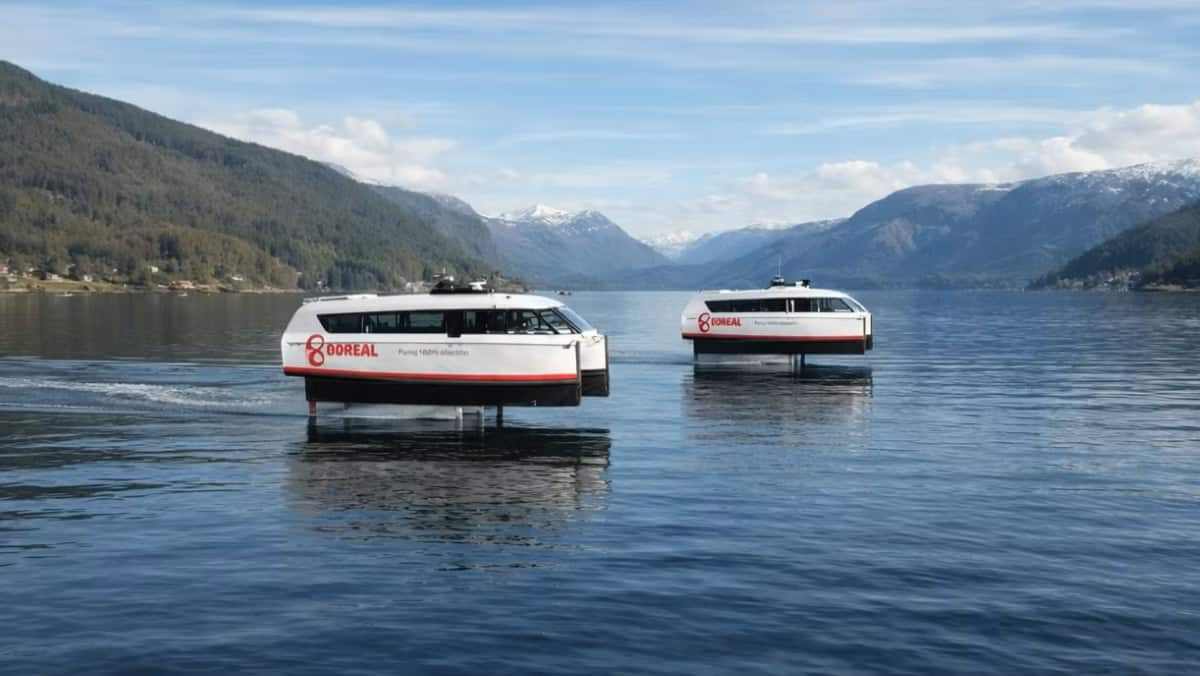
Norwegian transport operator Boreal AS has placed a landmark order for 20 Candela P-12 electric foiling vessels from Sweden-based Candela Technology, creating what is set to become the world’s largest electric vessel fleet.
Designed for high-speed, low-wake operations, the foiling craft promise a quieter, more efficient alternative for coastal mobility. The vessels will play a key role in enhancing commuter links along Norway’s fjord network, where maritime transport remains a vital part of everyday travel.
Norway is already the world’s most electrified car market, with around 99% of new car sales fully electric. Electrifying high-speed passenger vessels—“hurtigbåtar,” the backbone of rural transport—has, however, remained challenging, as conventional e-ferries lack the range and speed to replace the diesel-powered fast ferries connecting communities across the country’s deep fjords and more than 100,000 kilometres of coastline.
The Candela P-12, however, solves this: it combines a cruising speed of 25 knots with a range of around 40 nautical miles, enabling electric operation on routes previously only served by diesel vessels. Furthermore, the large fleet of 20 vessels will provide more frequent departures, and speed up travel times.
“Candela P-12 is the only electric passenger vessel that combines longer range with high speed without requiring extensive charging infrastructure. Our investment will enable new high-speed routes both in cities and in rural areas,” says Nikolai Knudsmoen Utheim, CEO at Boreal. “Norway has already led the electrification of maritime transport. With this fleet, Boreal wants to take the next step—accelerating zero-emission high-speed travel along the Norwegian coast and helping bring electric vessels to new markets beyond Norway.”
The P-12’s unique performance comes from computer-controlled hydrofoils—wings mounted beneath the hull—that lift the vessel above the water at speeds above 18 knots. By flying above the waves, drag is drastically reduced, and energy consumption drops by around 80 percent compared with conventional vessels of similar size. Already in successful use in Stockholm’s public transport, the P-12 has been hailed as a “game-changer” for transport, combining lower operational costs with low environmental impact.
Furthermore, the efficient P-12 can fully recharge in an hour using standard DC car fast chargers, avoiding the expensive megawatt-scale charging systems required by conventional electric ferries. The capability was recently demonstrated during a voyage between Sweden and Norway, when the P-12 completed the longest electric sea journey to date, recharging along the route using a mobile battery system transported by a Ford F-150 Lightning pickup.
The first two P-12 vessels will be delivered in 2027 and are planned to enter service on one of several potential routes currently being explored in Norway and abroad. The remaining vessels will follow in yearly batches between 2028 and 2030.
Passengers will also see a major upgrade in comfort. The vessel’s digital Flight controller reads wave conditions using sensors and adjusts the hydrofoils in real time, ensuring a smooth ride even in rough seas while keeping cabin noise extremely low.
Recent tests of the P-12 in Stockholm confirmed cabin noise levels of just 64 dB—lower than modern trains, aircraft, or ferries—making it the quietest high-speed vessel in operation.
“Tourists and commuters in Norway will enjoy better service and more frequent departures—free from seasickness, silent, and without the negative impacts of wake and emissions in the unique Norwegian fjords,” says Alexander Sifvert, Candela’s European Director.
“We’re thrilled to partner with Boreal, whose ambition and leadership are helping drive the electrification of maritime transport. This initiative shows how forward-thinking operators can accelerate the shift to zero-emission travel at sea, while reducing costs.”