Ship & Boat BuildingConversionsBoskalis Christens Rock Installation Vessel Windpiper

Boskalis Christens Rock Installation Vessel Windpiper

Following an 18-month conversion programme, Windpiper is set to strengthen Boskalis’ capabilities in subsea rock installation for offshore wind and marine infrastructure projects

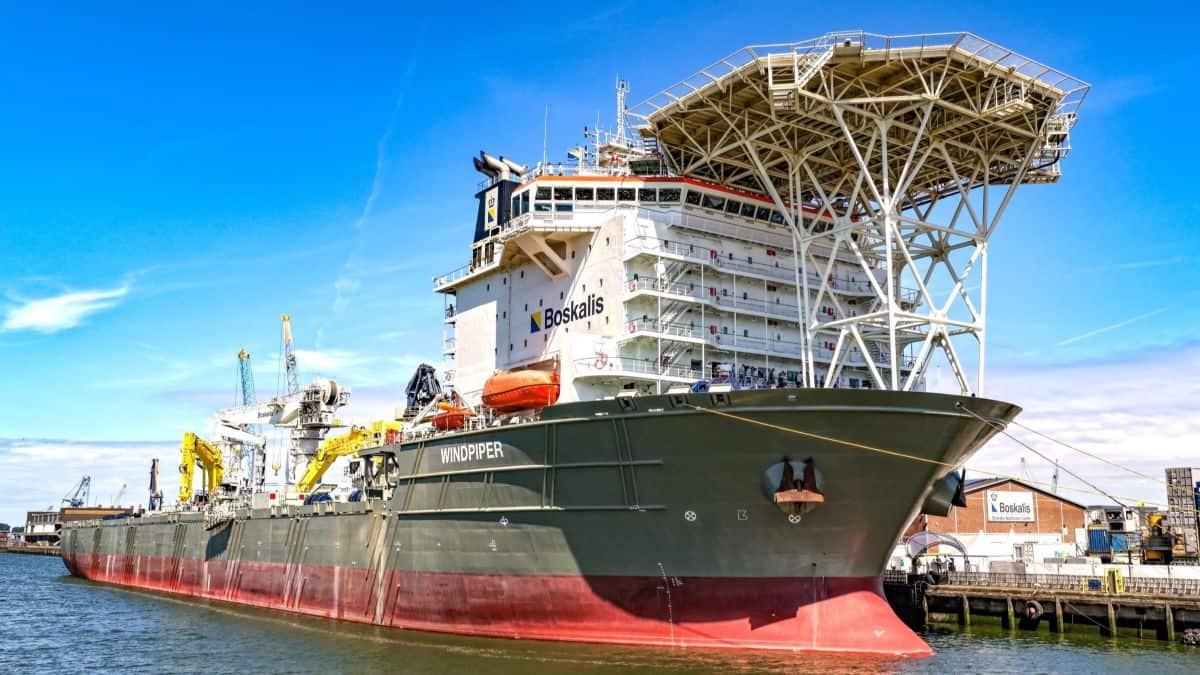
Boskalis has marked the completion of the conversion of its new offshore vessel Windpiper, which is now ready to enter service as what the company describes as the world’s largest subsea rock installation vessel.

The vessel has undergone an extensive 18-month conversion programme, transforming it into a specialist asset designed to support large-scale offshore energy and marine infrastructure projects.

Windpiper was officially christened by Ms Jones-Bos, a member of the Boskalis Supervisory Board, during a ceremony attended by company representatives and invited guests.

To celebrate the milestone, Boskalis also welcomed more than 3,000 employees and their family members on board the vessel during a special open day, marking the completion of one of the company’s most significant vessel conversion projects.

The commissioning of the 227-metre-long and 40-metre-wide Windpiper doubles Boskalis’ subsea rock installation capacity, significantly strengthening its ability to support large-scale offshore energy and marine infrastructure projects. With a cargo capacity of 45,500 tonnes distributed across two holds, the vessel is designed for projects involving long transit distances between rock loading facilities and offshore worksites, maximising efficiency and reducing the number of loading cycles.

Converted from an existing newbuild under Boskalis’ supervision, Windpiper has a total installed power of more than 31,000kW and is equipped with a moonpool-based fall pipe installation system alongside an inclined fall pipe for the accurate placement of protective rock around subsea infrastructure.


Latest News

Combining GMDSS call statistics with an industry-first maritime safety broadcast analysis, Inmarsat Maritime’s new safety data platform aims to support shipping in addressing its persistent and evolving operational risks. Deep-sea shipping is an inherently hazardous enterprise and the many operational risks faced by vessels, cargo, and crew will likely never be eliminated entirely. Nevertheless, data can play a significant role in minimising the frequency and severity of incidents at sea.

Inmarsat Maritime Safety Data Hub Highlights Global Shipping Risks

Combining GMDSS call statistics with an industry-first maritime safety broadcast analysis, Inmarsat Maritime’s new safety data platform aims to support shipping in addressing its...
Bureau Veritas Marine & Offshore has awarded an Approval in Principle (AiP) to OceanAlpha for the design of its L42B uncrewed surface vessel (USV), developed for offshore hydrographic and geophysical survey operations.

OceanAlpha Secures BV AiP for L42B Offshore Survey USV

OceanAlpha's L42B combines a modular survey payload with remote operation capabilities to support extended offshore data-gathering missions Bureau Veritas Marine & Offshore (BV) has awarded...

Damen Delivers Two Electric Patrol Vessels to Amsterdam

The latest delivery brings to six the number of Damen Patrol Vessels 1304 Electric supplied to Amsterdam since 2021 https://vimeo.com/1243208175?fl=pl&fe=sh Damen Shipyards Group has delivered two...
Kongsberg Maritime has unveiled the Arctic Hunter USV, a new class of uncrewed surface vessel designed to accelerate the deployment of hybrid naval fleets combining crewed and uncrewed assets.

Kongsberg Maritime Unveils Arctic Hunter USV

Kongsberg Maritime combines commercial shipbuilding expertise and autonomous vessel technology to support next-generation naval operations in Arctic waters Kongsberg Maritime has unveiled the Arctic Hunter...

Related news