Ship & Boat BuildingDry CargoCSL Deploys Self-Load/Unload MV CSL Flexvik for European Marine Construction

CSL Deploys Self-Load/Unload MV CSL Flexvik for European Marine Construction

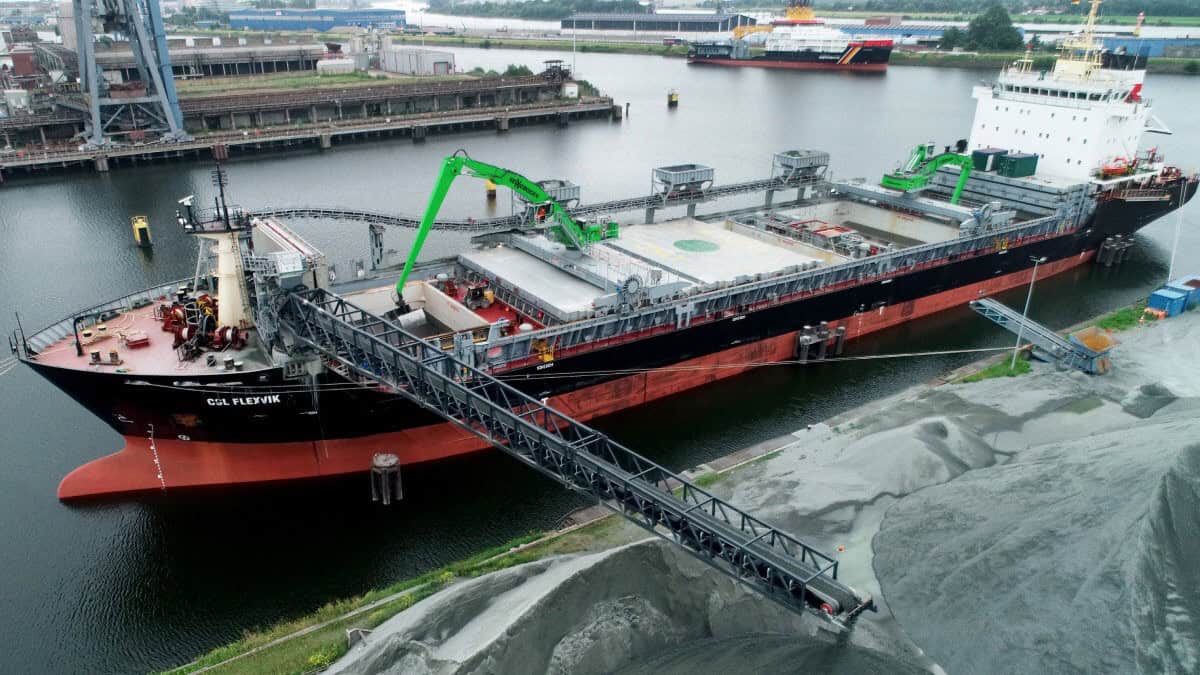
The CSL Group, a global leader in marine dry-bulk shipping, today announced the deployment of its newest vessel, the MV CSL Flexvik. This state-of-the-art, 18,003 DWT hybrid self-loading/unloading vessel has entered service to support complex marine construction projects and aggregate logistics across Europe, marking a significant enhancement to CSL’s versatile fleet.

Engineered for maximum versatility and efficiency, the CSL Flexvik is uniquely capable of handling a diverse range of cargo—from fine sand and gravel used in concrete production to large, 1-3 tonne armour rock essential for coastal protection and infrastructure projects.

Delivered on May 31, 2025, from Wulkan Shipyard in Szczecin, Poland, MV CSL Flexvik is the result of a strategic conversion from a conventional bulk carrier into a purpose-built vessel optimised for flexible, cost-effective delivery of materials for infrastructure and offshore energy projects.

Fitted with two gantry-mounted Sennebogen 870 electric excavators, MV CSL Flexvik can self-load and self-discharge with precision. Cargo can be offloaded via the conveyor belt system, which includes a 45-metre discharge boom, or directly using the onboard excavators. This means the ship can single-point discharge to a stockpile, transload materials to another vessel, and efficiently handle larger rock gradings, discharged directly using the excavators.

“CSL Flexvik brings a new level of operational flexibility to Europe’s marine construction logistics,” said Louis Martel, CSL’s President and CEO. “Its hybrid configuration, flexible rock-handling capabilities, and direct discharge options offer unmatched flexibility for project-based and industrial customers.”

Key Advantages:

  • Handles Full Range of Materials: Capable of transporting everything from sand and crushed stone to heavy rock armour.
  • Multiple Discharge Options: Offers boom discharge, directly over-side or vessel-to-vessel transhipment.
  • Supports Subsea Rock Installation Logistics: Can tranship rock to other vessels, enabling subsea rock installation vessels to remain in situ.
  • Reduces Port Time and Costs: Self-operating excavators reduce reliance on shore-based stevedores.


Latest News

LD Armateurs (LDA) and Norsepower have completed the installation of six Norsepower Rotor Sails™ aboard Spirit of Toulouse, the lead vessel in a new fleet of three low-emission roll-on/roll-off (RoRo) ships being built to support Airbus transport operations.

Six Rotor Sails Installed on Spirit of Toulouse

Six 35-metre rotor sails installed aboard Spirit of Toulouse, combining wind-assisted propulsion with methanol-capable engines to improve fuel efficiency and reduce emissions LD Armateurs and...
The German Navy's Sea Battalion will in future be deployed as land- and sea-mobile infantry in coastal waters and the coastal region. Its own tactical mobility on the water is of paramount importance. To this end, the Federal Office of Bundeswehr Equipment, Information Technology and In-Service Support (BAAINBw) concluded a contract on October 12, 2026, with the Finnish company Marine Alutech Oy Ab for the procurement of Watercat M18 AMC multi-purpose combat boats.

German Navy Selects Marine Alutech for 15 Combat Boats

Finnish shipbuilder Marine Alutech will supply 15 Watercat M18 AMC multi-purpose combat boats, alongside crew training, documentation and lifecycle support, to strengthen Germany’s coastal...
Sentiq Defence has commenced operations as an Italian integrator of autonomous and remotely operated maritime systems, bringing together technologies for defence, security and the blue economy.

Sentiq Brings Autonomous Maritime Technologies Together

Italian company Sentiq integrates USVs, underwater sonars, ROVs and aerial drones for defence, security and commercial maritime applications Sentiq Defence has commenced operations as an...
Starnav Elektra, the first hybrid platform supply vessel (PSV) designed and built in Brazil, has been delivered to ABS class, marking a milestone for the country’s offshore support vessel sector.

First Brazilian-Built Hybrid PSV Delivered to ABS Class

Built by Detroit Brasil for Starnav Serviços Marítimos, the hybrid PSV will support Petrobras offshore logistics under a long-term charter Starnav Elektra, the first hybrid...

Related news