



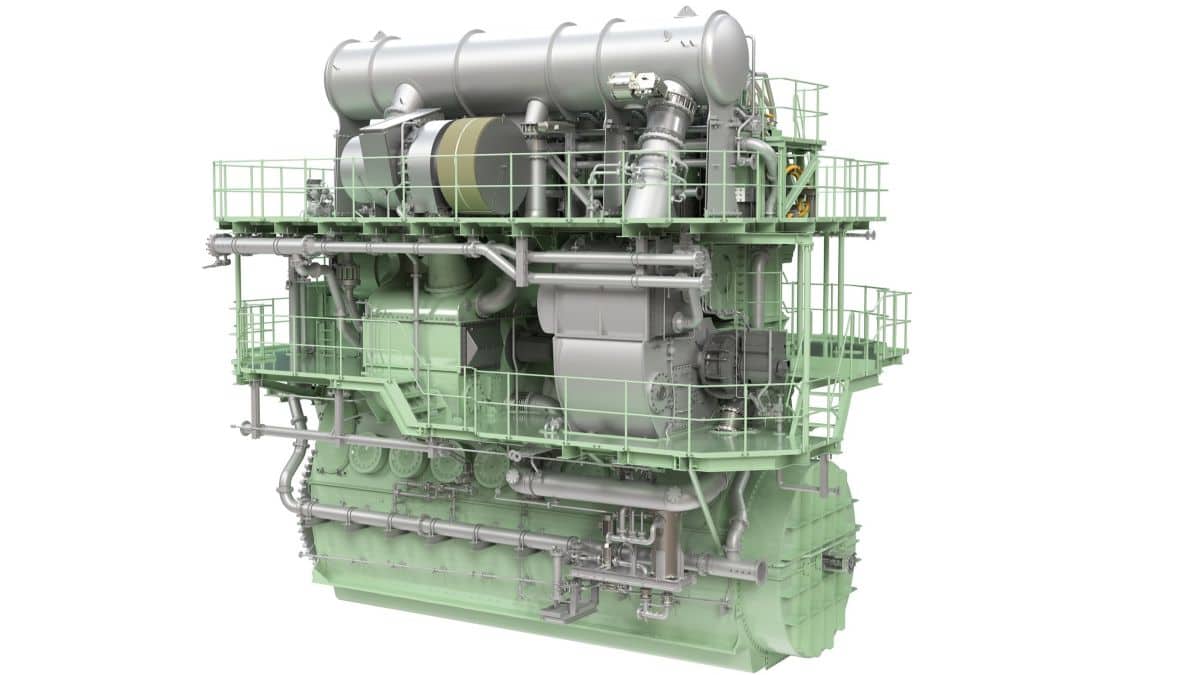
Norwegian shipowner GCC has selected four Everllence ME-GI Mk10.7 engines for a series of next-generation vehicle carriers being built at China Merchants Jinling Shipyard.
Everllence has secured the first commercial order for its latest-generation dual-fuel methane engine, marking a significant milestone for the company’s low-emission propulsion technology. Norwegian shipowner Global Car Carriers (GCC) has selected the Everllence B&W ME-GI (Gas Injection) Mk10.7 engine for a series of four new pure car and truck carriers (PCTCs) currently under construction in China.
The order comprises four 6S60ME-GI Mk10.7 engines, which will be manufactured by CSSC Engine Co., Ltd. in Qingdao. The engines will be installed aboard four 8,600 CEU vessels being built at China Merchants Jinling Shipyard in Nanjing.
Bjarne Foldager – Head of Two-Stroke Business, Everllence – said: “This new milestone marks the first commercial application of the ME‑GI engine on the Mk10.7 platform and underscores the market’s continued confidence in our dual‑fuel methane technology. The introduction of the new platform further enhances the ME‑GI’s capability, building on the continuous development and refinement of the existing technology. This first order for ME‑GI 10.7 engines also highlights the strong collaboration between owner, yard and engine builder, and reinforces Everllence’s position as a leading provider of two‑stroke, dual‑fuel propulsion solutions.”
Christian Ludwig – Vice President, Head of Global Sales & Promotion, Two-Stroke Business, Everllence – said: “The vessels will be equipped with the latest ME‑GI design, offering operational flexibility, the highest fuel efficiency, negligible methane slip and proven reliability based on the Diesel‑cycle combustion principle. The ME‑GI concept has been widely adopted across the maritime industry, with a strong orderbook and extensive in‑service experience supporting its position as a preferred dual‑fuel solution. The ME-GI platform alone has now accumulated more than 1,260 engine orders and over 33 GW of engine power.”
The new vessels represent a significant step forward for the car-carrier segment, combining large cargo capacity with future‑ready propulsion technology.
Everllence states that, by selecting the ME‑GI 10.7 platform, GCC gains:
- operational confidence from a proven dual‑fuel platform, backed by extensive in‑service experience across segments, reducing technology risk;
- lower fuel-consumption and improved earnings potential, driven by the high thermal-efficiency of the Diesel combustion cycle;
- fuel flexibility without efficiency penalty, enabling owners to optimise fuel strategy over time while maintaining consistently high performance in both fuel-oil and methane operation;
- reduced environmental footprint with near‑zero methane slip, supporting compliance strategies and minimising exposure to future methane-related regulation.
Everllence further states that the ME‑GI engine programme continues to expand across segments and applications with the introduction of the Mk10.7 generation representing the next step in its evolution. With hundreds of engines already in service and on order globally, the ME‑GI concept remains a cornerstone of Everllence’s dual‑fuel portfolio.










 Mk10.7 engine for four new pure car and truck carriers)