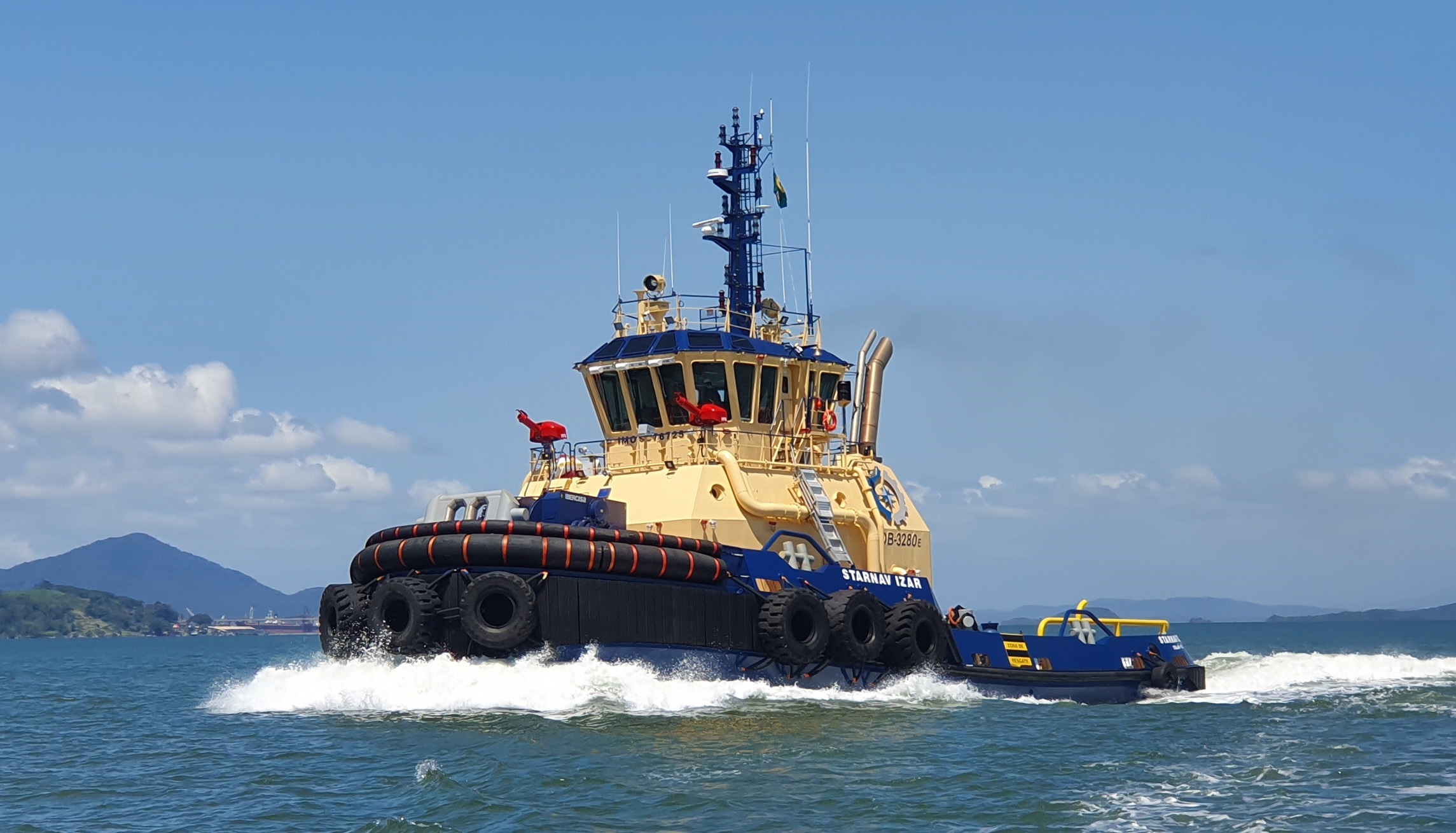
With a milestone project for South America, the Brazilian towage group Starnav is setting sails to reach the IMO 2030 goals: Starnav has contracted Detroit shipyard in Itajaí, Brazil, for equipping four newly built tugs with SCHOTTEL RudderPropellers. One of the 32 metre long and 11.6 metre wide escort tugs will feature the SCHOTTEL patented SYDRIVE-M technology right from start; the other three will be configured to be SYDRIVE-ready. As a mechanical hybrid solution without the costly complexity of common hybrid technology, SYDRIVE-M will ensure lower maintenance costs and less fuel consumption.
SCHOTTEL SYDRIVE-M will enable Starnav to offer more profitable and emission-reduced towing services in Brazilian ports. Beyond this, the towage group contributes to meeting the IMO 2030 and 2050 goals initiated by the International Maritime Organization.
Carlos Eduardo Pereira, CEO at Starnav Serviços Marítimos: “By making use of SCHOTTEL hybrid solution, we are taking the initiative to increasingly seek a clean operation. Starting now is particularly important: the vessels that are built today will be in the water for decades to come. Our focus has always been the high level of reliability in the equipment, mainly safety and environment care. With 34 vessels propelled by SCHOTTEL in our fleet, we will continue expanding our operations and benefit from a strong partner with extensive know-how in Brazil.”
Bollard pull of more than 80 tonnes
The main propulsion of each ASD tug consists of two diesel-driven SCHOTTEL RudderPropellers type SRP 490 (2,525 kW each) featuring fixed-pitch propellers with a diameter of 2.8 metres. With this thruster configuration, they will achieve more than 80 tonnes of bollard pull and a maximum speed of 12.5 knots.
The first of the four tugboats is scheduled to enter service in 2022.
Lower maintenance costs, less fuel consumption
SCHOTTEL SYDRIVE-M connects a port and starboard mounted azimuth thruster in one vessel, allowing the thrusters to be driven together by only one of the main engines. In turn, this leads to reduced operating hours of the main engines, resulting in lower maintenance costs as well as less fuel consumption and lower emissions.
The system needs no additional electronical components, which offers many advantages as demonstrated in three main operation modes: Light Operation or Free Sailing Mode, Full Thrust Operation Mode and FiFi-Mode.
New and more energy-efficient solutions
The International Maritime Organization’s (IMO) strategy on reducing greenhouse gases (GHGs) challenges all stakeholders in the maritime industry to find, develop and integrate new and more energy-efficient solutions, to meet GHG emission reduction goals for 2030 and 2050. A set of toolkits, such as the Ship Emissions Toolkit and the Port Emissions Toolkit, provide practical guidance on assessing emissions from and identifying emissions reduction opportunities for the fleet.
By investing in innovative hybrid concepts and offering greener operations, ship owners like Starnav contribute to achieve these goals.