



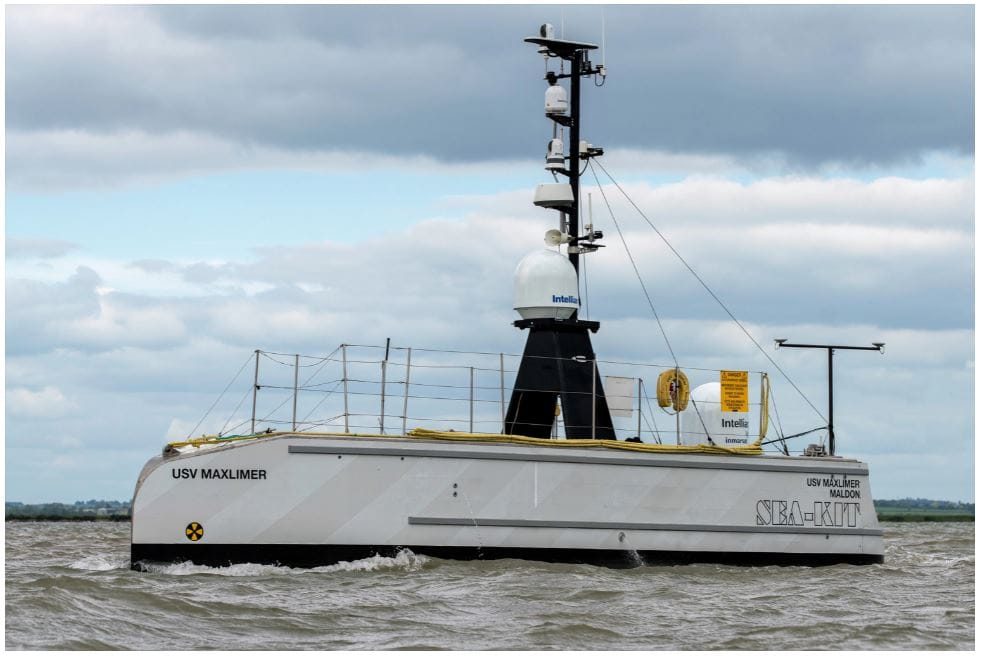
There is no “one size fits all” solution when it comes to sensors on Uncrewed Surface Vehicles (USVs). A diverse array of USVs inevitably means that sensor payloads have to be adapted to ensure their suitability for the intended application. Aiming to meet very specific user needs, SEA-KIT International, designer and builder of hi-tech USVs, has been integrating a Nortek DVL with ADCP functionality on their vehicle to obtain extended navigational capabilities in GPS-denied zones.
Nortek’s DVL is typically used below the sea surface to inform the position of autonomous or uncrewed vehicles. Instead, UK-based designer and builder of hi-tech USVs SEA-KIT chose to use a DVL on their USV while operating from the sea surface. Utilizing uncrewed platforms in operations for the offshore energy sector means that requirements for navigational redundancy and oceanographic information are becoming intertwined.
Varied requirements such as these can blur the lines of sensor specification, meaning that what might spring to mind as the most obvious choice for some is not always the best tool for the job. As part of a project running over spring and summer 2021, SEA-KIT worked with a number of sensor providers to demonstrate extended capabilities of their USVs. A crucial part of this process was technical insight from those involved to narrow down the most suitable sensors for their application.
Using a DVL from Nortek to aid safe USV vehicle operations and autonomy
Following discussions around sensor choice, Nortek and SEA-KIT decided on a DVL – a sensor typically used for subsea navigation – to enable navigation in GPS-denied zones, improving reliability of uncrewed operations.
“Addition and integration of new sensors are part of SEA-KIT’s constant focus on safe operations and our drive towards full autonomy. The DVL from Nortek has proven to be a highly capable tool which we will continue to use to help us achieve these ambitious targets,” says Ashley Skett, Operations Director at SEA-KIT.
A DVL helps robust navigation performance of USV vehicles
By interfacing Nortek’s DVL500 with an Inertial Navigation System from iXblue to provide speed over ground measurements, SEA-KIT were able to equip their 12 m USV Maxlimer with an alternative to satellite navigation. This capability is becoming increasingly important in a world where GPS signals cannot be guaranteed in all locations. Having a non-GPS-reliant navigation source ensures robust performance of vehicles in virtually all conditions, using technology that until recently has been the reserve of the subsea industry.

Following demonstrations to a number of industry operators, SEA-KIT were able to show the importance of such technologies.
“Clients agreed that redundancy of positioning is a critical USV function and a number of use cases were identified, such as operating within the 500 m zone and around wind turbines. They were impressed with the clear demonstration of the GNSS position versus the DVL position on a custom-made radar-style display,” says Skett.
“A DVL combined with an INS will help ensure that the desired autonomy can be achieved by uncrewed vessels. With the combined iXblue and Nortek solution you get peak sensor performance with great flexibility, meaning you do not need to make space for a larger single-housing system as you can configure the INS and DVL in a way that fits your vehicle’s constraints without sacrificing performance,” adds Maverick Piccininni, Regional Sales Manager at iXblue.
A cross-company collaborative approach to solving challenges for USV vehicles
Crucially, full navigation systems are a suite of sensors, each performing a specific role. Given that different components come from different manufacturers, a good working relationship between companies like Nortek and iXblue is essential when looking to provide coherent, tightly integrated navigation packages.
“The adoption of uncrewed operations has emphasized the need for sensor providers to collaborate and work closely with the integrator,” says iXblue’s Maverick Piccininni.
He stresses that adopting a truly collaborative approach to solving emerging challenges with uncrewed and autonomous systems is becoming increasingly important.
“It becomes evident with new vessels with evolving capabilities that this collaboration will encourage innovation and increased sensor performance,” he says.
Piccininni emphasizes that the close working relationship between iXblue and Nortek should inspire confidence in the sensors’ performance and reliability.
“Years of collaboration between Nortek and iXblue has led to best-in-class solutions for subsea and surface navigation that will continue to develop alongside the rapidly advancing USV market,” Piccininni adds.
Click here to find out more about subsea navigation and Nortek’s DVL.














