


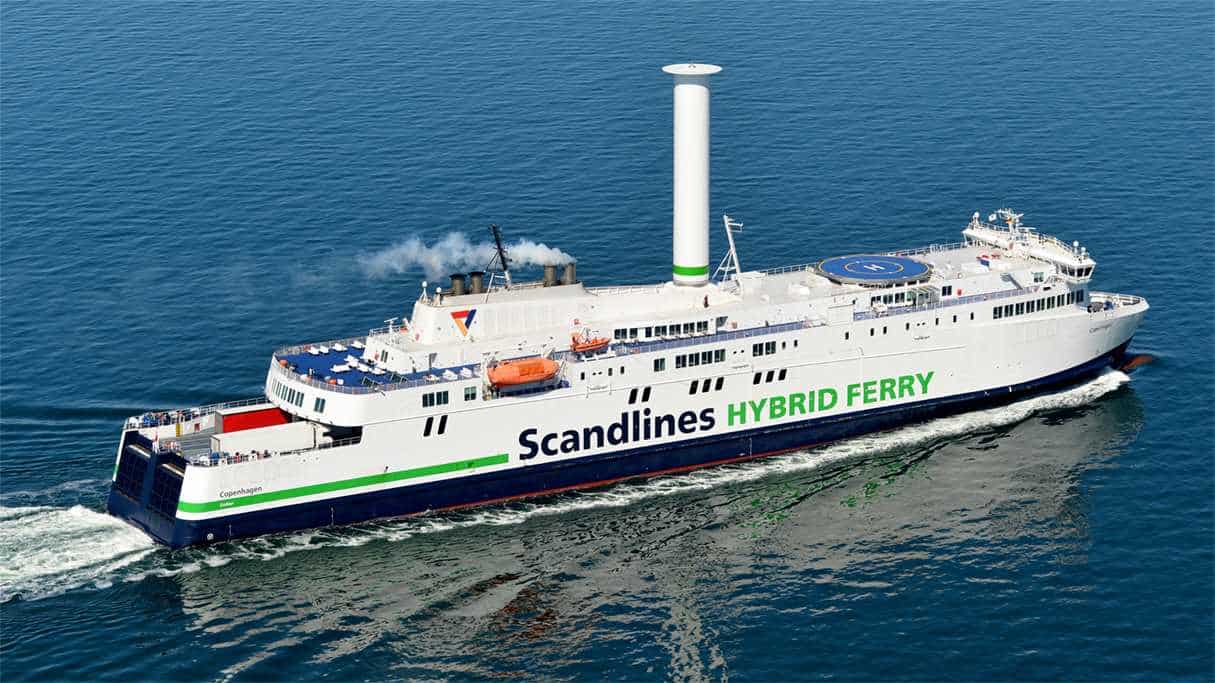
Scandlines’ decision to implement Kongsberg Maritime’s Health Management application proved to be a prudent one when it identified a bearing defect on their 169.5m hybrid RoPax ferry M/V Copenhagen. “We received a notification from the Health Management team that they had received a ‘pre-alarm’ concerning the E-mover drive end bearing on our starboard Azipull Thruster,” Stefan Egedal Petersen, the ferry’s Senior Chief Engineer, recalls. “A later report made it clear that the journey to bearing failure had started.”
Health Management was added last year to Kongsberg Maritime’s portfolio of Vessel Insight applications and is a major step in the ongoing evolution of smart ship technologies. Devised as a single interface via which users can receive continuous shipboard equipment condition reports, plan intelligent maintenance schedules and predict component wear/potential failures, Health Management has the potential to save considerable sums of money and maximise profitability for users in both the long and short term. Early notifications of abnormal wear or below-par equipment performance allow operators to monitor the fault while continuing operation. If required, spare parts can be ordered well in advance and remedial actions can be planned for the most opportune time, which in turn reduces vessel downtime.
Health Management on board M/V Copenhagen monitors its Azipull 120 thrusters, as Petersen explains. “The thrusters were equipped with additional sensors for monitoring while M/V Copenhagen and M/V Berlin were being built. We were interested in keeping a close eye on the condition of the units once the vessels were taken on by Scandlines, so we signed up for a Health Management service agreement for both vessels.” The sister vessels each carry up to 1,300 passengers and 460 cars, operating on the busy route between Rostock in Germany and Gedser in Denmark.
Under the terms of the service agreement, the vessels’ crews are presented with data and alerts which are also viewed remotely by Kongsberg Maritime’s onshore Health Management monitoring team, based in Rauma, Finland. The team will consequently advise the crews if an alert should require further attention. “We also receive reports on any changes to the condition of the Azipull thrusters over the course of the quarter,” Petersen confirms.
EARLY DIAGNOSIS
“The team’s message was: ‘Early stage bearing defect is being constantly evaluated. Trends are stable.’ This indicated a latent problem with electrical discharges in the drive end bearing, so it was agreed that the team should continue monitoring the defect and notify us if the situation started to deteriorate.”
Sure enough, the Health Management monitoring team issued an additional report, clearly indicating that trends were no longer stable, after a hard acceleration on the Azipull thruster intensified the development of the fault and made it clear that it was only a matter of time until the bearing failed. To limit the damage, the crew and Health Management monitoring team worked together to identify an optimal RPM range at which the starboard Azipull could operate, but at reduced power. “We detected the range at which we had the highest accelerations in the bearing,” Petersen comments, “and decided not to operate below 150RPM on the thruster unit. That way we kept the vibration below ‘pre-alarm’ level.”
An additional temporary measure was to apply an extra layer of grease to the bearing. The Health Management monitoring team was kept informed about these actions, and it was decided that the team would monitor these initiatives and issue a weekly special report on their effectiveness to the crew.
PROACTIVE MAINTENANCE
The timing of the defect couldn’t have been worse. “The ship was about to enter summer peak season,” Petersen remembers, “so it would have been very inconvenient if we’d had to go off-hire in the middle of the summer holiday period in order to deal with the problem.”
However, the same unfortunate timing nevertheless served to highlight the value of Health Management, as Petersen points out. “Thanks to the detailed data we received from the team, we could continuously evaluate the bearing failure and assess how far from breakdown we were, making proper arrangements for repair and procuring the spare parts. Health Management’s weekly reporting allowed us to ascertain if our scheduled repair date was realistic.”
Between them, the crew and Health Management team had devised a detailed fallback plan right at the start of the process, meaning that repair operations could begin immediately if a breakdown occurred before M/V Copenhagen’s scheduled off-hire. Fortunately, this situation never arose, and the electrical discharge problem was solved during the vessel’s next due maintenance stop by installing a ceramic bearing in place of the previous insulated bearing type.
The application has now become integral to operations on M/V Copenhagen. “We have created a quarterly job in our planned maintenance system to evaluate the quarterly reports we receive from Health Management,” Petersen notes. “These reports are methodically filed in our system, so we retain them as documentation. Reports are also available upon request from our Class Society.”
Stefan Egedal Petersen foresees a time wherein the Health Management application could be implemented in cooperation with suppliers, “which would of course be beneficial in terms of establishing the predictability of maintenance and setting up service intervals.
“One potential challenge is that the Health Management system operates as an internet service, which raises the issue of cyber security. However, this is an ongoing issue which the entire industry, shippers as well as suppliers, are having to deal with at every level of their business… and that’s another discussion entirely!
“Lastly,” Stefans adds, “I’d like to thank the Kongsberg Maritime Health Management team in Rauma for their support with this collaborative effort, helping us avoid disruption while perfectly matching the schedule we set forth to achieve.”
Health Management currently accommodates a range of products including KONGSBERG and third-party thrusters, Bergen engines and Kongsberg Maritime hydraulic winches, although more equipment will be added in due course.