



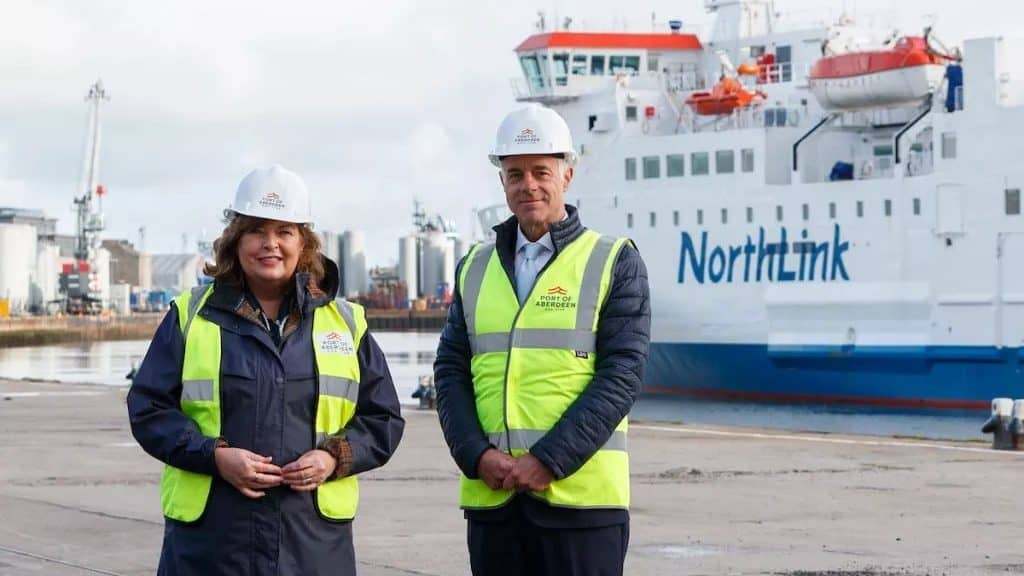
A significant emissions reduction project will see the installation of shore power facilities at Port of Aberdeen for Serco NorthLink’s passenger ferries.
This initiative, funded by Caledonian Maritime Assets Limited (CMAL) through a substantial seven-figure sum investment, will mitigate more than 1,300 tonnes of CO2 equivalent per year, improve air quality, and reduce noise.
Transport Minister Fiona Hyslop said: “The Scottish Government is committed to the decarbonisation of the transport sector to help deliver a just transition, and it’s great to see Port of Aberdeen aiming to be the first UK port to achieve net zero by 2040.”
The MV Hrossey and MV Hjaltland ferries have been converted to accept shore power and will ‘plug-in’ to a clean electrical power source, through the port’s renewable energy tariff, while berthed in Aberdeen. First power is expected in Q4 2024.
The new infrastructure will include a 1.7 MVA electrical supply, a new substation, and a quayside cable management system at Serco NorthLink’s facility within the port’s North Harbour.
Bob Sanguinetti, CEO, Port of Aberdeen said: “We are delighted to be part of this forward-thinking initiative which is an important strand of our industry-leading Net Zero strategy. We are committed to reducing our environmental impact and providing a cleaner, more sustainable port for our stakeholders.”
Kevin Hobbs, Chief Executive Officer, CMAL said: “This investment in cutting-edge shore power infrastructure at Port of Aberdeen is a pivotal step towards a greener maritime future. We’re not just reducing emissions but shaping a sustainable future for maritime transport – one that resonates with CMAL’s commitment to environmental sustainability and innovation.”
Port of Aberdeen is investing up to £55 million over the next 10 years to become the UK’s first net zero port by 2040. The ferry shore power initiative follows the recent award of funding from the UK Government for a multi-million pound project to design and deliver the first large-scale landside and vessel-side shore power system in Scotland.
These two projects alone will deliver a tangible reduction in emissions in the coming years and pave the way for the wider roll-out of shore power across the port. Port of Aberdeen is also working closely with stakeholders to understand potential infrastructure requirements to deliver future low and zero carbon fuels.
Additional environmental measures at the port include switching to hydrotreated vegetable oil for pilot vessels and equipment, implementing LED lighting, transitioning to electric vehicles (EVs), and expanding EV charging facilities.
Ms Hyslop continued: “Ports and harbours are crucial gateways to Scotland and have a key role to play in reducing transport emissions as well as supporting national, regional and local economies. The new South Harbour significantly increases the potential economic impact of Port of Aberdeen, and I’m keen to work with the port to ensure this impact is maximised.”














