



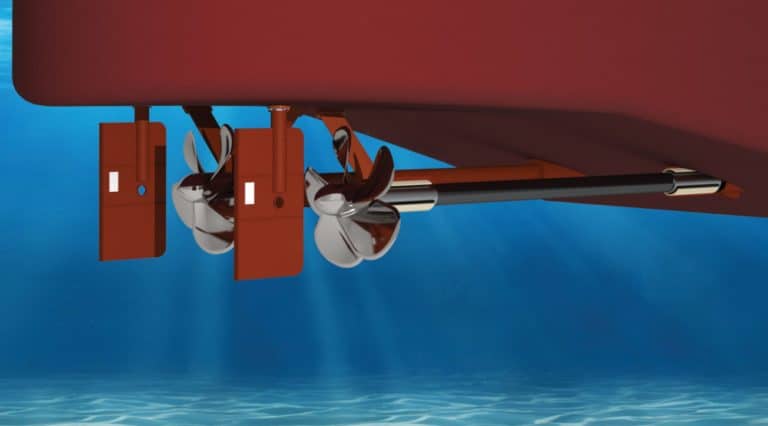
Thordon Bearings has indicated a polymer propeller shaft bearing lubricated by seawater could generate significantly less underwater radiated noise (URN) than metal bearings lubricated by oil.
The Canadian polymer bearings specialist says the low URN of a ship operating with seawater-lubricated propeller shaft bearings is one of the reasons why the arrangement is favoured by the naval, cruise and fisheries sectors.
“It is completely logical that seawater-lubricated polymer bearings are less noisy than metal ones, but our material is also quieter than rubber bearings and staves,” said Gary Ren, Thordon’s Chief Research Engineer.
“A common problem with conventional rubber bearings is the squeaking and squealing that can occur when trawling at low speeds. This high-pitched noise will reverberate for miles underwater. But the friction associated with conventional bearings could be removed with an elastomeric polymer bearing system, meaning shafts turn more easily. Noise is absorbed by the bearing in the 20 to 200rpm range.
“For fishing and fisheries survey vessels, a seawater-lubricated propeller shaft doesn’t scare the fish away and is often written into the vessel specification for this very reason.”
This claim is verified by New Zealand-based distribution and engineering partner, Henley Group, which has fitted Thordon bearings to some of the world’s largest all-carbon vessels.
“We have had customers take delivery of newbuilds only to find the original rubber bearings were causing a high-pitched squeal when the shafts were turning at low rpm, increasing in volume as shaft speeds decreased,” said Henley Group’s Jacob Power. “After conversion to Thordon’s material, these vessels experienced no squealing at all, in or out of gear or at low shaft speeds of 50rpm.”
Thordon Bearings’ Technical Director, Anthony Hamilton, added: “Marine noise pollution should be considered as serious as marine exhaust gas emissions or any other source of ship-to-air and ship-to-sea pollution; but there is currently no mandatory legislation in place to prevent or reduce this source of environmental damage. More meaningful measures are required if the wider commercial maritime industry is serious about having a zero environmental impact or achieving UN Sustainable Development Goal #14, protecting life below water.
“The technology is there and compared to other types of bearing system the low coefficient of friction and superior hydrodynamic performance at lower shaft speeds of a water-lubricated polymer bearing does result in a quieter operation.”
Last year, the International Maritime Organization agreed to update the non-mandatory technical guidelines MEPC.1/Circ.833 introduced in 2014. A new version of the guidelines is expected to be approved by the IMO’s Marine Environment Protection Committee at its meeting in July 2023.










 than metal bearings lubricated by oil.The Canadian polymer bearings specialist says the low URN of a ship operating with seawater-lubricated propeller shaft bearings is one of the reasons why the arrangement is favoured by the naval, cruise and fisheries sectors. “It is completely logical that seawater-lubricated polymer bearings are less noisy than metal ones, but our material is also quieter than rubber bearings and staves,” said Gary Ren, Thordon’s Chief Research Engineer.“ A common problem with conventional rubber bearings is the squeaking and squealing that can occur when trawling at low speeds. This high-pitched noise will reverberate for miles underwater. But the friction associated with conventional bearings could be removed with an elastomeric polymer bearing system, meaning shafts turn more easily. Noise is absorbed by the bearing in the 20 to 200rpm range. “For fishing and fisheries survey vessels, a seawater-lubricated propeller shaft doesn’t scare the fish away and is often written into the vessel specification for this very reason.”This claim is verified by New Zealand-based distribution and engineering partner, Henley Group, which has fitted Thordon bearings to some of the world’s largest all-carbon vessels.)