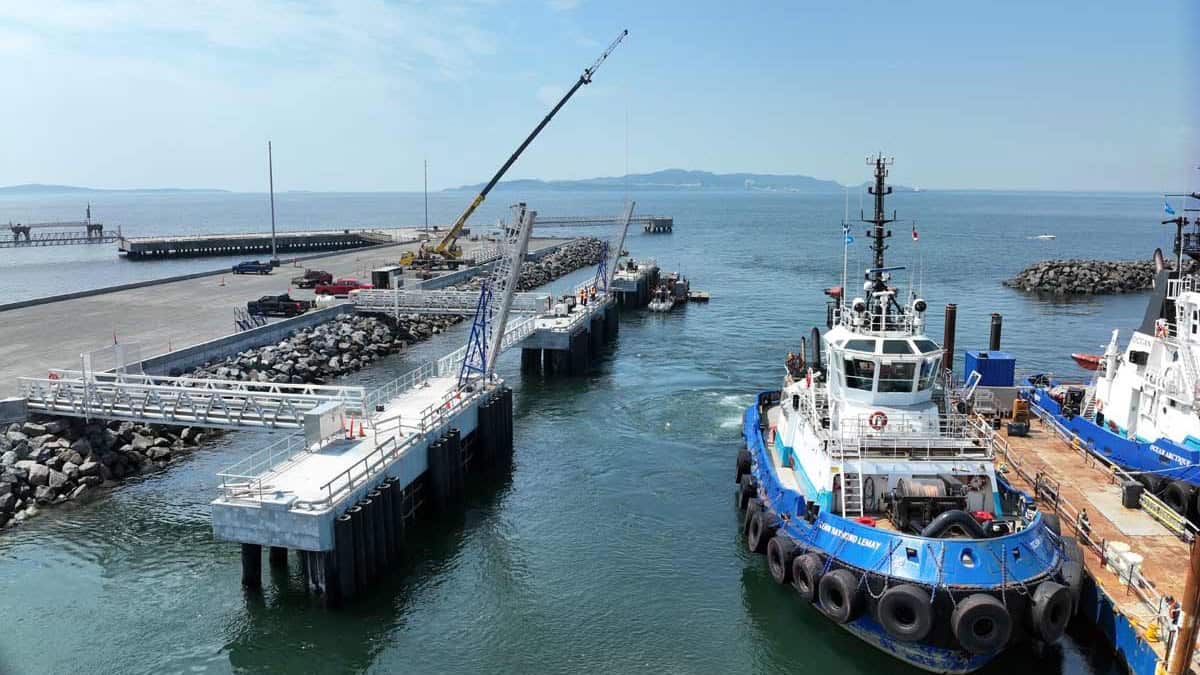
ShibataFenderTeam adapts proven Quebec fender configuration to meet the demands of tug operations
ShibataFenderTeam has designed and supplied three customised fender systems for the modernised Monseigneur-Blanche Terminal at the Port of Port de Sept-Îles on Canada’s North Shore of the Gulf of St. Lawrence.
The Port of Sept-Îles is a major hub for iron ore exports and industrial bulk shipping, while also supporting regional maritime transport and coastal communities. The port recently reopened its modernised Monseigneur-Blanche Terminal, originally built in 1956 and serving as its primary operational base and tugboat station since 2006.
As part of the modernisation, ShibataFenderTeam designed and supplied three customised fender systems, each comprising 16 Cylindrical Fenders (Ø600×300 mm, L4400 mm), five steel panels (2875–4000×3440 mm) and 16 SC Fenders (500x500x500 mm), together with the required mounting hardware. The fender configuration reflects an approach characteristic of Quebec, where vertically arranged Cylindrical Fenders are used in front of the fender panels. For the Monseigneur-Blanche Terminal, ShibataFenderTeam adapted this established arrangement to the particular demands of tug operations.
Tugs present a distinctive contact scenario: their own fenders vary in size and position along the vessel side, while hull geometry introduces further variation in the contact area. The Cylindrical Fenders provide an adaptable contact surface for these varying contact conditions while the vertical arrangement provides fender coverage over a relatively large area as water levels change – an important consideration given the approximately 4–5 m tidal variation at the terminal. Maintenance also remains straightforward: the Cylindrical Fenders can be lifted from their installed position and brought onto the quay for servicing or repair.
Translating the design into the installed berth geometry presented another challenge. As the supporting piles were driven at an angle, their final installed position could vary compared with the theoretical geometry shown in the design drawings. Rather than relying on fixed connection points, the panel connections therefore had to accommodate these field variations. SFT incorporated adjustable brackets and slotted holes to provide the required flexibility during installation.
The Monseigneur-Blanche Terminal shares its jetty with the adjacent cruise facilities, where ShibataFenderTeam supplied the fender systems in 2009. The latest installation for the tugboat terminal builds on this long-standing presence, adding another SFT reference at the Port of Sept-Îles.