



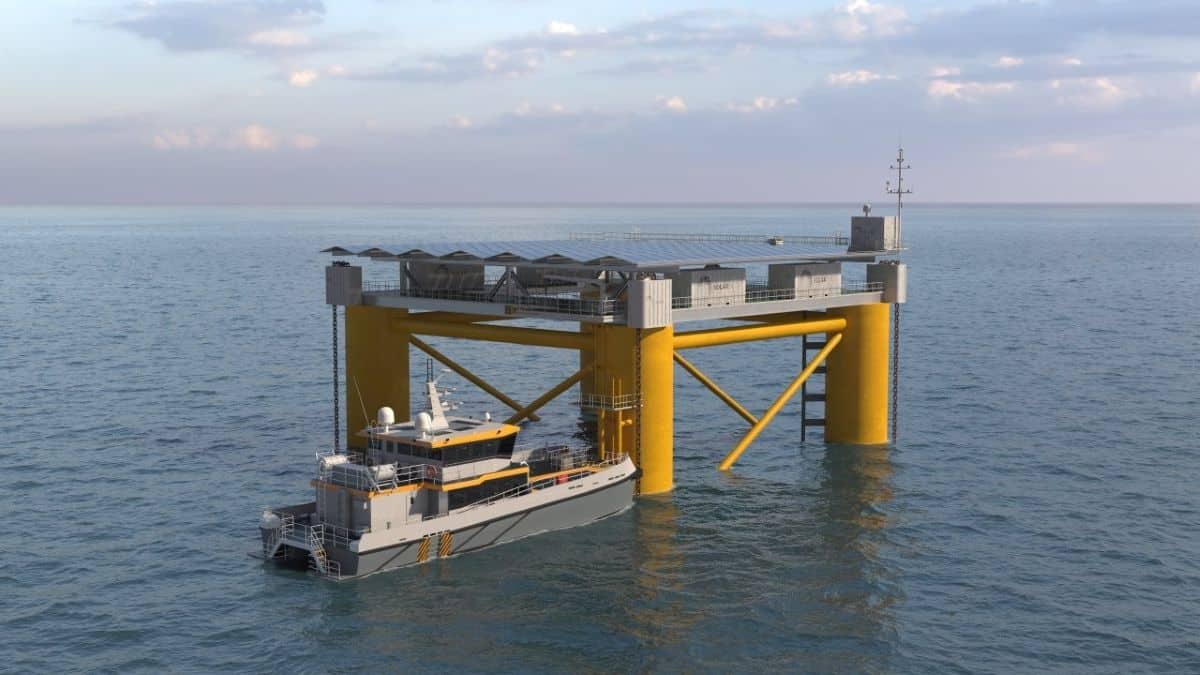
SolarDuck and MARIN will use the RVO-backed programme to progress an integrated offshore solar platform for powering offshore assets
Dutch offshore floating solar developer SolarDuck, in partnership with the Maritime Research Institute Netherlands (MARIN), has secured a €3.2 million grant from the Netherlands Enterprise Agency (RVO) to advance the Steady Seas research programme.
The funding will be used to advance the foundational design of SolarDuck’s Offshore Floating Power & Utility Hub, an innovative single-platform offshore solar solution designed to provide reliable power, communications and other utilities to remote offshore and subsea assets.
As offshore energy activity moves further from shore, the need for reliable in-field power is becoming increasingly important. Subsea oil and gas infrastructure, Carbon Capture and Storage (CCS) projects, offshore monitoring systems and other remote assets often depend on long subsea cables, umbilical’s or local generation using diesel generators. These solutions can be costly, complex to install, vulnerable to damage and carbon intensive.
SolarDuck’s Offshore Floating Power & Utility Hub is designed to offer an alternative: a redeployable offshore platform that generates renewable power where it is needed. In addition the Offshore Floating Power & Utility Hub supports continuous operations through integrated energy storage and auxiliary systems. This has the potential to reduce the lifecycle costs of CCS and subsea tie-back projects and consequently unlock investment opportunities.
Steady Seas builds on the operational experience and data gathered through SolarDuck’s DEI+ Merganser project in the Dutch North Sea. Under the new programme, SolarDuck will lead the overall Offshore Floating Power & Utility Hub design and system integration. MARIN will contribute hydrodynamic analysis, simulations, and basin testing to validate the platform’s behaviour, reliability and wave response under realistic offshore conditions. The results will support the next step toward demonstration projects with offshore industry partners.
The Steady Seas project combines applied research and technology development to address key technical questions for the Offshore Floating Power & Utility Hub, including hydrodynamic performance, mooring and motion behaviour, integration of power and communication systems and the interface with subsea infrastructure.
The programme will translate lessons from earlier offshore solar pilots into a robust basic design for a sector-specific platform that can support offshore oil and gas, carbon capture and storage and other remote offshore applications.
Don Hoogendoorn, CTO of SolarDuck, says: “Steady Seas allows us to take the lessons learned from building and testing Merganser in the North Sea and apply them to a design tailored for single-platform offshore applications. The technical challenges of powering assets far offshore are significant, from mooring and motion behaviour to integration with subsea infrastructure. This programme gives us the means to engineer and validate robust answers before the solution is deployed at sea.”
William Otto of MARIN says: “We are proud to continue our collaboration with SolarDuck and to support the further maturation of offshore floating photovoltaics. Within Steady Seas, MARIN will investigate the impact of the topology on behaviour and hydrodynamic coefficients, and it will assess the impact of extreme wave conditions on structural loading, including wave build-up beneath the platform. This kind of rigorous, test-driven validation is essential to bring offshore solar technology confidently toward commercial deployment.”
Following completion of the research phase, SolarDuck intends to move towards demonstration in collaboration with industry partners. Joint Industry Projects are currently being established to test the Offshore Floating Power & Utility Hub in operational offshore conditions and validate its ability to power and control remote assets in real-life environments.





 to advance the Steady Seas research)