



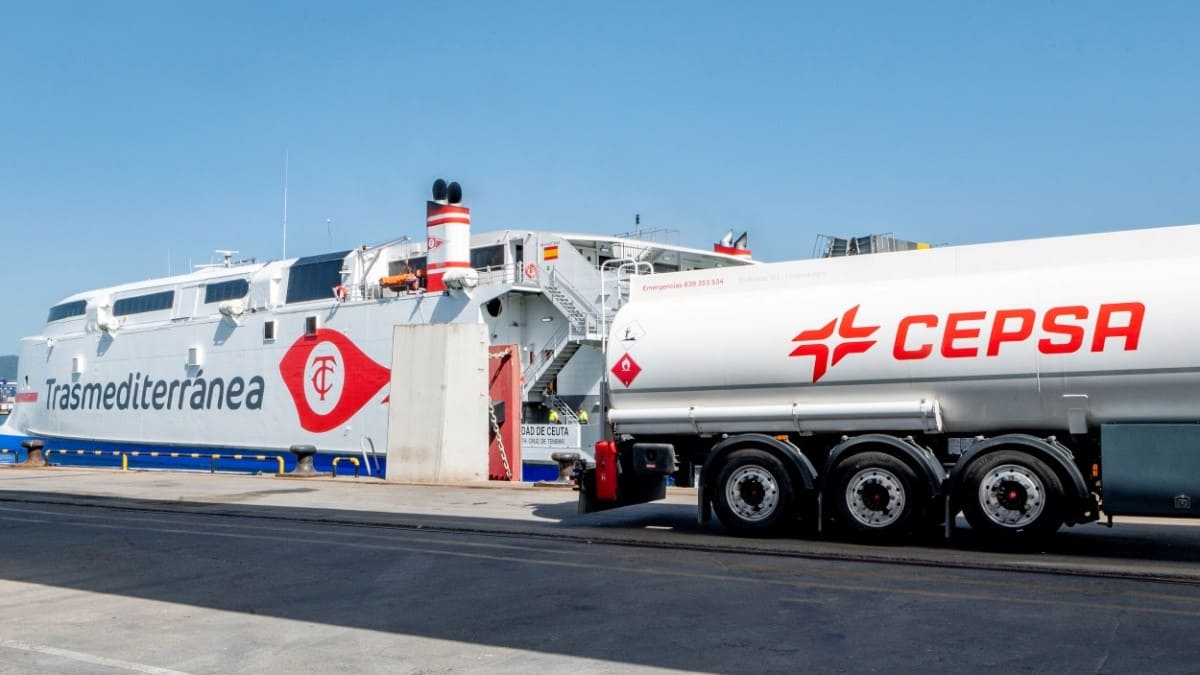
In August, Naviera Armas Trasmediterránea ferries will make 84 trips across the Strait of Gibraltar using Cepsa’s second-generation biofuels. This is the first time in Spain that passenger ferries will use this type of sustainable fuel, produced at Cepsa’s San Roque Energy Park (Campo de Gibraltar, Cadiz) from agricultural waste and supplied at the Port of Algeciras, making this port facility a leader in the decarbonization of maritime transport.
Cepsa, which is firmly committed to 2G biofuels to promote the decarbonization of maritime transport and the circular economy, is supplying this renewable diesel to the Naviera Armas Trasmediterránea ferries that connect Algeciras with Ceuta.
With this initiative, Cepsa has consolidated its position as a benchmark in the energy transition and national leader in the supply of energy for this type of transport, a market in which it has more than 90 years of experience, with presence in more than 60 Spanish ports.
To produce this renewable diesel, Cepsa has transformed one of its plants in the San Roque Energy Park, adapting the Isomax unit for production of second-generation biofuels via co-processing.
Samir Fernández, Director of Marine Fuel Solutions at Cepsa, highlighted the importance of this milestone in the company’s energy transition strategy: “We continue to promote sustainable mobility as one of the pillars of our strategic growth. With initiatives like these and the ones we are rolling out in air and rail transport, we are progressing towards our goal of becoming the leading biofuels producer in Spain and Portugal, while facilitating the decarbonization of our customers in the maritime sector.”
Agustín Aguilera, Director of Operations and Environment at Naviera Armas Trasmediterránea, said: “At Naviera Armas Trasmediterránea, we are firmly committed to the requirements of the energy transition. This is defined in our carbon footprint reduction plan, certified by Lloyd’s and endorsed by the Ministry for the Ecological Transition and the Demographic Challenge. We have taken important steps in this direction. We’ve had a natural understanding with Cepsa, which is why we entrusted them with the supply of 2G biofuels that we are already using in our ships in the Strait of Gibraltar and will extend to the rest of our fleet.”
Second-generation biofuels can be used in ships without engine modifications and have high potential for reducing CO2 emissions compared to conventional fossil fuels. Specifically, during the entire life cycle, from production to use in ships, CO2 emissions can be reduced by up to 90% compared to conventional fossil fuels.
This initiative will avoid over 63 tons of CO2 emissions, the equivalent of planting 750 trees, and allow Naviera Armas Trasmediterránea ferries to sail from the Port of Algeciras with up to 15% renewable diesel in their tanks, meeting EU targets ahead of time. Specifically, the European Commission’s Fit for 55 package includes the “Fuel EU Maritime” legislative initiative, which aims to reduce greenhouse gas emissions intensity in maritime transport by 2% in 2025, 6% in 2030 and 80% in 2050, compared to 2020 levels, by boosting the use of sustainable alternative fuels.
It also supports several of the 2030 Agenda’s Sustainable Development Goals: SDG 7 (Affordable and clean energy), SDG 8 (Decent work and economic growth), SDG 12 (Responsible consumption and production), and SDG 13 (Climate action).
One step closer to decarbonizing the maritime sector
Prior to this initiative, and through an analysis and testing phase at its Research Center, Cepsa tested the efficiency of this second-generation biofuel in its own fleet of ships before starting to market it to customers, ensuring optimum engine operation and performance.
Cepsa has a diversified portfolio of solutions to facilitate the decarbonization of maritime transport, including not just biofuels but also products such as liquefied natural gas (LNG). And thanks to new alliances, Cepsa will be able to supply in the future synthetic marine fuels, such as green ammonia or methanol produced as part of the Andalusian Green Hydrogen Valley, the largest green hydrogen project in Europe.
Through its 2030 strategy Positive Motion, Cepsa aims to lead sustainable mobility and promote the decarbonization of maritime, air and land transport through the production of green molecules. The company aspires to be the leading biofuel producer in Spain and Portugal by 2030, with production capacity of 2.5 million tons annually, and manufacturer of green hydrogen, with 2 GW of electrolysis capacity.
Cepsa and the Port of Algeciras recently participated in the Marine Environment Protection Committee (MEPC 80) of the International Maritime Organization (IMO) in London, where they presented different projects that both entities are working on to promote the decarbonization of maritime transport.







 from agricultural waste and supplied at the Port of Algeciras, making this port facility a leader in the decarbonization of maritime transport. Cepsa, which is firmly committed to 2G biofuels to promote the decarbonization of maritime transport and the circular economy, is supplying this renewable diesel to the Naviera Armas Trasmediterránea ferries that connect Algeciras with Ceuta. With this initiative, Cepsa has consolidated its position as a benchmark in the energy transition and national leader in the supply of energy for this type of transport, a market in which it has more than 90 years of experience, with presence in more than 60 Spanish ports. To produce this renewable diesel, Cepsa has transformed one of its plants in the San Roque Energy Park, adapting the Isomax unit for production of second-generation biofuels via co-processing. Samir Fernández, Director of Marine Fuel Solutions at Cepsa, highlighted the importance of this milestone in the company’s energy transition strategy: “We continue to promote sustainable mobility as one of the pillars of our strategic growth. With initiatives like these and the ones we are rolling out in air and rail transport, we are progressing towards our goal of becoming the leading biofuels producer in Spain and Portugal, while facilitating the decarbonization of our customers in the maritime sector.”Agustín Aguilera, Director of Operations and Environment at Naviera Armas Trasmediterránea, said: “At Naviera Armas Trasmediterránea, we are firmly committed to the requirements of the energy transition. This is defined in our carbon footprint reduction plan, certified by Lloyd's and endorsed by the Ministry for the Ecological Transition and the Demographic Challenge. We have taken important steps in this direction. We’ve had a natural understanding with Cepsa, which is why we entrusted them with the supply of 2G biofuels that we are already using in our ships in the Strait of Gibraltar and will extend to the rest of our fleet. ”Second-generation biofuels can be used in ships without engine modifications and have high potential for reducing CO2 emissions compared to conventional fossil fuels. Specifically, during the entire life cycle, from production to use in ships, CO2 emissions can be reduced by up to 90% compared to conventional fossil fuels. This initiative will avoid over 63 tons of CO2 emissions, the equivalent of planting 750 trees, and allow Naviera Armas Trasmediterránea ferries to sail from the Port of Algeciras with up to 15% renewable diesel in their tanks, meeting EU targets ahead of time. Specifically, the European Commission’s Fit for 55 package includes the “Fuel EU Maritime” legislative initiative, which aims to reduce greenhouse gas emissions intensity in maritime transport by 2% in 2025, 6% in 2030 and 80% in 2050, compared to 2020 levels, by boosting the use of sustainable alternative fuels.It also supports several of the 2030 Agenda’s Sustainable Development Goals: SDG 7 (Affordable and clean energy), SDG 8 (Decent work and economic growth), SDG 12 (Responsible consumption and production), and SDG 13 (Climate action).One step closer to decarbonizing the maritime sector Prior to this initiative, and through an analysis and testing phase at its Research Center, Cepsa tested the efficiency of this second-generation biofuel in its own fleet of ships before starting to market it to customers, ensuring optimum engine operation and performance. Cepsa has a diversified portfolio of solutions to facilitate the decarbonization of maritime transport, including not just biofuels but also products such as liquefied natural gas (LNG). And thanks to new alliances, Cepsa will be able to supply in the future synthetic marine fuels, such as green ammonia or methanol produced as part of the Andalusian Green Hydrogen Valley, the largest green hydrogen project in Europe.Through its 2030 strategy Positive Motion, Cepsa aims to lead sustainable mobility and promote the decarbonization of maritime, air and land transport through the production of green molecules. The company aspires to be the leading biofuel producer in Spain and Portugal by 2030, with production capacity of 2.5 million tons annually, and manufacturer of green hydrogen, with 2 GW of electrolysis capacity.Cepsa and the Port of Algeciras recently participated in the Marine Environment Protection Committee (MEPC 80) of the International Maritime Organization (IMO) in London, where they presented different projects that both entities are working on to promote the decarbonization of maritime transport.)