


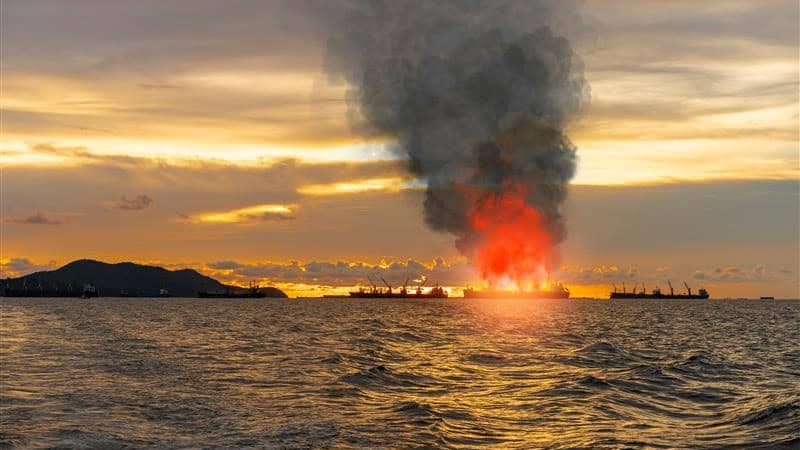
Global Survival Technology solutions provider Survitec has highlighted the dangers of inadequate maintenance, testing, and inspection of ship fire safety systems in a new white paper, which points to an alarming increase in fire-safety-related deficiencies found during Port State Control Inspections and subsequent ship detentions.
In a white paper released at the Posidonia tradeshow today, Survitec highlights that fire continues to be a leading cause of major shipping incidents, accounting for over 20% of total losses, and the most expensive cause of marine insurance claims. While the highest level of fire safety systems deficiencies in a decade was recorded by the Paris MoU in 2022, and the Tokyo MoU also reported an increase in detentions, with a staggering 15,562 deficiencies reported in 2023.
“Analysts report a 17% year-on-year rise in shipboard fires, which correlates with an increasing number of reports and testimonies from our network of certified service technicians and engineers that document serious faults requiring immediate corrective measures,” says Metkel Yohannes, Director of Service & Rental Solutions, Survitec.
Survitec has found that the economic downturn and the emphasis on cost reduction post-COVID have negatively impacted fire safety, with some shipowners and operators maintaining and inspecting safety equipment themselves in an attempt to save costs.
As Yohannes explains, “We’re finding basic errors and oversights that do not become apparent until either the ship fails an inspection and is detained – or there is a fire.”
He quotes an example. Survitec was called out to a vessel after an engine room fire. The crew had managed to extinguish the fire but suspected there was a fault with their high expansion foam firefighting system. The cause of the fault was a blockage in the system. The crew had installed a new foam pump and forgotten to remove one of the protective caps from the inlet.
Survitec also finds wrong parts being used or poorly fitted, or low-quality parts that deteriorate rapidly and fail. For example, in CO2 firefighting systems, hydraulic hoses are often mistaken for high-pressure hoses but they are not designed for CO2 applications and may burst under pressure.
“We see evidence of a slip in standards regarding basic safety practices but also a wide disparity in service quality between service providers. Approval stamps are being applied to fire systems and appliances that would or should not pass inspection. Some issues are self-evident; for example, rust on a valve or fire extinguisher is clear to see, but other issues are less obvious and can have catastrophic consequences,” says Yohannes.
The white paper highlights an incident involving a bulk carrier. The vessel had completed a fire safety inspection and received full certification from a local service provider. Shortly after leaving port, a fire broke out in the engine room. Over half of the cylinders failed to activate despite the CO2 system having been inspected and approved. While the fire was eventually extinguished, it caused significant damage to the vessel, resulting in off-hire and repair costs estimated between $2-3 million USD.
Yohannes states, “The development and introduction of alternative fuels, including the use and transportation of lithium-ion batteries, brings new fire risks and safety challenges that can’t be ignored. Fire systems and equipment must be maintained and tested as mandated by SOLAS, the IMO and the FSS code.
“Shipowners and operators need accredited service partners they can trust. They must have confidence in the system of approvals. It is clear there are substandard inspections taking place, which is worrying. Although service providers may boost many approvals, they may not be suitably equipped or resourced to perform all the required tests.”
Yohannes concluded, “As an industry, current practice should be reviewed to determine if more oversight and governance, and more quality control procedures are required to protect crew and vessel safety.”
The white paper can be downloaded in full here: https://survitecgroup.com/contact/unveiling-the-true-cost-of-inadequate-fire-safety-inspections/