




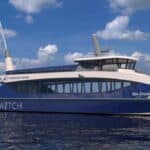
Workboat pilots from offshore access specialist Tidal Transit have become the first expert end users to experience Artemis Technologies’ marine workboat simulator, as part of a joint project to develop the world’s first 24 passenger high-speed zero-emission crew transfer vessel (CTV).
The North Sea operator has linked with Artemis Technologies, based in Belfast, for the venture which is backed by the UK government’s Clean Maritime Demonstration Competition (CMDC), funded by the Department for Transport.
The initiative seeks to demonstrate the transformative power of the revolutionary Artemis eFoiler® electric propulsion system to eliminate carbon emissions in global CTV operations.
The Tidal Transit visit to Artemis Technologies’ new research, design and manufacturing facility in Belfast, came as the Artemis team prepares to bring to market the world’s first commercially viable, zero emissions 11m workboat.
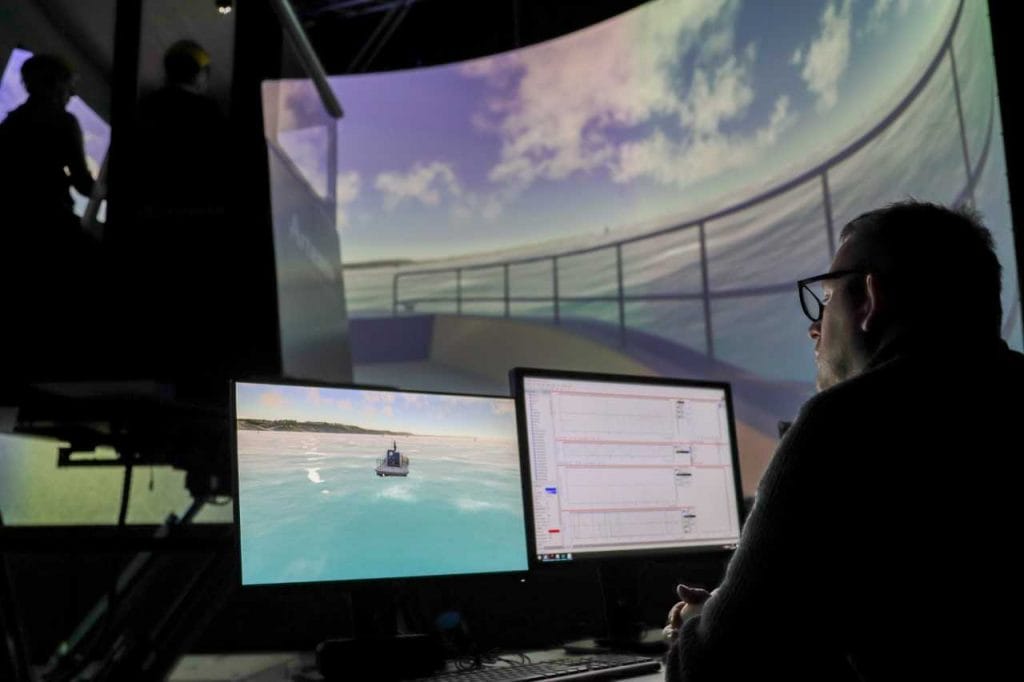
The simulator allows multiple scenarios to be tested, such as wind and sea state and enables the pilots to experience an e-foiling workboat.
Leo Hambro, Commercial Director of Tidal Transit, which operates a fleet of purpose-built offshore wind CTVs in waters around the UK and overseas, said:
“The reaction from our skippers to using the simulator has been incredible, delivering as close to a real-life experience as you could imagine, without being at sea.
“The complexity of the simulator enabled us to test the vessel’s capabilities in a range of situations, including pushing against the wind turbine for the safe transfer of technicians.”
During the Belfast visit, the Tidal Transit team also viewed the Artemis electric drivetrain in operation at the Marine Research Group tank testing facility at Queen’s University Belfast.
Leo Hambro continued:
“What we found so exciting about the Artemis eFoiler ® solution is the reduction in drag when the system lifts the vessel out of the water. This provides both speed, comfort range, minimal wake and a 70% reduction in energy costs.
“The Artemis Technologies eFoiler system looks set to be a game changer for our industry as we seek to decarbonise our fleet.”
Artemis Technologies founder and CEO Dr Iain Percy OBE said:
“Burning around 1,500 litres of diesel a day, crew transfer vessels are a major pollutant, so this project is incredibly important in our wider mission to help decarbonise maritime.
“It is a tremendous privilege to partner with Tidal Transit as the first expert end user of our simulator, originally developed for the America’s Cup.
“This is another significant milestone in our company’s evolution and comes on the eve of unveiling our Artemis eFoiler 11m workboat.”
The Artemis eFoiler ® integrates a high-power density electric drivetrain into an autonomously controlled hydrofoil, combining proven technologies from yacht racing, motorsport, and the aerospace industry.
The Clean Maritime Demonstration Competition (CDMC) which is part of the Prime Minister’s ten-point plan for a green industrial revolution builds on the vision set out in the Department for Transport’s Clean maritime plan 2019.
It has allocated up to £23,259,000 match-funding to UK innovators to support the design and development of zero emission vessel technologies and greener ports through a series of technology trials and feasibility studies.









.The North Sea operator has linked with Artemis Technologies, based in Belfast, for the venture which is backed by the UK government’s Clean Maritime Demonstration Competition (CMDC), funded by the Department for Transport.)