


Ecomar Propulsion and Kuasar UK combine electric propulsion and vessel design expertise to launch the fully battery-electric BLUEWAKE 150 Ferry at Seawork 2026
Ecomar Propulsion and Kuasar UK have entered into a strategic partnership to develop a new generation of zero-emission commercial vessels, combining their expertise in electric propulsion and vessel design.
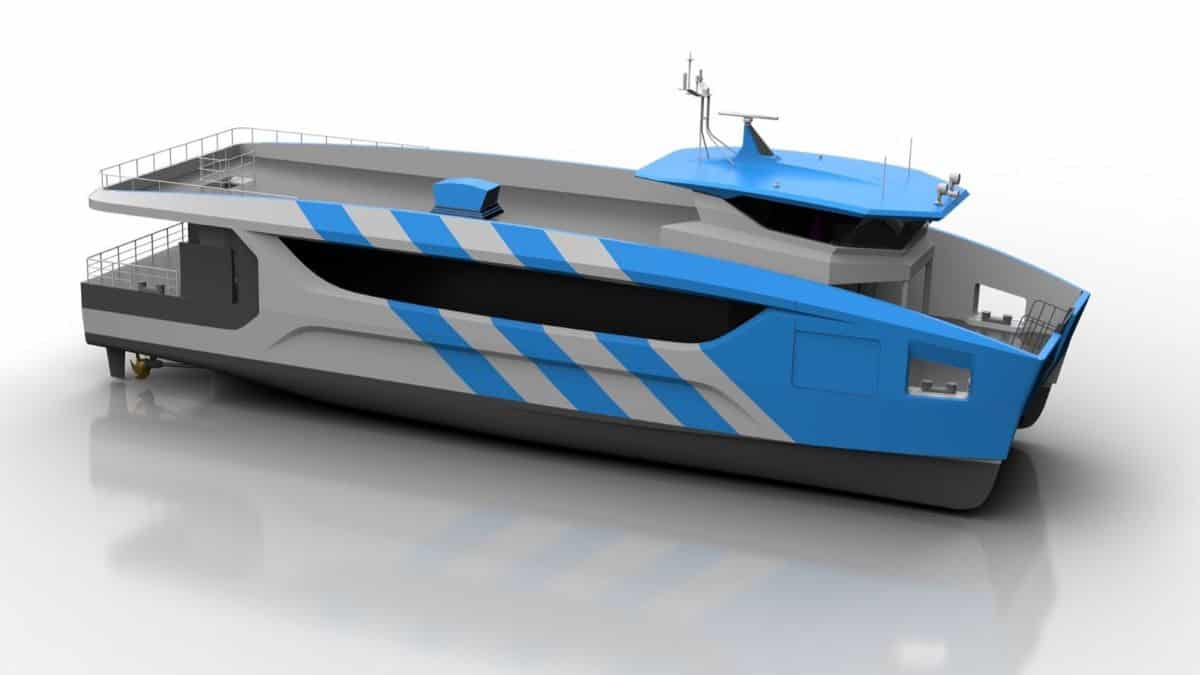
The collaboration’s first project is the BLUEWAKE Ferry range, a series of fully electric passenger vessels designed to support the maritime sector’s transition to sustainable transport. Leading the range is the BLUEWAKE 150 Ferry, a fully battery-powered vessel capable of carrying up to 150 passengers, with additional variants to meet a range of operational requirements.
The partners will officially unveil the BLUEWAKE 150 Ferry at Seawork 2026, where the design is expected to generate significant interest from operators seeking practical, emissions-free solutions for passenger transport.
“We are absolutely delighted to publicly announce our new partnership and product lines”, said Ecomar Propulsion CEO, Eugene Bari. “The complementary skills of Kuasar UK and Ecomar Propulsion mean that we can offer off the shelf designs for commercially viable zero emission vessels which meet all class requirements.”
Noyan Kilinç (CEO) of Kuasar UK said “As a young naval design house, we believe that collaboration with pragmatic advanced technology companies like Ecomar Propulsion enhances our position as a global leader in advanced ship design”.
The intention of the partners is to create more market ready ships for use across the globe. “We are open for business”, said Ecomar’s CTO, Nik Lekkas. “This is the first of many designs we are planning that increase the BLUE WAKE portfolio of new technology, commercial ferries and other civil marine ships.”
Powered by optional e-motors, including Ecomar Kairos electric drives, the vessel offers safe and continuous operations. The digital control systems and integrated energy management make the ship a highly efficient machine. Reducing OPEX costs immediately making it more cost effective than almost any ICE vessel.
Mr. Kilinç of Kuasar added, “We have build slots available for composite and aluminium vessels to be delivered in around 14 months. The cost is managed on the basis of specific needs of our customers.”
The ferry has been designed with modular battery clusters coming in different power ranges and options to include a state of the art hydrogen package. It comes with fully integrated electronic systems which generate instant performance feedback for the captain.
“Foiling is fine for small boats, but we are aiming at bigger boats dealing with heavier payloads that replace fossil fuelled vessels operating in coastal and populated waters,” said Ecomar CEO, Eugene Bari. “Reliability sometimes is more important that pure speed.”
Integrated data monitoring give owners predict charging and bunkering, optimises energy use, and schedule adjustment can be adapted in real time.
The proprietary SMART digital management package allows the vessel to maintain speed whilst minimising the energy use, cutting down on operational costs and reducing maintenance costs. The intention is to maximise operator income streams whilst also giving passengers the best possible experience.
“Penalties for operating polluting ships are coming into force across the world making it more and more expensive if they are not replaced. We have prepared detailed costing and the ferry is good to go”, stated Mr Bari
“Due to our detailed preparation, production costs can be guaranteed, build slots are available and prices are accurate”, added Mr Kilinç.
The integration of class approved high-quality equipment removes uncertainty and makes this vessel competitive in every way. Combined with advanced hull design and technological efficiency the benefits are immediate.
The partners have removed uncertainty by using proven technology and designing the boat so that future upgrades are easy to achieve.
The vessel statistics are impressive. LOA 30m, Beam 11.4m, Draft 1.4m, Displacement 120T, Cruise 20kts. The baseline ship is designed run on battery, but variants can also run on battery or hydrogen utilizing an autonomous hybrid energy system as required.
“This boat is ideal for high passenger traffic routes like the River Mersey or the Scottish Islands where ageing fleets are in desperate need of replacement. There are hundreds of locations where this shallow draft craft could be deployed,” Bari continued.
Concerns around recharging and range have been considered at every stage. The design aims for shortened battery charging periods and the team have even defined the shore power requirements. To reduce infrastructure costs and high-power electricity for municipal routes and private ports, they recommend using a cost effective, 2MW charger. This approach makes perfect sense in regions where infrastructure is a bottleneck.
“We believe that this kind of vessel, regardless of the IMO, makes sense. The war in Iran proves that. The rocketing price of fossil fuels and the reducing cost of going clean make economic sense however you look at it,” Said Bari. “Finance for buyers is becoming easier and cheaper and we are happy to introduce potential customers to a range of financiers to get deals done,” said Nik Lekkas.
Kilinç added, “Carbon free power will only get cheaper. That gives owners increase profits with no compromise, so there is absolutely no reason to delay. Stretched supply chains, taxation and emission penalties, along with customer demand for better transport solutions are going to drive change as much as the IMO.”
The partnership between Kuasar UK and Ecomar Propulsion demonstrates that innovation lies at the heart of shipbuilding. With a clear intention to add to the portfolio in future by designing a range of different vessels that can be licenced and built anywhere, the partners are actively pushing the speed and scale of global decarbonisation.