




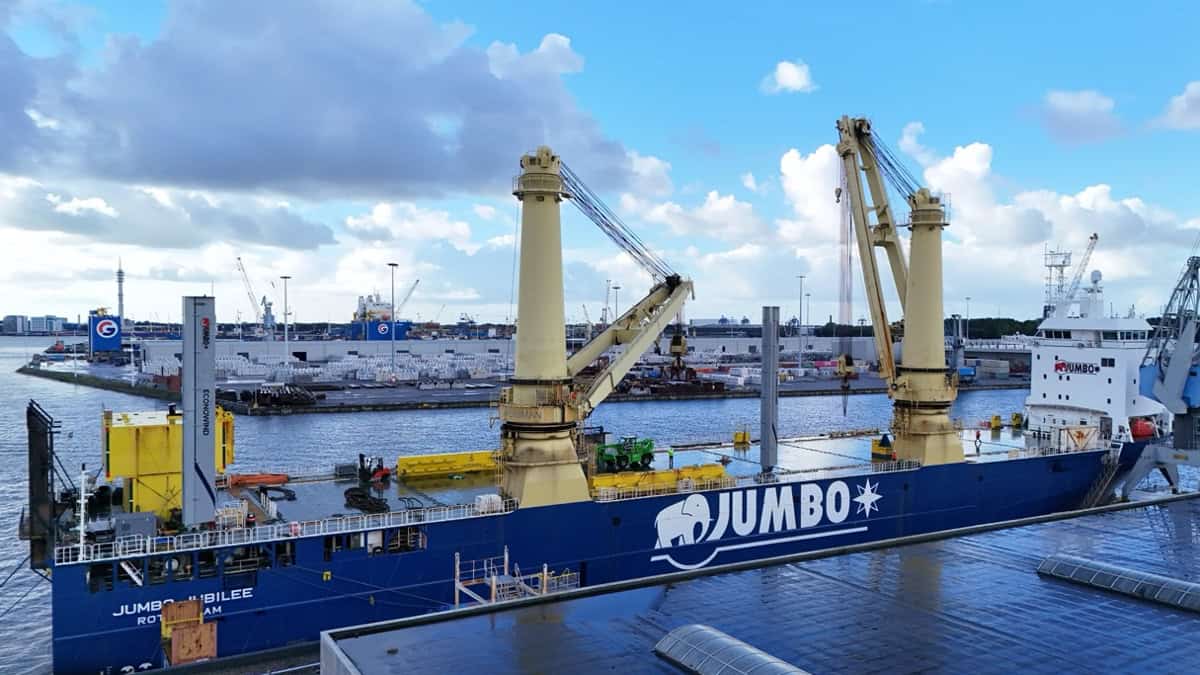
Jumbo announce the successful installation of two mechanical sails from Econowind to Heavy Lift Vessel (HLV) Jumbo Jubilee. The wind assisted ship propulsion (WASP) solution is the latest in a series of innovative technologies installed to the vessel in a bid to boost fuel efficiency and cut carbon.
Jumbo is committed to advancing sustainable heavy-lift shipping with innovative energy-saving and decarbonisation initiatives across its fleet, says Jumbo Maritime CEO Daan Koornneef.
“At Jumbo, we believe that every step towards sustainability is crucial. The installation of these mechanical sails on Jumbo Jubilee is a testament to our commitment to decarbonise and innovate. While there’s always more work to be done, initiatives like this propel us closer to a greener maritime industry. We’re proud of our team’s continued efforts in making Jumbo a leader in sustainable shipping.”
The company’s approach is to apply multiple fuel-saving solutions to a single vessel, thereby making possible the measurement of each technology’s contribution to the overall picture.
Examples already applied to Jumbo Jubilee include an efficiency boosting propeller coating, AI powered anti-fouling monitoring system and an eco-control system. This latest move, the installation of two Econowind ventofoils, will assess the impact of WASP on the vessel’s efficiency.
Jumbo Technical Manager Andres Cassanova explains, “While not fully optimised for our vessel type, these sails will help us to gather valuable insights on real-world fuel savings and explore further optimisations that will allow Jumbo to reduce its environmental footprint even more.”
The relatively small footprint of the ventofoils makes them an ideal solution for installation on a heavy lift vessel, where space is required for project cargoes. Additionally, the sails are flexibly mounted on a customised frame engineered in-house by Jumbo structural engineer Estelle Bongers. With this, the sails can be moved, or even transferred to another vessel should additional space be required for cargo.
The installation of the (WASP) ventofoils follows application of an anti-fouling coating on the ship’s propeller to maintain efficiency, as well as the introduction of an AI powered anti-fouling hull coating monitoring system.
This innovative system captures a wide range of date including vessel speed, geographical position, as well as sea water temperature and other environmental conditions and parameters. This allows the system to make predictions and provide notifications when there is a risk of accelerated fouling.
This means that Jumbo can perform an inspection and undertake maintenance in advance of a decrease in fuel efficiency. It also means the system can be maintained using less aggressive methods, ensuring its preservation for longer duration’s between dockings.
A further measure is the installation of an eco-control system to the vessel. “This can be viewed as a type of intelligent cruise control,” explains Andres. “It allows us to set a fuel consumption or maximum speed limit. With this, the eco-control system takes over and, based on RPM and propeller pitch, is continually adjusting to ensure optimally efficient performance, minimal fuel consumption and emissions.”
With these significant technologies installed to the Jumbo Jubilee, Jumbo expects to achieve fuel savings. A crucial factor in this, says Technical Superintendent Patrick Feddes, is collaboration. “If you want to reduce your environmental footprint, it’s not only down to one part of the company. It’s a team effort between those on board the ships and those on shore. The technologies play an important supporting role in creating energy savings, but a significant factor is awareness and cooperation throughout the various departments of the organisation.”
Casanova: “It’s the years of technical expertise, in-house engineering and strong teamwork that drive sustainable innovation from desk to deck.”
Pictures: Barry ten Brinke











 Jumbo Jubilee. The wind assisted ship propulsion (WASP))