


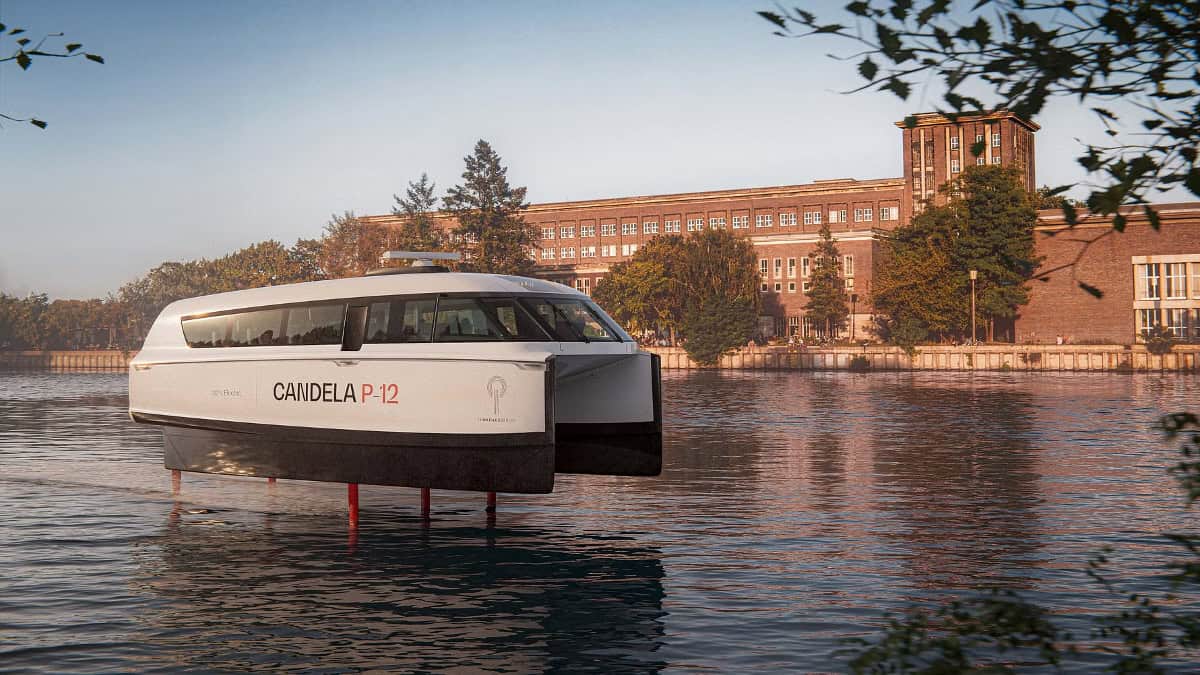
Swedish tech company Candela announce the sale of a Candela P-12 electric foiling ferry to Funkhaus/Reederei Riedel, marking a watershed moment for zero-emission transport in Germany.
The P-12 Shuttle electric foiling ferry line is planned to connect the East Side Gallery, near Ostbahnhof, with the cultural hub Funkhaus. The electric hydrofoil ferry, which can travel at 25 knots across the Spree, is the fastest electric ship in the world and the first of its kind in Germany.
“Berlin is a city with a lot of water, but this is hardly used for transport. We want to open up waterways for fast, emission-free transport. We need that if we want to reduce emissions and congestion on the roads,” said Brigitte Junker from Candela.
The Swedish ship manufacturer Candela is a pioneer in sustainable water transport and the world’s first manufacturer of electric foiling vessels. These ships utilise computer-stabilised underwater wings to raise their hulls above the water, cutting energy consumption by 80% compared to conventional ships. The Candela P-12 fast electric foiling ferry, which is set to debut in Stockholm’s public transport system this fall, has been dubbed a “game changer” by the maritime industry, as it is the first electric vessel with both long range and high speed, thanks to its efficiency. But for city waterways, the most important aspect of the hydrofoil technology is the lack of damaging wakes, which in Stockholm has earned it an exemption from speed limits that other vessels must adhere to.
In Berlin, the vessel has been purchased by Funkhaus/Reederei Riedel, which already operates a fleet of shuttle vessels within the city.
“We would start with an hourly service,” said Uwe Fabich, the owner of Reederei Riedel and Funkhaus, a cultural hub and popular venue for concerts, festivals, and other cultural events. With a ten-minute journey per route, the schedule could be expanded to two trips per hour in each direction.
The issue with Berlin, as with other major cities, is rush hour traffic, says Uwe Fabich. Those driving from the center to the Funkhaus must endure heavily congested streets.
“There’s always a traffic jam. Public transportation isn’t much better. Tram line 21, which heads in this direction, is one of the few Berlin tram lines with a 20-minute frequency. After getting off, there’s still a long walk to the Funkhaus,” says Uwe Fabich.
This is how the idea to develop the area via waterway came about. The Reedrei Riedel and Funkhaus are directly on the river. With the P-12, investments in adapting dock infrastructure and charging will be negligible, as the vessel’s adjustable bow ramp can handle existing dock heights from 0.2m to 2m high. Its low energy use enables the P-12 to replenish its battery from a conventional car DC charger in just an hour.
“Operating costs would be 90 percent lower than diesel ships due to the low energy consumption and our maintenance-free electric C-POD motors,” says Brigitte Junker.
The high-speed ferry is also intended as a showcase for Berlin. “It would be a perfect connection to the outer areas,” says Fabich. Where the Spree and other waterways are wide enough, it could successfully compete with other modes of transport.
Berlin has a long history of water transport. Since the 19th century, steamships have carried Berliners and Berlin tourists through the city. It is one of the most beautiful ways to get to know Berlin, yet today it is mostly unused for public transport.
“With the hydrofoil technology, we hope to change this and use mankind’s oldest transport infrastructure for fast, zero-emission commuting,” Brigitte Junker concludes.