


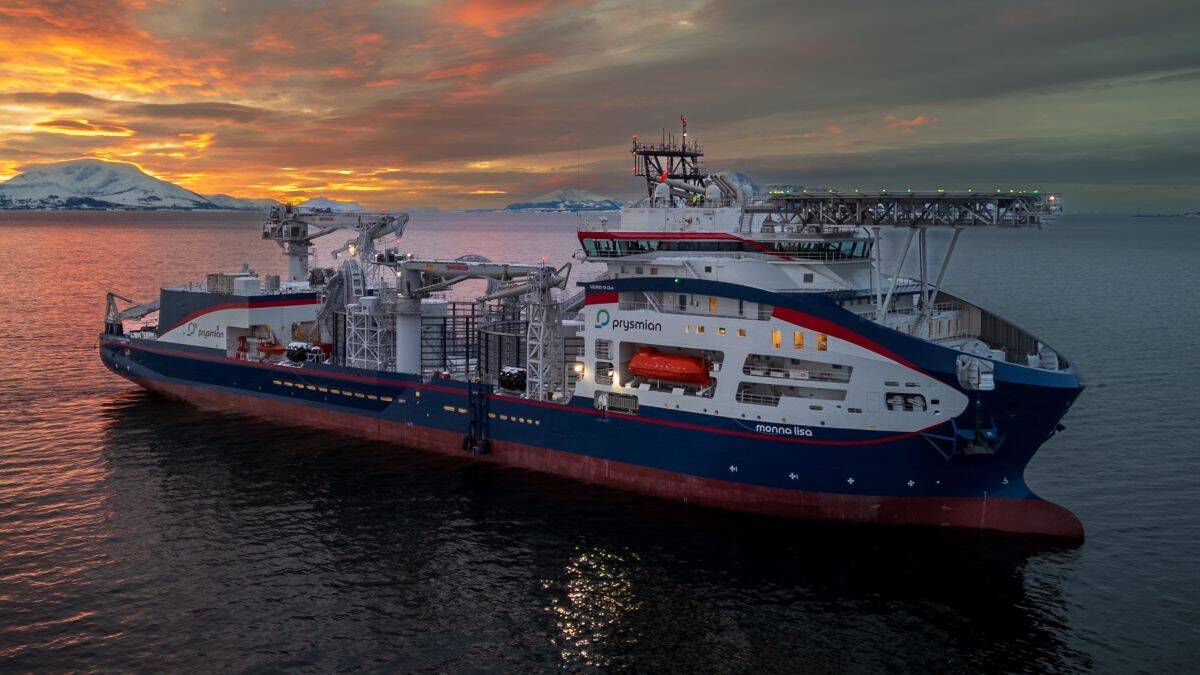
MacGregor’s crane packages, including 100-tonne active heave-compensated cranes, are supporting accurate high-capacity subsea lifts aboard Prysmian’s advanced cable-laying vessels, Prysmian Leonardo da Vinci and Prysmian Monna Lisa.
Active heave-compensated (AHC) cranes are an essential tool in the offshore energy sector, supporting precise subsea lifts in various sea states and weather conditions.
As a specialist in load-handling solutions for the maritime and offshore industries, MacGregor has been delivering high-performance AHC cranes for 25 years, with its systems now operational on board more than 250 vessels worldwide.
A high-profile 2025 reference for MacGregor’s AHC cranes comes from Prysmian – a world-leading provider of cable systems for energy and telecommunications. The Italian company’s cable-laying vessels (CLVs), feature a MacGregor package comprising a 100-tonne AHC crane, a 20-t offshore crane, a 3-t deck crane, and the OnWatch Scout condition monitoring and maintenance solution.
Delivered in February by Norway-based shipbuilder VARD Group, a subsidiary of Italy’s Fincantieri Group, Prysmian Monna Lisa recently received the Ship of the Year 2025 award. The accolade recognises the vessel’s status as the most advanced vessel of its kind at sea – a title previously held by the 2021-built Prysmian Leonardo da Vinci.
The trusted and class-approved MacGregor AHC cranes on board these vessels are field-tested for reliability even in harsh marine environments. Leveraging a unique rounded jib as opposed to the conventional box-shaped design, they are also lighter than comparable products on the market, with a higher lifting capacity relative to their weight.
In addition to facilitating more efficient cable-laying operations, this helps to minimise total vessel weight, says Ivar Fjermeros, Senior Sales Manager, Advanced Offshore Solutions, MacGregor. “Reducing steel weight from the crane increases relative lifting power, but it also decreases the ship’s overall weight, in turn enabling a higher deck load, improving stability, and cutting fuel consumption and emissions,” he says. “For Prysmian’s CLVs, this means safer, more accurate, and more sustainable cable-laying operations in all conditions.”
“We are proud to have MacGregor’s cranes on board our fleet. Their superior performance and cutting-edge technology perfectly support our mission to deliver innovative, safe, and reliable cable-laying solutions across the globe,” commented Davide Leoni, New Building Vessel Manager at Prysmian.
By enabling the owner to monitor the condition of crane components through a user-friendly control system, OnWatch Scout facilitates maintenance and timely fault detection to help keep unplanned downtime to a minimum. In the event of equipment failure, Prysmian can rely on the expertise of MacGregor’s global support network, which offers remote diagnostics and responsive spare parts delivery from service hubs on six continents.
“Cranes are mission-critical systems for cable-laying vessels: if they’re not functioning properly, the entire mission could be compromised,” says Fjermeros. “That’s why offshore operators like Prysmian choose MacGregor – for our innovative yet time-tested products, our proven reliability, and our globally available support network.”
Upon entry into service in 2027, a third DP3 cable laying vessel, Prysmian Alessandro Volta, will feature the same MacGregor cranes package as its predecessors. The 191-metre CLV will represent an evolution of the class, with higher cable-loading capacity and further advanced technical solutions.
With MacGregor’s proven technology and unwavering support, Prysmian’s advanced CLVs are set to continue making waves while leading the way for the world’s energy transition.