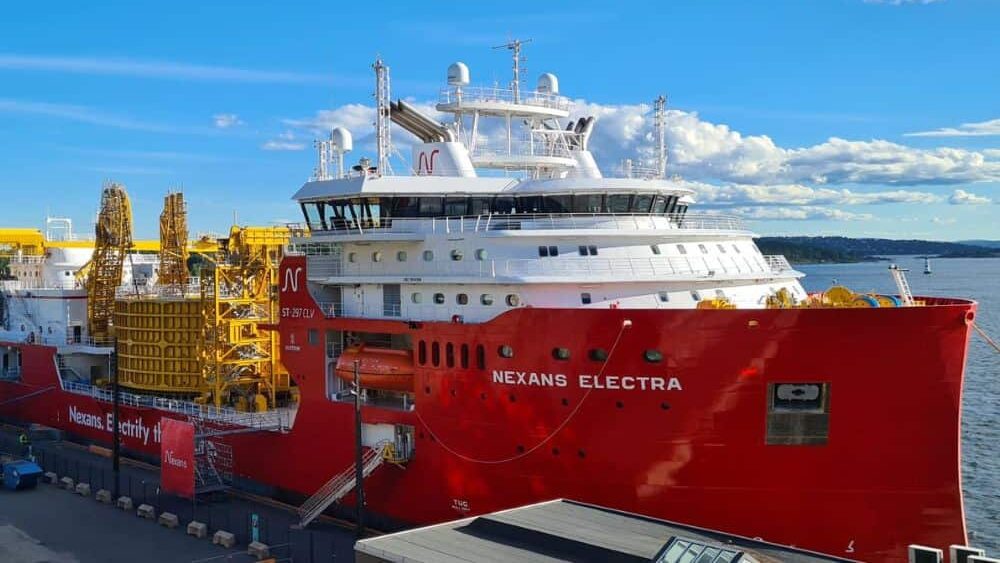
Nexans inaugurates newest CLV Nexans Electra, to support large-scale power cable projects worldwide
Nexans has officially inaugurated the cable laying vessel (CLV) Nexans Electra during a ceremony in Oslo, Norway, marking the vessel’s entry into commercial service and strengthening the company’s subsea cable installation capabilities for offshore energy and interconnection projects.
Having been christened earlier this year, Nexans Electra now joins the company’s operational fleet as a fully commissioned asset. The vessel has been designed to support the growing scale and complexity of offshore wind developments, subsea power links and grid interconnection projects worldwide.
Matching the size of CLV Nexans Aurora at 149.9 meters in length and 31 meters in width, Nexans Electra represents a significant leap in installation capacity:
- Three turntables with a combined capacity of 13,500 tons
- Capability to lay up to four cables simultaneously
- Full suite of advanced subsea installation tools, including burial and protection systems
- Hybrid power system compatible with biodiesel blends, supporting reduced operational emissions
This exceptional versatility enables the vessel to execute both large-scale offshore wind developments and long-distance HVDC interconnectors, the critical infrastructure backbone of the global energy transition.
With the addition of Nexans Electra, Nexans further reinforces its world-class offshore fleet, now comprising three cable laying vessels capable of tackling the most complex subsea projects on the planet. Alongside CLV Nexans Aurora and C/S Nexans Skagerrak, this fleet underpins Nexans’ ability to execute large-scale projects at scale and depth, across both interconnectors and offshore wind.
“This is Nexans’ third cable-laying vessel of this generation. After the Nexans Skagerrak, after the Nexans Aurora, comes the Nexans Electra. Some people talk about the energy transition. We, at Nexans, don’t talk. We act, we build the infrastructure it needs.” – Julien Hueber, CEO, Nexans
Built at Ulstein Verft, Nexans Electra reflects close collaboration between Nexans, Norwegian shipbuilding expertise, and a global network of technology partners.
The entry into service of Nexans Electra arrives as demand for subsea cables hits record levels. Demand for high-voltage subsea cables is accelerating, driven by rapid offshore wind expansion and the growing need for cross-border power interconnections.
As a global leader in high-voltage cable systems, Nexans has delivered more than 443 interconnection projects worldwide, representing 46 GW of installed capacity. With a record adjusted PWR-Transmission backlog of €7.7 billion in 2025, securing long-term visibility through 2028, the addition of Electra directly strengthens the Group’s capacity to deliver on this growing pipeline.
Key projects already underway or recently awarded include:
- East Anglia TWO (UK): 960 MW offshore wind, ~100 km of 275 kV HVAC subsea cables
- LanWin 2 (Germany): 250 km of 525 kV HVDC cables, 2 GW offshore wind capacity
- Tyrrhenian Link (Italy): World record HVDC installation depth of 2,150 meters
- Celtic Interconnector (Ireland/France): First electricity link between Ireland and France, 700 MW
- Dieppe–Le Tréport (France): 496 MW offshore wind export cables
- Malta-Sicily second interconnector (Matla/Italy): 225 MW interconnector.
Beyond its technical performance, CLV Nexans Electra reflects the Group’s drive to combine operational excellence and environmental responsibility. Its hybrid propulsion system is designed to reduce emissions during installation operations, while its advanced installation technologies ensure precision and reliability in even the most demanding offshore environments.
The inauguration event in Oslo brought together customers, partners, public authorities, and employees, reflecting the shared effort that a project of this scale demands.